The global magazine and marketplace for classic car enthusiasts, by enthusiasts.


Filter
Classic Lion Peugeot, Stoewer for sale - Lion Peugeot, Stoewer cars for sale
-

1924 Stoewer type D3 roadster
Rare opportunity to buy a vintage 1924 Stoewer type D3 roadster in fully restored condition. More than € 50K were spent in 2018 and 2019 on its restoration . Detailed work invoices come with the car. A video can be sent on request . Price € 64000 ex Eibergen Netherlands imported EEC.


Lion-Peugeot
France, 1906 – 1913
(1) Les Fils de Peugeot Frères, Beaulieu-Valentigney, 1906 – 1910
(2) SA des Automobiles et Cycles Peugeot, Audincourt, 1910 – 1913
The Lion-Peugeot car started as an independent venture by Robert Peugeot in the motor cycle factory at Beaulieu-Valentigney, which had been used for Lion-Peugeot car manufacture until the establishment of the SA des Automobiles Peugeot in 1897. These Michaux-designed voiturettes Lion-Peugeot cars were produced in direct competition with the cars from Audincourt, and the original chain-driven single at £125 filled a gap left by the discontinuation of the original Peugeot Baby. Already the Lion-Peugeot car company were trying their hand in the Coupe des Voiturettes, but made no impression in 1906 or 1907 against Sizaire-Naudin and Delage. The first of the classic racing V-twin Lion-Peugeot cars made its appearance in 1908, and from 1909 to 1911 the Lion-Peugeot car marque was renowned for some very odd machines, which took advantage of regulations more concerned with bores than with strokes. The 1909 Lion-Peugeot cars, victorious in both the Catalan Cup and the Coupe itself, were made with 1.9-litre engines, a single of 100x250mm and a twin of 80x192mm, the former having three valves per cylinder, but the peak of Lion-Peugeot cars was reached in 1910 with the fantastic Lion-Peugeot VX5, an 80x280mm V-twin with twin carburetors, developing 95bhp. The driver of the Lion-Peugeot car had to look round, rather than over the engine. There was a companion 65x260mm V4, really two twins in series. In spite (or perhaps because) of this, Lion-Peugeot cars had to be content with 2nd place in that year’s Coupe des Voiturettes. They tried once again in 1911 with a Lion-Peugeot V4, this time using the relatively modest stroke/bore rato of 2:1.
By 1910, the production Lion-Peugeot cars had grown up into 1.7-litre transverse V-twins with 3-speed gearboxes and shaft drive, though chain-driven versions were still available on Lion-Peugeot cars as late as 1911. The reunion of the two rival Peugeot companies, however, signaled the end of these eccentricities: though a touring V4 Lion-Peugeot car was announced in 1911 and was made with a 4-speed gearbox, pressure lubrication, and pedal-operated rear-wheel brakes, the Lion-Peugeot car designation was dropped at the end of 1913. The 1.9-litre VD Peugeot of 1914 marked the end of this line of development and none of the Lion-Peugeot car derivatives survived World War 1.
Source: Georgano, encyclopedia of motorcar; MCS
The information is written with the greatest of care. However, if you have any suggested amendments please contact us at office@prewarcar.com
Stoewer
D, 1899 – 1939
(1) Gebrüder Stoewer, Fabrik für Motorfahrzeuge, Stettin, 1899 – 1916
(2) Stoewer-Werke AG vorm. Gebr. Stoewer, Stettin, 1916 – 1939
The Stoewer car factory developed out of the Stoewer ironworks and was among the pioneers of the German car industry. After manufacturing motor cycles, tricycles and quadricycles for two years, Stoewer turned to cars in 1899. The first Stoewer car had a rear-mounted 2-cylinder engine. 4-cylinder Stoewer cars followed in 1901, and electric Stoewer cars were also produced. Best known were the 2-cylinder Type T Stoewer car (2.280cc and 3/12PS), the 4-cylinder Stoewer P4 (3.052cc and 11/22PS), the Stoewer G4 (1.500cc and 6/12PS) and the 6-cylinder Stoewer P6 (8.820cc and 34/60PS), evolved in the 1905-1907 period all Stoewer cars with shaft-drive. The Stoewer B1 of 6/16PS and the Stoewer B6 of 9/22PS which appeared in 1910 were also built by Mathis under licence. The G4 Stoewer car was the basis for the Stoewer B5, which Stoewer car in 1912 became famous by setting up a record at Brooklands with 67.7mph. The new range of Stoewer cars which appeared in 1913 was also based on successful earlier cars. They were the Stoewer C1 (6/18PS), Stoewer C2 (10/28PS) and C3 Stoewer car (6-cylinder and 19/45PS). Shortly before the outbreak of World War 1 the Stoewer car range was headed by the F4 Stoewer car with a 4-cylinder, 8.8-litre 33/100PS ohc engine. After the war an enormous Stoewer car appeared, the Stoewer D7, using a 6-cylinder 11.2-litre 42/120PS aero engine, as well as some conservative sv 4- and 6-cylinder Stoewer cars with rear wheel and transmission brakes. Front wheel brakes appeared on Stoewer cars in 1925. Stoewer introduced 8-cylinder Stoewer cars in 1928. These were the Stoewer Superior, Stoewer Marschall, Stoewer Gigant and Stoewer Repräsentant with engines ranging from 2-litres and 45bhp to 4.9-litres and 100bhp. The Stoewer car firm re-entered the economy class in 1931 with the V5, a front-driven Stoewer car with a V4 1.188cc engine, followed by the front-drive models R140 (1.369cc), R150 (1.488cc) and R180 (1.769cc). Another 8-cylinder was the front wheel drive Greif V8 with a 2.488cc engine, which was replaced by the conventional 6-cylinder 3.609cc Arcona Stoewer car in 1938. In 1934 the 1½-litre 4-cylinder Stoewer car and 2½-litre V8 Stoewer car were shown at the Brussels Salon by Monsieur Dewaet under the name D.S. (Dewaet-Stoewer). The Greif Junior was built under Tatra licence with an opposed 4-cylinder 1.474cc engine. It succeeded the Röhr Junior. In the middle of the range was the Stoewer Sedina with a 4-cylinder engine of 2.4-litres.
Production of private Stoewer cars was given up at the outbreak of World War 2 in 1939. The Stoewer car factory was destroyed during the war and production of Stoewer cars was not resumed.
Source: Georgano, encyclopedia of motorcar; HON
The information is written with the greatest of care. However, if you have any suggested amendments please contact us at office@prewarcar.com


Featured

1915 Rolls-Royce Silver Ghost Barker Tourer
⁃ An exceptionally rare original bodied pre-war Silver Ghost⁃ Desirable Barker tourer in exciting barn find condition⁃ ..

K3 Replica on KN Chassis
"The K3 Magnette must rank in the history books as the most famous and successful of all the record breaking MGs. With only 33 examples produced durin..
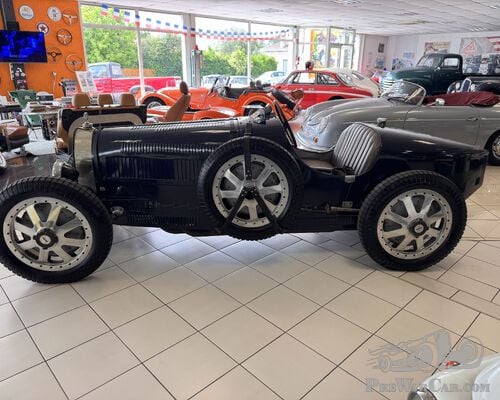
Bugatti 35 B Pur Sang
Bugatti 35 B Pur Sang,importée par un membre délégué de la FFVE il y’a une quinzaine d années.Participation à de nombreux Rallyes Bug..