The global magazine and marketplace for classic car enthusiasts, by enthusiasts.


Filter
Classic Locomobile, DeSoto for sale - Locomobile, DeSoto cars for sale
-

Locomobile 8-80 Sedan 1927
Very rare American quality car, also called the Rolls Royce of the states.as far as known, there are only 5 survivors leftIn a beautiful condition, nice interior.The car is in good running condition.Starts and drives easily.Dutch license plate -
1898 Locomobile/Stanley Steam Car Replica
1898 Locomobile/stanley Steam Car Replica. A replica in the style & spirit of early steam cars such as those from Stanley & Locomobile. This is a fully functional working example that is simple to drive with just an accelerator, a brake pedal & tiller steering.


Locomobile
US, 1899 – 1929
(1) Locomobile Company of America, Westboro, Mass., 1899 – 1900
(2) Locomobile Company of America, Bridgeport, Conn., 1900 – 1929
Locomobile cars was one of the two companies which resulted from the purchase of the Stanley brothers’ steam-car design rights in 1899 by A.L. Barber and J.B. Walker. Walker separated from Barber and formed the Mobile concern, while his former partner did good business with the little Locomobile steam runabout. This Locomobile car (or actually the Locomobile steamcar) consisted of a welded ‘bicycle’ framework, a carriage body, a twin-cylinder simple engine and a 14in boiler under the driver’s seat. The Locomobile steamcar was tiller-steered and chain-driven and at $600 it looked a better bargain than the Locomobile car was, suffering from the crudest of lubrication arrangements and an astronomical water consumption: the boiler of the Locomobile steamcar had to be refilled every 20 miles. In spite of this W.M. Letts managed to sell 400 Locomobile steamcars in England in 1900 and 1901, at which time the four-storey Locomobile car until 1903, with bigger boilers, culminating in a 10hp wheel-steered dos-à-dos which sold for $1.600.
Locomobile cars eventually sold their Locomobile steamcar rights back to the Stanleys, but in the meantime A.L. Riker had designed a petrol Locomobile car on Panhard lines, with a 4-cylinder engine, automatic inlet valves and pressed-steel frame. Radiators of this Locomobile car were of the Mercédès honeycomb type in 1905, in which year Joe Tracy competed in the last Gordon Bennett Cup Race with a very Mercédès-like T-headed chain-driven racer Locomobile car. More successful was Locomobile cars ioe ‘Old 16’, built in 1906. George Robretson drove this Locomobile car to victory in the 1908 Vanderbilt Cup, while another Locomobile car victory was first place in the touring-car category of the 1913 Glidden Tour, this achieved with a 1909 Locomobile car that had already covered 100.000 miles. In the meantime the Locomobile car company had settled down to a long line of expensive and beautifully-made T-headed touring cars, the early Locomobile cars being chain-driven fours. In 1907 $3.800 was asked for the 3¾-litre Locomobile Model E and $4.500 for the 5¾-litre Locomobile Model H. By 1909, the bigger four had grown up to 7.7-litres, and 1911 brought the debut of the famous T-headed Locomobile 48, originally with ‘square’ engine dimensions of 114x114mm, but later Locomobile cars growing up to 8½-litres. This Locomobile cars developed 90bhp, had dual magneto ignition (later coil) and was still being listed in 1929; the price for this Locomobile car was $4.800 in 1912, increased to $9.600 towards the end of its production run. Body styles were attractive, especially the open Locomobile Sportifs and Locomobile Gunboat Roadsters introduced during World War I. There was also a smaller Locomobile 38 to the same specifications.
Locomobile cars encountered financial difficulties in 1920, and after a short spell with Crane-Simplex and Mercer in the Hare’s Motors group, Locomobile cars was acquired by W.C. Durant’s last empire in 1922. Durant continued the Locomobile 48 and added another luxury Locomobile car, the Locomobile 90 with L-head Monobloc engine, but the Locomobile car factories were utilized for the production of the inexpensive Flint. In 1925 came the Locomobile Junior 8, a competitor for the Chrysler with a 3¼-litre ohv engine, selling at $1.785. In 1929, the last year of Locomobile car production, the 48 and 90 were still available, but the staple Locomobile car was a 4.9-litre Lycoming-engined straight-9 at $2.850, a sad end for a firm which had been advertising eleven years before that ‘no stock parts or ready-made units are permitted’.
Source: Georgano, encyclopedia of motorcar; MCS
The information is written with the greatest of care. However, if you have any suggested amendments please contact us at office@prewarcar.com
DeSoto
US, 1913 – 1916
DeSoto Motro Car Co, Auburn, Ind.
The DeSoto appears to have succeeded the Zimmerman. This was a large car with a 55hp, 6-cylinder engine, which was furnished with a compressed-air starter. The DeSoto model Six-55 five-seater touring car sold for $2185.
US, 1928 – 1960
Chrysler Motors Corp, Detroit, Mich.
The DeSoto was launched in 1928 as a 3.2-litre side valve six to compete with Oldsmobile, Pontiac and the cheaper Nashes. Styling and general design of the DeSoto were in line with the 1929 Chryslers, and at $885 for a DeSoto sedan 90.000 were sold in the first twelve months. A 3.4-litre straight-8 DeSoto on a 9ft 6in wheelbase was announced for 1930 as the world’s cheapest 8-cylinder car. However, DeSoto suffered badly in the Depression, and in 1932, when flexible rubber engine mountings and free wheels were made available, sales dropped to 26.000 DeSoto cars.
The DeSoto disappeared from the British market about this time, though certain ‘Chrysler’ models listed in England (the Mortlake, Croydon, and some of the Richmonds) were in fact DeSoto cars in all but name. A 6-cylinder version of Chrysler’s advanced unitary-construction Airflow, the SE-type with a 4-litre engine, was brought out in 1934, but was an unsuccessful as its bigger sister. Later DeSotos followed regular Chrysler lines closely though in later years there was a tendency for DeSoto to move into a higher price class than Dodge; by 1952 DeSotos started $300 higher than the companion make.
By 1939 the DeSoto cars for sale were being made with independent front suspension, hypoid back axles and column change. There was a choice at DeSoto of two 6-cylinder engines and three wheelbase lengths, the longest of these being reserved for seven-seater bodywork – DeSoto continued to offer a really roomy family car right up to 1954. A 4-speed semi-automatic Vacumatic transmission became an option in 1941, but DeSoto’s big post-war change of models did not take place until 1952, when the division followed Chrysler’s lead in adopting the oversquare ohv V8; the DeSoto version was of 4½-litre capcity and developed 16-bhp. With the advent of Chrysler’s ‘flight sweep’ styling in 1955, the side-valve sixes were dropped and the standard engine in a DeSoto was now a 4.8-litre eight, giving 185bhp in Firedome guise, and 200bhp in Fireflite form. Though this redesigning saved Chrysler sales generally, the slump in the medium-price class had an adverse effect on DeSoto and in 1959 the DeSoto division was merged with Plymouth. Last of the DeSotos were the 1961 models, unitary-construction cars with a choice of three engines: Plymouth’s 145bhp ohv ‘slant six’ as used in the Valiant, and V8s of 230 and 265bhp, the two former only in Canadian DeSotos. Production of DeSoto cars ceased in November 1960 after only a few had been delivered.
Source: Georgano, encyclopedia of motorcar; MCS
The information is written with the greatest of care. However, if you have any suggested amendments please contact us at office@prewarcar.com


Featured
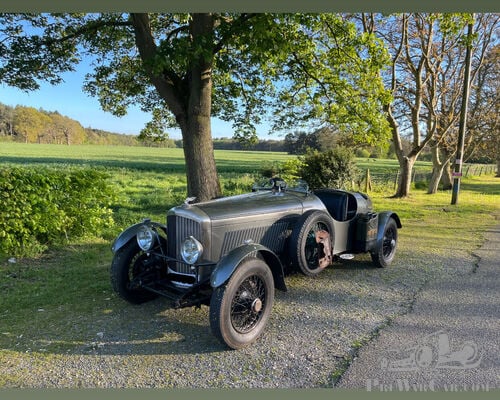
Derby Bentley Special 4-1/4
Sadly i am having to sell on my Bentley special ( Icarus). It is currently a work in progress and still needs finalising/ refining. A great o..
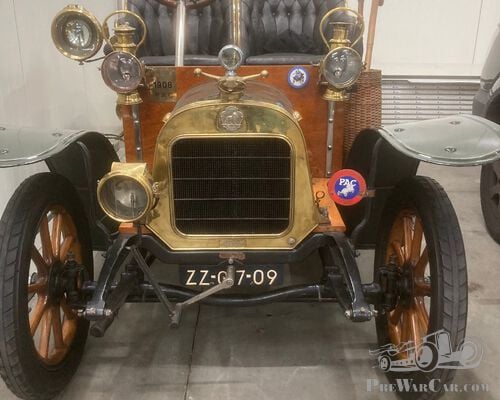
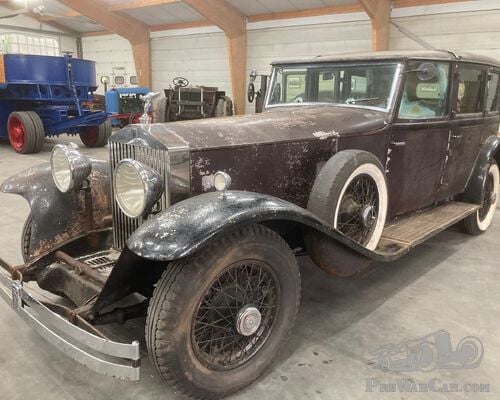
Rolls-Royce
Rolls-Royce Phantom ll chassisnummer 287 AJS. bouwjaar 1932, Links gestuurd, Brewster Keswick Sedance Towncar