The global magazine and marketplace for classic car enthusiasts, by enthusiasts.


Filter
Classic Locomobile, Léon Bollee for sale - Locomobile, Léon Bollee cars for sale
-

1898 Locomobile/Stanley Steam Car Replica
1898 Locomobile/stanley Steam Car Replica. A replica in the style & spirit of early steam cars such as those from Stanley & Locomobile. This is a fully functional working example that is simple to drive with just an accelerator, a brake pedal & tiller steering. -
Locomobile 8-80 Sedan 1927
Very rare American quality car, also called the Rolls Royce of the states.as far as known, there are only 5 survivors leftIn a beautiful condition, nice interior.The car is in good running condition.Starts and drives easily.Dutch license plate


Locomobile
US, 1899 – 1929
(1) Locomobile Company of America, Westboro, Mass., 1899 – 1900
(2) Locomobile Company of America, Bridgeport, Conn., 1900 – 1929
Locomobile cars was one of the two companies which resulted from the purchase of the Stanley brothers’ steam-car design rights in 1899 by A.L. Barber and J.B. Walker. Walker separated from Barber and formed the Mobile concern, while his former partner did good business with the little Locomobile steam runabout. This Locomobile car (or actually the Locomobile steamcar) consisted of a welded ‘bicycle’ framework, a carriage body, a twin-cylinder simple engine and a 14in boiler under the driver’s seat. The Locomobile steamcar was tiller-steered and chain-driven and at $600 it looked a better bargain than the Locomobile car was, suffering from the crudest of lubrication arrangements and an astronomical water consumption: the boiler of the Locomobile steamcar had to be refilled every 20 miles. In spite of this W.M. Letts managed to sell 400 Locomobile steamcars in England in 1900 and 1901, at which time the four-storey Locomobile car until 1903, with bigger boilers, culminating in a 10hp wheel-steered dos-à-dos which sold for $1.600.
Locomobile cars eventually sold their Locomobile steamcar rights back to the Stanleys, but in the meantime A.L. Riker had designed a petrol Locomobile car on Panhard lines, with a 4-cylinder engine, automatic inlet valves and pressed-steel frame. Radiators of this Locomobile car were of the Mercédès honeycomb type in 1905, in which year Joe Tracy competed in the last Gordon Bennett Cup Race with a very Mercédès-like T-headed chain-driven racer Locomobile car. More successful was Locomobile cars ioe ‘Old 16’, built in 1906. George Robretson drove this Locomobile car to victory in the 1908 Vanderbilt Cup, while another Locomobile car victory was first place in the touring-car category of the 1913 Glidden Tour, this achieved with a 1909 Locomobile car that had already covered 100.000 miles. In the meantime the Locomobile car company had settled down to a long line of expensive and beautifully-made T-headed touring cars, the early Locomobile cars being chain-driven fours. In 1907 $3.800 was asked for the 3¾-litre Locomobile Model E and $4.500 for the 5¾-litre Locomobile Model H. By 1909, the bigger four had grown up to 7.7-litres, and 1911 brought the debut of the famous T-headed Locomobile 48, originally with ‘square’ engine dimensions of 114x114mm, but later Locomobile cars growing up to 8½-litres. This Locomobile cars developed 90bhp, had dual magneto ignition (later coil) and was still being listed in 1929; the price for this Locomobile car was $4.800 in 1912, increased to $9.600 towards the end of its production run. Body styles were attractive, especially the open Locomobile Sportifs and Locomobile Gunboat Roadsters introduced during World War I. There was also a smaller Locomobile 38 to the same specifications.
Locomobile cars encountered financial difficulties in 1920, and after a short spell with Crane-Simplex and Mercer in the Hare’s Motors group, Locomobile cars was acquired by W.C. Durant’s last empire in 1922. Durant continued the Locomobile 48 and added another luxury Locomobile car, the Locomobile 90 with L-head Monobloc engine, but the Locomobile car factories were utilized for the production of the inexpensive Flint. In 1925 came the Locomobile Junior 8, a competitor for the Chrysler with a 3¼-litre ohv engine, selling at $1.785. In 1929, the last year of Locomobile car production, the 48 and 90 were still available, but the staple Locomobile car was a 4.9-litre Lycoming-engined straight-9 at $2.850, a sad end for a firm which had been advertising eleven years before that ‘no stock parts or ready-made units are permitted’.
Source: Georgano, encyclopedia of motorcar; MCS
The information is written with the greatest of care. However, if you have any suggested amendments please contact us at office@prewarcar.com
Léon Bollee
France, 1895 – 1933
(1) Automobiles Léon Bollée, Le Mans, 1895 – 1924
(2) Morris Motors Ltd, Usines Léon Bollée, Le Mans, 1925 – 1931
(3) Sté Nouvelle Léon Bollée, Le Mans, 1931 – 1933
Leon Bollee was a son of Amédée Bolllée père, the most important pioneer of steam road vehicles in France. Leon Bollee, however, turned to really small petrol Leon Bollee cars. He was the first to do so, and therefore had to invent a new name for his Leon Bollee car of 1895 – he called it a Leon Bollee voiturette. This Leon Bollee car was a tandem two-seater 3-wheeler that was faster than any other petrol-engined vehicle on the road when the Leon Bollee car was working, thanks to a powerful 3hp engine and light weight, but the power unit was unreliable on the Leon Bollee car. The Leon Bollee car had a single air-cooled cylinder of 650cc and used hot-tube ignition. There were 3 forward speeds on the Leon Bollee car, with belt final drive. The frame was tubular. Four years after the Leon Bollee voiturette appeared, Leon Bollee superseded it with a 4-wheeler with independent front suspension by double transverse leaf springs. This Leon Bollee car had a single-cylinder, water-cooled engine. Unlike the Leon Bollee voiturette, this Leon Bollee car made no mark. The design rights were sold to Darracq, and around 1901 the name of Leon Bollee cars vanished. Meanwhile, the term voiturette had been taken up by the trade and public in general as the name for a small light car.
The Leon Bollee car reappeared in 1903 as an entirely normal, full-sized car in the more expensive class, backed by Vanderbilt money and designed for the American market. This Leon Bollee car was made in 28hp (4.6-litres) and 45hp (8-litres) versions, with four cylinders and chain drive, and led on to a 11.9-litre six Leon Bollee car in 1907, in which year the first shaft driven Leon Bollee car appeared. From 1909 there was also a small modern four, the Leon Bollee 10/14hp. The 1910 range embraced 9 Leon Bollee cars, including 2 of over 10-litres capacity. Electric lighting became available on Leon Bollee cars in 1913, but the Leon Bollee grew increasingly old-fashioned after World War 1 despite the introduction of ohv in 1922 on Leon Bollee cars and front wheel brakes in 1923. Late in 1924 Sir William Morris bought the Le Mans Leon Bollee car factory. From making a wide range of conservative French Leon Bollee fours, it turned to thinly-disguised products of Cowley, Oxford, the idea being to breach the French tariff walls from the inside. The first Morris- Leon Bollee had a 12CV 2½-litre 4-cylinder unit-construction engine made by Hotchkiss, the engine manufacturers controlled by Morris, but it had push-rod overhead valves and bore little evidence of its parentage. Not so the 18CV Morris- Leon Bollee car of 1928. This was a 3-litre straight-8 with single overhead camshaft that reflected Morris’ takeover of Wolseley two years earlier. Morris’ own new six of 1928 was mirrored in the 15CV 2.6-litre Le Mans product of 1929. The bodies for the Morris- Leon Bollee car were all made in France and were usually considerably more dashing and attractive than their British counterparts. Chassis of this Morris- Leon Bollee car were made in France, and all cars had a 4-speed gearbox. At one time, 50 12CV Morris- Leon Bollee cars were being turned out each week. However, Morris’ enterprise was not a success, and he discontinued it in the hard times of the Depression. A new syndicate was formed in September 1931 to sell the same range of cars under the name of Leon Bollee cars. This lasted for less than two years and few Leon Bollee cars were made.
Source: Georgano, encyclopedia of motorcar; TRN
The information is written with the greatest of care. However, if you have any suggested amendments please contact us at office@prewarcar.com


Featured
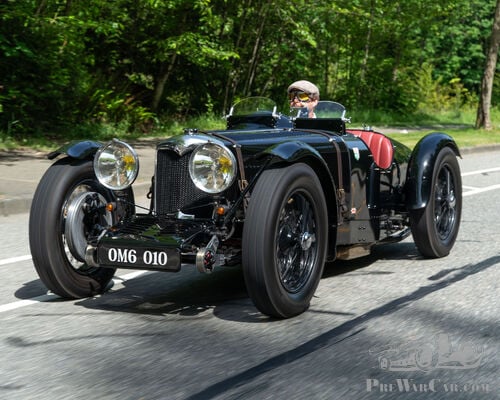
Riley 14/6 Special 1933
The ExperienceStep into the golden age of British motoring. This 1933 Riley 14/6 Special is a masterclass in pre-w..

Alfa 6C1750 Spider
Alfa 6C1750 Spider with complete history from delivery in 1930 to first owner in Firenze till today with copy Libretto/license plate all the years
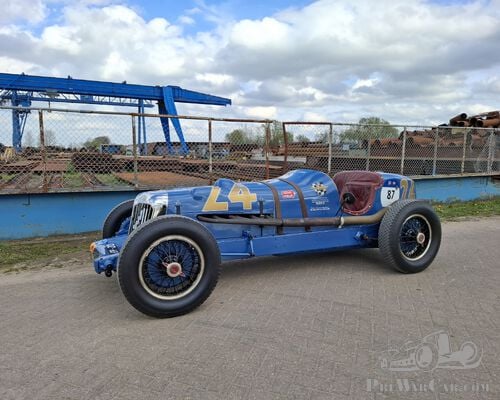
1932 - Graham " Lucenti " Indianapolis
Original participant of the 1932, 1934 and 1935 Indy 500. Best result: finishing 10th overall in the 1934 Indy 500 with driver “Herb” Ardinger...