The global magazine and marketplace for classic car enthusiasts, by enthusiasts.


Filter
Classic BSA, Marmon for sale - BSA, Marmon cars for sale
-

Marmon Type 70 Sedan 1930 for sale
Marmon-Roosevelt straight eight sedan. Model 97, Type 70. The body was built by Hayes Corp. Roosevelt is the companion make to Marmon, nevertheless the Marmon label is featured on the car. The car makes a striking impression with it's six wire wheels and handsome headlights. It runs and drives but it requires work. The restoration is older and .. -
1931 Marmon Sedan 88
MARMON - SEDAN 88 Year 1931GasolineHistorical, 8 cylinders, very good condition.


B.S.A.
GB, 1907 – 1926, 1933 – 1936
Birmingham Small Arms Co Ltd, Sparkbrook, Birmingham, Coventry
In 1907 the famous Midlands arms manufacturers began to make cars as a sideline. They were not entirely new to the field, having made parts for the Roots in 1897. Neither then nor later did they show much originality in their BSA cars. E.E. Baguley, formerly of Ryknield, was in charge, and later produced in 1908, a copy of the successful 40hp Itala from Italy. Other conventional, medium-sized BSA fours followed in small quantities. The major change that followed in 1911, after the company’s takeover of Daimler, was the adoption of Knight double sleeve-valve engines, as used by the latter concern, in BSA cars. These differed from Daimlers in being generally smaller and lighter. The first, the BSA Twelve of about two litres, weighed only 1.232lb in chassis form. Open bodies were of pressed steel from 1912: a single, important innovation that went largely unregarded. BSA also made the Stoneleigh, which was a BSA except for name and radiator, from then until 1914. It should nog be confused with the better-known Stoneleigh light car of the 1920s.
The first post-war BSA was a light car – an attempt to cash in on the boom in popular motoring, but superior to a great many. The BSA Ten of 1921 was powered by an air-cooled V-twin engine of modern design, with overhead valves, coil ignition, aluminium crankcase, and aluminium pistons in iron liners. This BSA developed 18bhp from a cubic capacity of 1080cc, and was made by Hotchkiss of Coventry. This power unit was smooth and though, like all of its kind, it was noisy, it was eventually made quieter by improvements. The rear axle of the BSA Ten with its underslung worm drive on Lanchester patents, was always silent. This uncharacteristic quality helped to sell the BSA Ten well until it was dropped in 1924. The next BSA’s were in fact small Daimlers, with 6-cylinder Knight double-sleeve-valve engines of under two litres. They were discontinued in 1926. From 1933 to 1936, this policy was resumed. In 1931, BSA had taken over Lanchester and introduced a line of completely new Lanchesters as cheap Daimlers. In turn, a still cheaper range christened BSA’s followed from 1933, consisting of a machine basically similar to the Lanchester: a BSA Ten but with a side-valve engine, and a BSA Light Six identical to its Lanchester opposite number. These BSA cars were made in the Daimler factory at Coventry. After 1936, no more cars came from the motor car division of BSA.
GB, 1929 – 1940
B.S.A. Cycles Ltd, Small Heath, Birmingham
In 1924 Hotchkiss, makers of proprietary engines for other car firms, were taken over by their main customer, William Morris. They had also made an excellent 1100cc, V-twin, air-cooled engine with overhead valves for the Birmingham Small Arms Company, for use in that company’s BSA light car (this engine also powered the short-lived Hotchkiss light car itself). BSA Cycles Ltd (the motor cycle division of BSA) acquired manufacturing rights in the engine to drive, in 1-litre form, the front wheels of a 3-wheeler of very modern conception with independent front suspension. This, the famous BSA Beeza, first appeared in 1929, ready for the 1930 season. In 1933 flexibility was added to the BSA’s virtues when a water-cooled 1100cc 4-cylinder sv engine became available. In the previous year, the BSA manufacturers had already tried to attract a wider market by adding a solid axle and another wheel at the rear. This became the BSA Nine in 1933. The front wheel drive BSA 4-wheeler was dropped for a season, but reappeared as the 9hp BSA Scout in 1935. From 1936 to 1940 the Scout in 1200cc BSA Ten form was the only BSA sold, the 2- and 4-cylinder 3-wheelers having been dropped in the former year. There was talk in the early 1950s of resuming production of a small BSA car with a 2-cylinder air-cooled engine, but it came to nothing.
Source: Georgano, encyclopedia of motorcar; TRN
The information is written with the greatest of care. However, if you have any suggested amendments please contact us at office@prewarcar.com
Marmon
US, 1902 – 1933
(1) Nordyke and Marmon Co, Indianapolis, Ind., 1902 – 1925
(2) Marmon Motor Car Co, Indianapolis, Inc., 1926 – 1933
Howard Marmon’s first cars were advanced machines, featuring air-cooled V4 engines of oversquare dimensions, with mechanically-operated overhead valves and pressure lubrication. Something approaching independent front suspension was achieved on Marmon cars by the use of double-three-point suspension, with a separate sub-frame for engine and transmission. Only the 2-speed gearbox of planetary type conformed on the Marmon cars to American practice of the period. These Marmon cars persisted until 1908, though 1907 brought the introduction of selective sliding-type gearboxes on the Marmon car and a short-lived 60hp V8. In 1908 buyers of Marmon cars had the choice of air or water cooling and cylinder heads were detachable. The following year Marmon went over to conventional T-head in-line fours rated at 40/45hp and 50/60hp, and two years later only the 5.2-litre Model 32 Marmon car with rear-axle gearbox was listed. Marmon cars did well in contemporary competition, with 54 1st places logged with a Marmon car between 1909 and 1912; Ray Harroun won the first Indianapolis 500 in 1911 with a specially-built 6-cylinder Marmon car, the well-known Marmon Wasp. An enormous 9.3-litre six rated at 48hp was available in 1914.
In 1916 the advanced ohv 6-cylinder Marmon 34 with aluminium cylinder block, body, bonnet and radiator shell, and double transverse rear suspension was introduced. The engine capacity of this Marmon car was 5½-litres, and its output 74bhp; developments of this Marmon car were still listed as late as 1927, acquiring Delco coil ignition in 1920, and the option of a Marmon car with front wheel brakes in 1923. The Marmon cars were expensive: $5.000 was asked for a touring car in 1921. A not very successful 3.1-litre ohv straight-8 in the Marmon car appeared in 1927, but the following season only Marmon cars with eights were made, the cheapest sv Marmon 68 selling for $1.395. In 1928 Marmon also entered some front-wheel-drive Marmon cars at Indianapolis, but they were in fact only revamped Millers. The Marmon car company sold 22.300 Marmon cars in 1929, thanks to a cheap new straight-8 at under $1.000, the Marmon Roosevelt. This brandname, however, did not last, for the Marmon car appeared in the 1930 programme as the Marmon R, along with three other eights, the sv 69, and two big ohv Marmon cars with 4-speed gearboxes and capacities of the 4.9- and 5.2-litres respectively.
Marmon cars swansong was the magnificent 9.1-litre 200bhp 16-cylinder model of 1931. This Marmon car was beautifully proportioned, and had an alloy engine. The list price of the Marmon car was $4.925; there was a companion Marmon 8-125 in 1932, but only the Marmon Sixteen was listed for 1933. At the very end Marmon was testing a Marmon car with a 150bhp V12 with independent front suspension, De Dion rear axle, and tubular backbone frame, but this never saw production.
Source: Georgano, encyclopedia of motorcar; MCS
The information is written with the greatest of care. However, if you have any suggested amendments please contact us at office@prewarcar.com


Featured
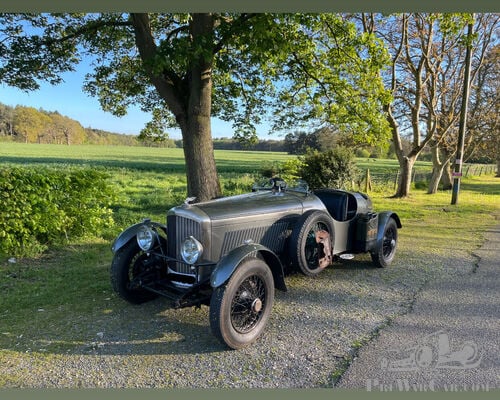
Derby Bentley Special 4-1/4
Sadly i am having to sell on my Bentley special ( Icarus). It is currently a work in progress and still needs finalising/ refining. A great o..

Alfa 6C1750 Spider
Alfa 6C1750 Spider with complete history from delivery in 1930 to first owner in Firenze till today with copy Libretto/license plate all the years

Lagonda LC Tourer 1934
The Lagonda story began in 1901 in Staines, a small town in the UK. The company enjoyed its greatest successes around 1935. During this period, the..