The global magazine and marketplace for classic car enthusiasts, by enthusiasts.


Filter
Classic Chalmers, Marmon for sale - Chalmers, Marmon cars for sale
-

Marmon Type 70 Sedan 1930 for sale
Marmon-Roosevelt straight eight sedan. Model 97, Type 70. The body was built by Hayes Corp. Roosevelt is the companion make to Marmon, nevertheless the Marmon label is featured on the car. The car makes a striking impression with it's six wire wheels and handsome headlights. It runs and drives but it requires work. The restoration is older and .. -
1931 Marmon Sedan 88
MARMON - SEDAN 88 Year 1931GasolineHistorical, 8 cylinders, very good condition.


Chalmers / Chalmers-Detroit
US, 1908 – 1924
Chalmers Motor Car Co, Detroit, Mich.
The Chalmers was one of the most popular automobiles made in the United States for more than a decade. The Chalmers was the successor to the Thomas-Detroit which was built by a company which had been founded in 1906 by E.R. Thomas (builder of the Thomas car in Buffalo, N.Y.), Roy D. Chapin and Howard Earle Coffin; the two latter had previously served at Oldsmobile. The Thomas-Detroit of which some 500 were sold during the first year of production, was marketed through the parent firm in Buffalo which manufactured a larger line of cars under the Thomas emblem. The Thomas-Detroit was a medium priced four-cylinder car which had been designed by Coffin. In 1907, Hugh Chalmers, vice president of the National Cash Register Co and a noted salesman, entered the firm. Shortly after, he bought a half of E.R. Thomas’ stock and became president of the company which became the Chalmers-Detroit Motor Company. The Thomas-Detroit became the Chalmers-Detroit in 1908 and in 1910, the Chalmers. Open and closed Chalmers models in two lines comprised the Chalmers four-cylinder cars, with self-starters appearing in 1912. Chalmers (as Chalmers-Detroit) had distinguished itself in road races as early as 1908 when W.R. Burns won the Motor Parkway Sweekstakes at Jericho, N.Y., averaging 48.7mph in the six-lap 140.76 mile run.
In 1913, the Chalmers brought out its first 6-cylinder model, as well as the four and apart from small mechanical and design changes, continued both until 1914. The Chalmers four was dropped from the 1915 line, however, and sixes were to be used exclusively in Chalmers until the ending of manufacture. By 1915, some 20.000 Chalmers cars per year were coming off the Chalmers production line and would even exceed that figure before the advent of World War 1. In 1917, an L-head motor replaced the earlier overhead-valve type and on August 4th, Chalmers again headed racing news when Joe Dawson won the 24-hour stock Car Endurance Run at Sheepshead Bay, N.Y. Sales flagged following the end of the war and Hugh Chalmers, always the salesman, and with the realization that a competitor, Maxwell, wasn’t faring well either, arranged to lease his Chalmers plants to Maxwell, using his salesmanship to promote the two concerns and getting the benefit of Maxwell tooling and manufacturing equipment. By the early 1920s, however, many makes of cars were in financial difficulties due to over-expansion and recession, and Walter P. Chrysler was called in to try and reorganize Maxwell. Chrysler was at this time planning his own corporation and in 1922 Chalmers was taken over by Maxwell which had become a Chrysler subsidiary. The last Chalmer cars for sale were equipped with Lockheed hydraulic brakes but 1923 was the last year of Chalmers production with some 9000 units leaving the factories. The Maxwell survived until 1925 when it became the Chrysler Four.
Source: Georgano, encyclopedia of motorcar; KM
The information is written with the greatest of care. However, if you have any suggested amendments please contact us at office@prewarcar.com
Marmon
US, 1902 – 1933
(1) Nordyke and Marmon Co, Indianapolis, Ind., 1902 – 1925
(2) Marmon Motor Car Co, Indianapolis, Inc., 1926 – 1933
Howard Marmon’s first cars were advanced machines, featuring air-cooled V4 engines of oversquare dimensions, with mechanically-operated overhead valves and pressure lubrication. Something approaching independent front suspension was achieved on Marmon cars by the use of double-three-point suspension, with a separate sub-frame for engine and transmission. Only the 2-speed gearbox of planetary type conformed on the Marmon cars to American practice of the period. These Marmon cars persisted until 1908, though 1907 brought the introduction of selective sliding-type gearboxes on the Marmon car and a short-lived 60hp V8. In 1908 buyers of Marmon cars had the choice of air or water cooling and cylinder heads were detachable. The following year Marmon went over to conventional T-head in-line fours rated at 40/45hp and 50/60hp, and two years later only the 5.2-litre Model 32 Marmon car with rear-axle gearbox was listed. Marmon cars did well in contemporary competition, with 54 1st places logged with a Marmon car between 1909 and 1912; Ray Harroun won the first Indianapolis 500 in 1911 with a specially-built 6-cylinder Marmon car, the well-known Marmon Wasp. An enormous 9.3-litre six rated at 48hp was available in 1914.
In 1916 the advanced ohv 6-cylinder Marmon 34 with aluminium cylinder block, body, bonnet and radiator shell, and double transverse rear suspension was introduced. The engine capacity of this Marmon car was 5½-litres, and its output 74bhp; developments of this Marmon car were still listed as late as 1927, acquiring Delco coil ignition in 1920, and the option of a Marmon car with front wheel brakes in 1923. The Marmon cars were expensive: $5.000 was asked for a touring car in 1921. A not very successful 3.1-litre ohv straight-8 in the Marmon car appeared in 1927, but the following season only Marmon cars with eights were made, the cheapest sv Marmon 68 selling for $1.395. In 1928 Marmon also entered some front-wheel-drive Marmon cars at Indianapolis, but they were in fact only revamped Millers. The Marmon car company sold 22.300 Marmon cars in 1929, thanks to a cheap new straight-8 at under $1.000, the Marmon Roosevelt. This brandname, however, did not last, for the Marmon car appeared in the 1930 programme as the Marmon R, along with three other eights, the sv 69, and two big ohv Marmon cars with 4-speed gearboxes and capacities of the 4.9- and 5.2-litres respectively.
Marmon cars swansong was the magnificent 9.1-litre 200bhp 16-cylinder model of 1931. This Marmon car was beautifully proportioned, and had an alloy engine. The list price of the Marmon car was $4.925; there was a companion Marmon 8-125 in 1932, but only the Marmon Sixteen was listed for 1933. At the very end Marmon was testing a Marmon car with a 150bhp V12 with independent front suspension, De Dion rear axle, and tubular backbone frame, but this never saw production.
Source: Georgano, encyclopedia of motorcar; MCS
The information is written with the greatest of care. However, if you have any suggested amendments please contact us at office@prewarcar.com


Featured
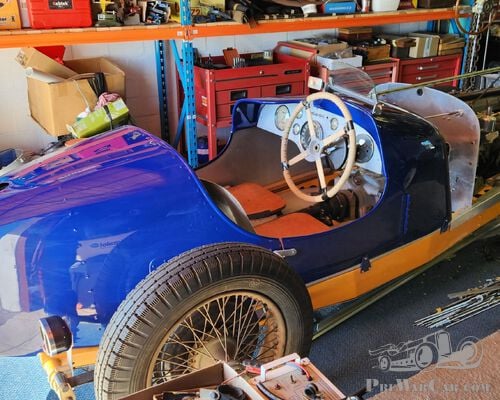
Riley TT Sprite
1935 6-cylinder TT Sprite replica. Chassis # 46A2722. Engine # 6A2722. Original Ulster Imp body. Restoration nearing completion. Engine, Ge..
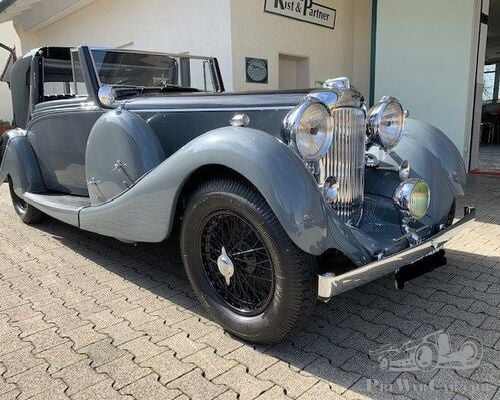
Lagonda LG 45 Coupe de Ville Sedanca by Mayfair
The successor to the M45, the LG45 was built around the same highly capable, competition-proven 4.5-litre Meadows inline-six engine, but featured r..
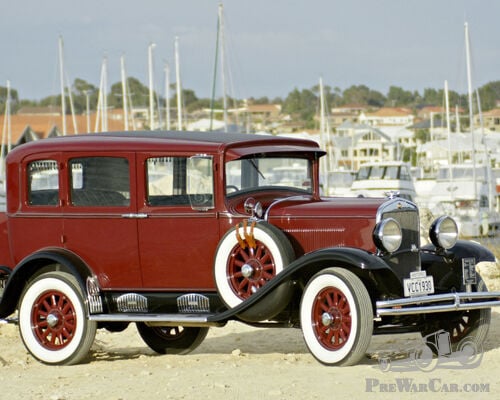
1930 Chrysler 66 Six-Wheel Equipped Royal Sedan
An exceptionally well restored and highly awarded Chrysler 66 Royal Sedan, with only two owners in nearly 97 years.The present owner ..