The global magazine and marketplace for classic car enthusiasts, by enthusiasts.


Filter
Classic Marmon, DeSoto for sale - Marmon, DeSoto cars for sale
-

Marmon Type 70 Sedan 1930 for sale
Marmon-Roosevelt straight eight sedan. Model 97, Type 70. The body was built by Hayes Corp. Roosevelt is the companion make to Marmon, nevertheless the Marmon label is featured on the car. The car makes a striking impression with it's six wire wheels and handsome headlights. It runs and drives but it requires work. The restoration is older and .. -
1931 Marmon Sedan 88
MARMON - SEDAN 88 Year 1931GasolineHistorical, 8 cylinders, very good condition.


Marmon
US, 1902 – 1933
(1) Nordyke and Marmon Co, Indianapolis, Ind., 1902 – 1925
(2) Marmon Motor Car Co, Indianapolis, Inc., 1926 – 1933
Howard Marmon’s first cars were advanced machines, featuring air-cooled V4 engines of oversquare dimensions, with mechanically-operated overhead valves and pressure lubrication. Something approaching independent front suspension was achieved on Marmon cars by the use of double-three-point suspension, with a separate sub-frame for engine and transmission. Only the 2-speed gearbox of planetary type conformed on the Marmon cars to American practice of the period. These Marmon cars persisted until 1908, though 1907 brought the introduction of selective sliding-type gearboxes on the Marmon car and a short-lived 60hp V8. In 1908 buyers of Marmon cars had the choice of air or water cooling and cylinder heads were detachable. The following year Marmon went over to conventional T-head in-line fours rated at 40/45hp and 50/60hp, and two years later only the 5.2-litre Model 32 Marmon car with rear-axle gearbox was listed. Marmon cars did well in contemporary competition, with 54 1st places logged with a Marmon car between 1909 and 1912; Ray Harroun won the first Indianapolis 500 in 1911 with a specially-built 6-cylinder Marmon car, the well-known Marmon Wasp. An enormous 9.3-litre six rated at 48hp was available in 1914.
In 1916 the advanced ohv 6-cylinder Marmon 34 with aluminium cylinder block, body, bonnet and radiator shell, and double transverse rear suspension was introduced. The engine capacity of this Marmon car was 5½-litres, and its output 74bhp; developments of this Marmon car were still listed as late as 1927, acquiring Delco coil ignition in 1920, and the option of a Marmon car with front wheel brakes in 1923. The Marmon cars were expensive: $5.000 was asked for a touring car in 1921. A not very successful 3.1-litre ohv straight-8 in the Marmon car appeared in 1927, but the following season only Marmon cars with eights were made, the cheapest sv Marmon 68 selling for $1.395. In 1928 Marmon also entered some front-wheel-drive Marmon cars at Indianapolis, but they were in fact only revamped Millers. The Marmon car company sold 22.300 Marmon cars in 1929, thanks to a cheap new straight-8 at under $1.000, the Marmon Roosevelt. This brandname, however, did not last, for the Marmon car appeared in the 1930 programme as the Marmon R, along with three other eights, the sv 69, and two big ohv Marmon cars with 4-speed gearboxes and capacities of the 4.9- and 5.2-litres respectively.
Marmon cars swansong was the magnificent 9.1-litre 200bhp 16-cylinder model of 1931. This Marmon car was beautifully proportioned, and had an alloy engine. The list price of the Marmon car was $4.925; there was a companion Marmon 8-125 in 1932, but only the Marmon Sixteen was listed for 1933. At the very end Marmon was testing a Marmon car with a 150bhp V12 with independent front suspension, De Dion rear axle, and tubular backbone frame, but this never saw production.
Source: Georgano, encyclopedia of motorcar; MCS
The information is written with the greatest of care. However, if you have any suggested amendments please contact us at office@prewarcar.com
DeSoto
US, 1913 – 1916
DeSoto Motro Car Co, Auburn, Ind.
The DeSoto appears to have succeeded the Zimmerman. This was a large car with a 55hp, 6-cylinder engine, which was furnished with a compressed-air starter. The DeSoto model Six-55 five-seater touring car sold for $2185.
US, 1928 – 1960
Chrysler Motors Corp, Detroit, Mich.
The DeSoto was launched in 1928 as a 3.2-litre side valve six to compete with Oldsmobile, Pontiac and the cheaper Nashes. Styling and general design of the DeSoto were in line with the 1929 Chryslers, and at $885 for a DeSoto sedan 90.000 were sold in the first twelve months. A 3.4-litre straight-8 DeSoto on a 9ft 6in wheelbase was announced for 1930 as the world’s cheapest 8-cylinder car. However, DeSoto suffered badly in the Depression, and in 1932, when flexible rubber engine mountings and free wheels were made available, sales dropped to 26.000 DeSoto cars.
The DeSoto disappeared from the British market about this time, though certain ‘Chrysler’ models listed in England (the Mortlake, Croydon, and some of the Richmonds) were in fact DeSoto cars in all but name. A 6-cylinder version of Chrysler’s advanced unitary-construction Airflow, the SE-type with a 4-litre engine, was brought out in 1934, but was an unsuccessful as its bigger sister. Later DeSotos followed regular Chrysler lines closely though in later years there was a tendency for DeSoto to move into a higher price class than Dodge; by 1952 DeSotos started $300 higher than the companion make.
By 1939 the DeSoto cars for sale were being made with independent front suspension, hypoid back axles and column change. There was a choice at DeSoto of two 6-cylinder engines and three wheelbase lengths, the longest of these being reserved for seven-seater bodywork – DeSoto continued to offer a really roomy family car right up to 1954. A 4-speed semi-automatic Vacumatic transmission became an option in 1941, but DeSoto’s big post-war change of models did not take place until 1952, when the division followed Chrysler’s lead in adopting the oversquare ohv V8; the DeSoto version was of 4½-litre capcity and developed 16-bhp. With the advent of Chrysler’s ‘flight sweep’ styling in 1955, the side-valve sixes were dropped and the standard engine in a DeSoto was now a 4.8-litre eight, giving 185bhp in Firedome guise, and 200bhp in Fireflite form. Though this redesigning saved Chrysler sales generally, the slump in the medium-price class had an adverse effect on DeSoto and in 1959 the DeSoto division was merged with Plymouth. Last of the DeSotos were the 1961 models, unitary-construction cars with a choice of three engines: Plymouth’s 145bhp ohv ‘slant six’ as used in the Valiant, and V8s of 230 and 265bhp, the two former only in Canadian DeSotos. Production of DeSoto cars ceased in November 1960 after only a few had been delivered.
Source: Georgano, encyclopedia of motorcar; MCS
The information is written with the greatest of care. However, if you have any suggested amendments please contact us at office@prewarcar.com


Featured
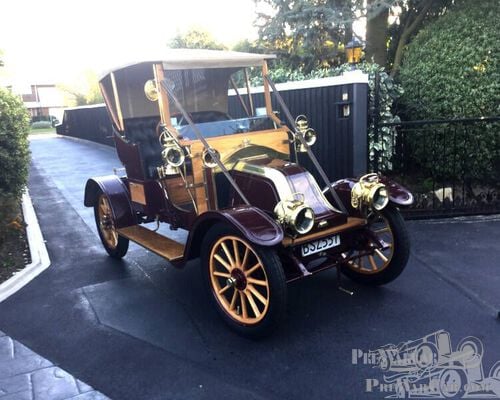
Renault /AX 1913 - named Gigi
Purchased fully renovated from New Zealand and imported to the UK. We have owned her for over10 years. Gigi is currently living in France where she..
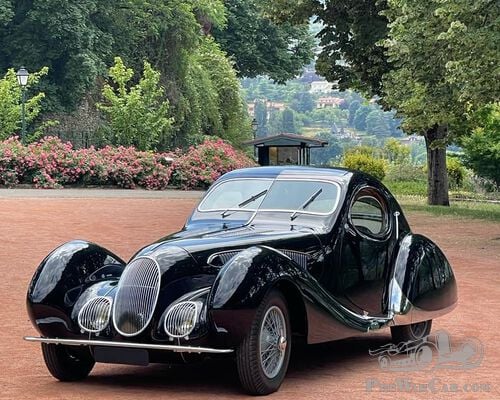
1939 Talbot-Lago T150C “Goutte d’Eau” — Iconic French Coachbuilt Masterpiece
Talbot-Lago T150C ‘Teardrop’ — An Icon of French Automotive Art There are motor cars that define an era. And then there are those tha..
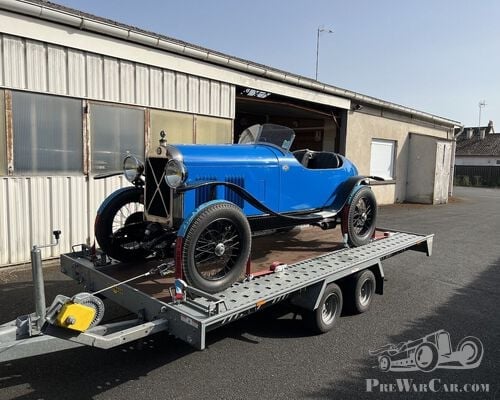
Salmson VAL 3 Séries 7
1927 Salmson VAL3 Series 7. Completely restored a few years ago, in very good overall condition, both bodywork and mechanics. Bordino-style bodywor..