The global magazine and marketplace for classic car enthusiasts, by enthusiasts.


Filter
Classic Maxwell, DeSoto for sale - Maxwell, DeSoto cars for sale
-

1910 Maxwell model Q
Maxwell produced automobiles from 1904 through 1925. It started in Tarrytown, New York, under the name of Maxwell-Briscoe Company as its founders were Jonathan Dixon Maxwell and the Briscoe Brothers. Jonathan Maxwell gained experience working for Oldsmobile and Benjamin Briscoe was an early industry pioneer who was convinced that the car David D..

Maxwell
US, 1904 – 1925
(1) Maxwell-Briscoe Motor Co, Newcastle, Ind. Tarrytown N.J., 1904 – 1913
(2) Maxwell Motor Corporation, Detroit, Mich., 1913 – 1925
The Maxwell car make, the work of Jonathan Maxwell and Benjamin Briscoe, appeared in 1904 as a flat-twin runabout Maxwell car with square (4x4in) cylinder dimensions, a conventionally bonneted style, mechanically-operated inlet valves, thermos-syphon cooling, and shaft drive. The Maxwell car sold for $750, and the make’s early years were marked by distinguished performances in the Glidden Tours, with outright victories of Maxwell cars in 1911 and 1912. Inevitably, 4-cylinder versions followed, the D-type being a big Maxwell car rated at 30/40hp, though twins were still made as late as 1912, when the Maxwell Messenger runabout was listed at $625 (£150 in England). 9.000 Maxwell cars had been sold by the summer of 1909, by which time the Maxwell car company had become part of a short-lived United States Motor Co – other members of this group included Stoddard-Dayton and Brush.
With the collapse of the combine in 1912, Briscoe departed to form his own company, but Maxwell salvaged what was left, and continued to evolve inexpensive 4-cylinder Maxwell cars from the Mascotte and Mercury which had sold for $950 and $1.150 respectively. Though a few sixes Maxwell cars were made, Maxwell’s staple during the rest of the make’s career was a cheap sv monobloc four with 3-speed gearbox which sold for $750 in 1914, and $655 in 1916, the latter price including full electrical equipment. Total production of Maxwell cars and trucks in 1917 topped the 100.000 mark, and post-war Maxwell cars had coil ignition.
Output of the Maxwell car went up to 32hp in 1921 with the coming of the new Good Maxwell. Walter P. Chrysler took over Maxwell cars and its associated company Chalmers in 1923, and the Chrysler Six, introduced for 1924, outsold Maxwell cars with 4-cylinder. The 1925 Maxwell cars were the last; they were replaced by a 4-cylinder Chrysler which ultimately gave way to the Plymouth in 1928.
Source: Georgano, encyclopedia of motorcar; MCS
The information is written with the greatest of care. However, if you have any suggested amendments please contact us at office@prewarcar.com
DeSoto
US, 1913 – 1916
DeSoto Motro Car Co, Auburn, Ind.
The DeSoto appears to have succeeded the Zimmerman. This was a large car with a 55hp, 6-cylinder engine, which was furnished with a compressed-air starter. The DeSoto model Six-55 five-seater touring car sold for $2185.
US, 1928 – 1960
Chrysler Motors Corp, Detroit, Mich.
The DeSoto was launched in 1928 as a 3.2-litre side valve six to compete with Oldsmobile, Pontiac and the cheaper Nashes. Styling and general design of the DeSoto were in line with the 1929 Chryslers, and at $885 for a DeSoto sedan 90.000 were sold in the first twelve months. A 3.4-litre straight-8 DeSoto on a 9ft 6in wheelbase was announced for 1930 as the world’s cheapest 8-cylinder car. However, DeSoto suffered badly in the Depression, and in 1932, when flexible rubber engine mountings and free wheels were made available, sales dropped to 26.000 DeSoto cars.
The DeSoto disappeared from the British market about this time, though certain ‘Chrysler’ models listed in England (the Mortlake, Croydon, and some of the Richmonds) were in fact DeSoto cars in all but name. A 6-cylinder version of Chrysler’s advanced unitary-construction Airflow, the SE-type with a 4-litre engine, was brought out in 1934, but was an unsuccessful as its bigger sister. Later DeSotos followed regular Chrysler lines closely though in later years there was a tendency for DeSoto to move into a higher price class than Dodge; by 1952 DeSotos started $300 higher than the companion make.
By 1939 the DeSoto cars for sale were being made with independent front suspension, hypoid back axles and column change. There was a choice at DeSoto of two 6-cylinder engines and three wheelbase lengths, the longest of these being reserved for seven-seater bodywork – DeSoto continued to offer a really roomy family car right up to 1954. A 4-speed semi-automatic Vacumatic transmission became an option in 1941, but DeSoto’s big post-war change of models did not take place until 1952, when the division followed Chrysler’s lead in adopting the oversquare ohv V8; the DeSoto version was of 4½-litre capcity and developed 16-bhp. With the advent of Chrysler’s ‘flight sweep’ styling in 1955, the side-valve sixes were dropped and the standard engine in a DeSoto was now a 4.8-litre eight, giving 185bhp in Firedome guise, and 200bhp in Fireflite form. Though this redesigning saved Chrysler sales generally, the slump in the medium-price class had an adverse effect on DeSoto and in 1959 the DeSoto division was merged with Plymouth. Last of the DeSotos were the 1961 models, unitary-construction cars with a choice of three engines: Plymouth’s 145bhp ohv ‘slant six’ as used in the Valiant, and V8s of 230 and 265bhp, the two former only in Canadian DeSotos. Production of DeSoto cars ceased in November 1960 after only a few had been delivered.
Source: Georgano, encyclopedia of motorcar; MCS
The information is written with the greatest of care. However, if you have any suggested amendments please contact us at office@prewarcar.com



Featured
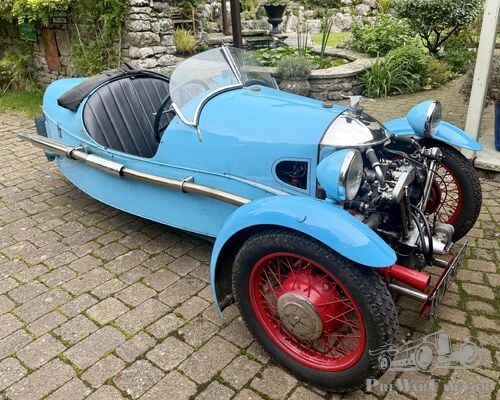
1933 Morgan Three-Wheeler Super Sports, Beetle Back • Show-Specification Car
First registered24 March 1933RegistrationXJ 6336 - original and transferableChassis numberD174Engine numberDTZE 94 H 31..
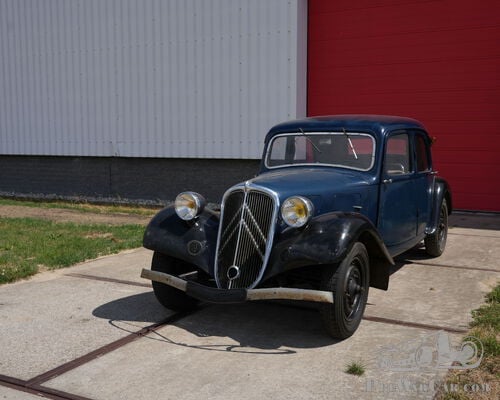
1935 Citroën Traction Avant
Early-production Traction AvantExceptionally original, unrestored conditionRecently part of a major museum collection
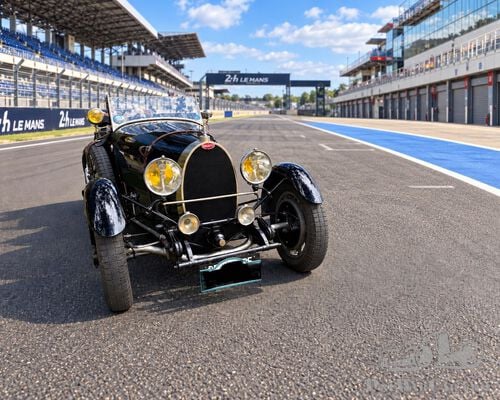
BUGATTI 43 GRAND SPORT
Bugatti Type 43 Grand Sport — Une histoire à poursuivre au volant Certaines automobiles se contemplent avec admiration. D’autres susc..