The global magazine and marketplace for classic car enthusiasts, by enthusiasts.


Filter
Classic Maxwell for sale - Maxwell cars for sale
-

Chenard & Walcker Model G
The Chenard & Walcker is a 1905 Model G, equipped with a 5-liter, four-cylinder engine producing 20 horsepower, enabling the car to reach a top speed of approximately 85 km/h | 50 mp/h. The body is a Double Phaeton and was crafted by the renowned coachbuilder Jean-Henri Labouredette. In addition to the radiator b.. -
rare Peerless for sale
The Peerless Motor Corporation of Cleveland, Ohio, manufactured high-quality cars between 1900 and 1931. Peerless, along with Packard and Pierce-Arrow, became known as the ‘Three P’s of Motordom’ (top-of-the-range cars) in the United States. The car offered for sale is one of the very few vehicles still in existence today. The new car was import.. -
Lancia Lambda 3rd Series Short-Chassis Torpedo
With a monocoque body, four-wheel brakes, independent front suspension and V4 overhead camshaft engine, many enthusiasts view the Lancia Lambda as one of the great and innovative automobiles of all time. The Lambda was also successful in competition with privately entered cars finishing fourth and fifth behind the works OMs in the first Mille Migli.. -
1932 Rolls-Royce Phantom II Continental Drophead Coupe by Carlton
Vintage and Prestige are proud to offer this 1932 Rolls-Royce Phantom II Continental Drophead Coupe by Carlton For Sale. Previous UK Registration: 544 YUS Chassis no: 32MS Engine no: HD 55 Mileage shown: 22,480 32MS was first ordered by the Duke of Sutherland; Sir G.. -
1928 Packard 533 Golfers Coupe
1928 Packard 533 Golfers Coupe Chassis number 144148RRegistration number: UC1064 Vintage and Prestige Fine Motor Cars are proud to be offering this 1928 Packard 533 Golfers Coupe for sale. A spectacular Packard in mint order throughout. This right hand drive example was sold new to the UK in 1928 and has remained here since... -
Fiat 520 - Bj. 1928 originaler Zustand / 6 - Zylinder
Fiat 520 - Bj. 1928 originaler Zustand / 6 - ZylinderWir bieten Ihnen diesen wunderschönen Fiat 520 aus dem Jahr 1928 an.Der Wagen befand sich rund 50 Jahre lang in Familienbesitz und präsentiert sich heute in einem weitgehend unrestaurierten Originalzustand. Behutsame Ausbesserungen sowie authentische Gebrauchs- und Altersspuren u.. -
Rolls Royce 20HP doctors coupe 1929
Rolls Royce 20HPCarrosserie "coupé docteur" de 1929Chassis GEN81 Intégralement restaurée par un spécialiste Anglais du modeleVoiture tres soignée, carrosserie - sellerie - mecanique en excellent état Part toutes distances, participation a Paris - Pekin sans probleme en 2013 Carte gri.. -
1938 Bentley Petersen 4 ½-Litre Blower Lemans Replica
1938 Bentley Petersen 4 ½-Litre Blower Lemans Replica Chassis Number: GGR64 Registration Number: FGO523 This stunning Bentley 4 ½-Litre Blower recreation was hand-crafted by the marque specialists at Bob Petersen Engineering in the UK, and according to recent correspondence with.. -
1940 Chevolet Master Business Coupe
5-Fenster_Coupe.Sammler-Zustand.Zweifarbige Lackierung in Burgund und Schwarz.einwandfreie Chromteile.Neuer Kabelbaum.Innenraum mit neuer Polsterung.Überholter 235-cui-Reihen-6_Zylinder (3,9 Liter) mit 140 SAE-PS.3-Gang-Schaltgetriebe.Firestone-Weißwandreifen.Teardrop-Fenderskirts. -
1934 Derby Bentley 3 ½ Litre All Weather Tourer by Barker
1934 Derby Bentley 3 ½ Litre All Weather Tourer by Barker Chassis Number: B-169-AE Registration Number: AXM20 A unique and handsome rare all-weather tourer bodied by Barker of London in 1934. The coachwork on this car is particularly distinguised & quite rare with lovely sca..


Maxwell
US, 1904 – 1925
(1) Maxwell-Briscoe Motor Co, Newcastle, Ind. Tarrytown N.J., 1904 – 1913
(2) Maxwell Motor Corporation, Detroit, Mich., 1913 – 1925
The Maxwell car make, the work of Jonathan Maxwell and Benjamin Briscoe, appeared in 1904 as a flat-twin runabout Maxwell car with square (4x4in) cylinder dimensions, a conventionally bonneted style, mechanically-operated inlet valves, thermos-syphon cooling, and shaft drive. The Maxwell car sold for $750, and the make’s early years were marked by distinguished performances in the Glidden Tours, with outright victories of Maxwell cars in 1911 and 1912. Inevitably, 4-cylinder versions followed, the D-type being a big Maxwell car rated at 30/40hp, though twins were still made as late as 1912, when the Maxwell Messenger runabout was listed at $625 (£150 in England). 9.000 Maxwell cars had been sold by the summer of 1909, by which time the Maxwell car company had become part of a short-lived United States Motor Co – other members of this group included Stoddard-Dayton and Brush.
With the collapse of the combine in 1912, Briscoe departed to form his own company, but Maxwell salvaged what was left, and continued to evolve inexpensive 4-cylinder Maxwell cars from the Mascotte and Mercury which had sold for $950 and $1.150 respectively. Though a few sixes Maxwell cars were made, Maxwell’s staple during the rest of the make’s career was a cheap sv monobloc four with 3-speed gearbox which sold for $750 in 1914, and $655 in 1916, the latter price including full electrical equipment. Total production of Maxwell cars and trucks in 1917 topped the 100.000 mark, and post-war Maxwell cars had coil ignition.
Output of the Maxwell car went up to 32hp in 1921 with the coming of the new Good Maxwell. Walter P. Chrysler took over Maxwell cars and its associated company Chalmers in 1923, and the Chrysler Six, introduced for 1924, outsold Maxwell cars with 4-cylinder. The 1925 Maxwell cars were the last; they were replaced by a 4-cylinder Chrysler which ultimately gave way to the Plymouth in 1928.
Source: Georgano, encyclopedia of motorcar; MCS
The information is written with the greatest of care. However, if you have any suggested amendments please contact us at office@prewarcar.com


Featured
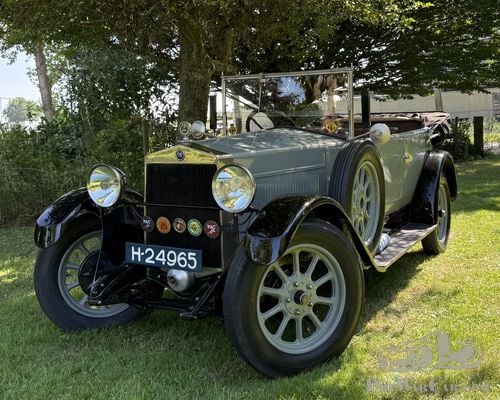
Fiat 509 Torpedo / Spider – Exceptionally Original and Complete
A Rare and Highly Original Example with Long-Term Dutch HistoryOffered for sale is an exceptionally original and remarkably complete Fiat 50..
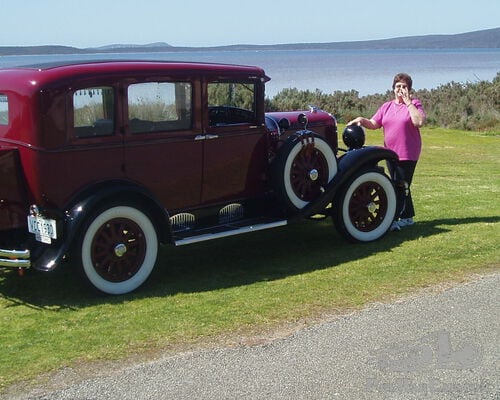
1930 Chrysler 66 Six-Wheel Equipped Royal Sedan
An exceptionally well restored and highly awarded Chrysler 66 Royal Sedan, with only two owners in nearly 97 years.The present owner ..
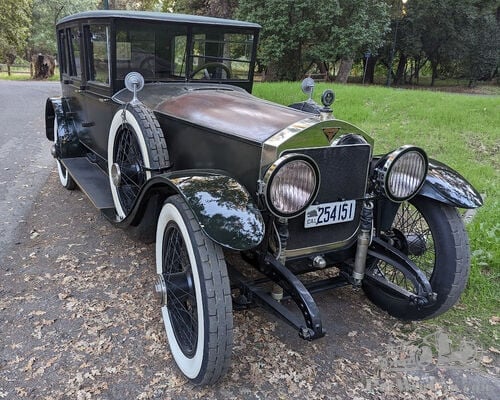
1916 Simplex, Crane model 5
1916 Simplex, Crane MODEL 5CUSTOM MADE HISTORIC PRESERVATION VEHICLE – READY TO TOUR!This Simplex recently completed th..