The global magazine and marketplace for classic car enthusiasts, by enthusiasts.


Filter
Classic Maybach, Stoewer for sale - Maybach, Stoewer cars for sale
-

1934 Maybach Zeppelin DS8 Stromlinien Cabriolet - one-off body
Maybach was a technological leader in European vehicle manufacturing12-cylinder engine with 8-litre displacement and 200 hpUnique 8-speed shift regulator transmissionOnly 24 Maybach Zeppelin cars, including 2 chassis, still exist todayOne-of-a-kind bodyworkOriginal leather interior in excellent c.. -
1938 Maybach SW 38 Gläser Cabriolet
German first deliveryRare bodywork by Gläser, DresdenIn the same ownership for 15 yearsDocumented history in the Maybach Register The SW38 is widely regarded as one of the most elegant and technically impressive six-cylinder cars produced in Germany in the late 1930s. With its powerful engine,.. -
1924 Stoewer type D3 roadster
Rare opportunity to buy a vintage 1924 Stoewer type D3 roadster in fully restored condition. More than € 50K were spent in 2018 and 2019 on its restoration . Detailed work invoices come with the car. A video can be sent on request . Price € 64000 ex Eibergen Netherlands imported EEC.


Maybach
D, 1921 – 1941
Maybach Motoren-Werke GmbH, Friedrichshafen
Wilhelm Maybach left the Daimler company in 1907. Together with Count Zeppelin he founded a factory primarily for the production of aero engines, especially for the Zeppeling air-ships. These engines were designed by Karl Maybach, Wilhelm’s son. After World War 1, Karl Maybach started to build a 22/70ps 5.7-litre 6-cylinder engine intended for motor cars. This Maybach engine was used by Spyker, but no other factories were interested, so Maybach decided to take up Maybach car production on his own. From the beginning Maybach cars aimed at a high quality car with outstanding driving comfort. The first Maybach Model W3 appeared at the 1921 Berlin Motor Show, and this Maybach car featured a very advanced 2-speed pedal-controlled transmission. This Maybach carmodel was produced until 1926. It was followed by the ohv Maybach Model W5 (for sale in 1926 – 1930) using a 27/120ps 7-litre engine in the same chassis, this being available with Maybach’s Schnellgang 2-speed auxiliary box, giving the Maybach car 4 forward speeds. The Maybach 12 of 1929 had a V12 7-litre engine, which was superseded one year later by the Maybach Zeppelin, also with V12 7-litre engine of 150bhp; after 1931 the Maybach car was also available with an 8-litre 200bhp engine. The Zeppelin range was listed until 1939. Maybach Zeppelin car chassis were also fitted with 6-cylinder engines of 7-litres capacity (already used in Maybach Model W5) and a new 5.2-litre engine developing 130bhp (the Maybach W6 and DSH models respectively). These Maybach cars retained beam axles to the end and were characterized by 7-speed boxes of great complexity. A Zeppelin chassis for the Maybach car cost the equivalent of £1.300 in Germany.
In 1935 a new 6-cylinder Maybach car was presented, starting the SW range. This was the Maybach SW35 with a 3.5-litre 140bhp engine. Engine capacity of this Maybach car was raised to 3.8-litres in the Maybach SW38 in 1936 and to 4.2-litres in the SW42 of 1940. Production of the Maybach car ceased in 1941. The Maybach Zeppelin shared with the Mercedes 770 the claim to be the most exclusive German car of the 1930s. This reputation was enhanced by Maybach cars high standards of material and finish, of comfort and quietness in running. No less well-made were the 6-cylinder Maybach cars which were in the first rank of German cars of this class. Maybach only built complete chassis for their Maybach cars, bodies being made by various firms to customers’ special requirements. Best known of these firms was Spohn of Ravensburg. Spohn aslo built aerodynamic bodies to Jaray designs for the Maybach Zeppelin in 1932 and 1934, and for the Maybach SW35 in 1935. These versions Maybach cars were produced only in very limited numbers. Maybach car production was not taken up again after World War 2. Altogether, some 2.000 Maybach cars are believed to have been made. In 1960 Maybach cars pooled their interests with Daimler-Benz in the manufacture of diesel engines for locomotives and ships.
Source: Georgano, encyclopedia of motorcar; HON
The information is written with the greatest of care. However, if you have any suggested amendments please contact us at office@prewarcar.com
Stoewer
D, 1899 – 1939
(1) Gebrüder Stoewer, Fabrik für Motorfahrzeuge, Stettin, 1899 – 1916
(2) Stoewer-Werke AG vorm. Gebr. Stoewer, Stettin, 1916 – 1939
The Stoewer car factory developed out of the Stoewer ironworks and was among the pioneers of the German car industry. After manufacturing motor cycles, tricycles and quadricycles for two years, Stoewer turned to cars in 1899. The first Stoewer car had a rear-mounted 2-cylinder engine. 4-cylinder Stoewer cars followed in 1901, and electric Stoewer cars were also produced. Best known were the 2-cylinder Type T Stoewer car (2.280cc and 3/12PS), the 4-cylinder Stoewer P4 (3.052cc and 11/22PS), the Stoewer G4 (1.500cc and 6/12PS) and the 6-cylinder Stoewer P6 (8.820cc and 34/60PS), evolved in the 1905-1907 period all Stoewer cars with shaft-drive. The Stoewer B1 of 6/16PS and the Stoewer B6 of 9/22PS which appeared in 1910 were also built by Mathis under licence. The G4 Stoewer car was the basis for the Stoewer B5, which Stoewer car in 1912 became famous by setting up a record at Brooklands with 67.7mph. The new range of Stoewer cars which appeared in 1913 was also based on successful earlier cars. They were the Stoewer C1 (6/18PS), Stoewer C2 (10/28PS) and C3 Stoewer car (6-cylinder and 19/45PS). Shortly before the outbreak of World War 1 the Stoewer car range was headed by the F4 Stoewer car with a 4-cylinder, 8.8-litre 33/100PS ohc engine. After the war an enormous Stoewer car appeared, the Stoewer D7, using a 6-cylinder 11.2-litre 42/120PS aero engine, as well as some conservative sv 4- and 6-cylinder Stoewer cars with rear wheel and transmission brakes. Front wheel brakes appeared on Stoewer cars in 1925. Stoewer introduced 8-cylinder Stoewer cars in 1928. These were the Stoewer Superior, Stoewer Marschall, Stoewer Gigant and Stoewer Repräsentant with engines ranging from 2-litres and 45bhp to 4.9-litres and 100bhp. The Stoewer car firm re-entered the economy class in 1931 with the V5, a front-driven Stoewer car with a V4 1.188cc engine, followed by the front-drive models R140 (1.369cc), R150 (1.488cc) and R180 (1.769cc). Another 8-cylinder was the front wheel drive Greif V8 with a 2.488cc engine, which was replaced by the conventional 6-cylinder 3.609cc Arcona Stoewer car in 1938. In 1934 the 1½-litre 4-cylinder Stoewer car and 2½-litre V8 Stoewer car were shown at the Brussels Salon by Monsieur Dewaet under the name D.S. (Dewaet-Stoewer). The Greif Junior was built under Tatra licence with an opposed 4-cylinder 1.474cc engine. It succeeded the Röhr Junior. In the middle of the range was the Stoewer Sedina with a 4-cylinder engine of 2.4-litres.
Production of private Stoewer cars was given up at the outbreak of World War 2 in 1939. The Stoewer car factory was destroyed during the war and production of Stoewer cars was not resumed.
Source: Georgano, encyclopedia of motorcar; HON
The information is written with the greatest of care. However, if you have any suggested amendments please contact us at office@prewarcar.com


Featured
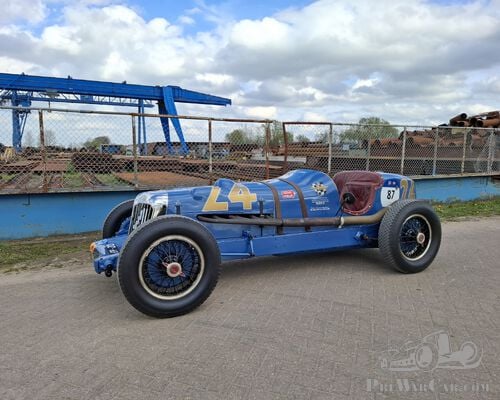
1932 - Graham " Lucenti " Indianapolis
Original participant of the 1932, 1934 and 1935 Indy 500. Best result: finishing 10th overall in the 1934 Indy 500 with driver “Herb” Ardinger...

K3 Replica on KN Chassis
"The K3 Magnette must rank in the history books as the most famous and successful of all the record breaking MGs. With only 33 examples produced durin..
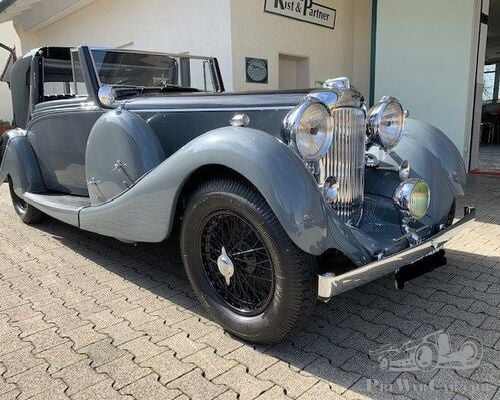
Lagonda LG 45 Coupe de Ville Sedanca by Mayfair
The successor to the M45, the LG45 was built around the same highly capable, competition-proven 4.5-litre Meadows inline-six engine, but featured r..