The global magazine and marketplace for classic car enthusiasts, by enthusiasts.


Filter
Classic Albion, Mercer for sale - Albion, Mercer cars for sale
-

1901 Albion A1 Dogcart 8HP Twin Cylinder - VCC Dated
1901 Albion Model A1 8HP Twin Cylinder Dog CartRegistration No. BS8677Chassis No. 45E Established in 1899 in Finnieston Street Glasgow by Dr Thomas Blackwood Murray and Norman Fulton, the Albion Motor Company were once the largest provider of commercial vehicles in the British Empire. Albion were famed for their relia.. -
1913 Mercer Model 35-J Raceabout | RM Sotheby's | The Monterey Auction
To Be OFFERED AT AUCTION at RM Sothebys' The Monterey Auction event, 13 - 15 August 2026. $2,750,000 - $3,500,000 USD America’s greatest and most legendary early sports carA genuine raceabout with exceptionally well-known historyFormerly owned by Paul Cadwell, Webster Knight II, and Burt UpjohnDesirable late-pr..


Albion
GB, 1900 – 1913
Albion Motor Car Co Ltd, Scotstoun, Glasgow
Still active as a truck manufacturers within the Leyland Group, Albion was founded at the end of 1899 by T. Blackwood Murray and Norman Fulton, late of Arrol-Johnston and their early products were dogcarts with varnished-wood bodywork much in the Arrol-Johnston idiom, with 2-cylinder opposed-piston underfloor engines, low tension magneto ignition, and Murray’s patent governor. Wheel steering replaced the tiller in 1902, and a year later Albion began production of a 16hp vertical-twin which was made for many years, usually with solid tyres, and often with shooting-brake bodywork. ‘Cars for country houses’, especially Scottish ones, were a speciality of the house, though rather less rustic was a side-valve 5.6-litre chain-driven four introduced in 1906. This 24hp model had a seven-year production run. The last Albion passenger car was a 15hp Monobloc four with side valves in a T-head and worm drive, which sold for £475 in 1912. At the end of 1913 Albion elected to concentrade on commercial vehicles, though large shooting brakes using the 15hp engine continues to be made.
Source: Georgano, encyclopedia of motorcar; MCS
The information is written with the greatest of care. However, if you have any suggested amendments please contact us at office@prewarcar.com
Mercer
US, 1910 – 1925; 1931
(1) Mercer Autocar Co, Trenton, N.J., 1910
(2) Mercer Automobile Co, Trenton, N.J., 1910 – 1925
(3) Elcar Motor Car Co, Elkhart, Ind., 1931
The Mercer car was named after Mercer County, New Jersey, where the Mercer car was made. The most famous Mercer car of all was the Mercer Type 35 Runabout of 1911, designed by Finlay R. Porter. The specification of this Mercer car was ordinary enough, embracing at first a 5-litre, 4-cylinder, Continental-built T-head engine that produced a little over 10bhp per litre at a leisurely 1.700rpm. There were 3 forward speeds. The classic ‘body work’ consisted of a bolster tank, two bucket seats, and a monocle windscreen. However, in common with other speedsters, the Mercer car weighed very little and could pull a high axle ratio, which helped the Mercer car to attain a guaranteed 70mph. In 1912, by contrast, a few Mercer cars were made with the Owen Magnetic’s Entz transmission. A more efficient, L-head engine giving up to 89bhp at 3.000rpm according to tune was substituted in 1915. Also, the Mercer car had a 4-speed gearbox. This 22 Series was designed by E.H. Delling. However, some of the old Raceabout’s character was lost, in that the body of the new version had sides and a bench-type front seat, instead of the two stark bucket seats of the first type. Indeed, full touring Mercer cars were offered as well. The Mercer Series 4 and 5, beginning in 1919, had yet another designer in A.C. Schultz, and even had an electric starter. Nevertheless, these Mercer cars were still European in concept in that the engines had a fixed head and a magneto, and drove through a plate clutch and, however much they had compromised with popular taste, the Mercer car could still attain 75mph. A six with an ohv engine made by Rochester was introduced at the same time, and sixes alone were made from 1923. The old line of Mercer cars finally died two years later. However magnificent they may have been, the Mercer car bore too little relation to what the public wanted to survive. Production never exceeded 500 Mercer cars a year. An attempt was made by the Elcar Motor Co and the engine by Continental. The latter was a straight-8 providing 140bhp and 100mph.
Source: Georgano, encyclopedia of motorcar; TRN
The information is written with the greatest of care. However, if you have any suggested amendments please contact us at office@prewarcar.com


Featured
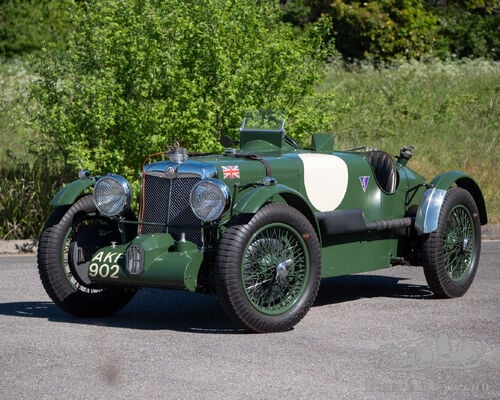
K3 Replica on KN Chassis
"The K3 Magnette must rank in the history books as the most famous and successful of all the record breaking MGs. With only 33 examples produced durin..
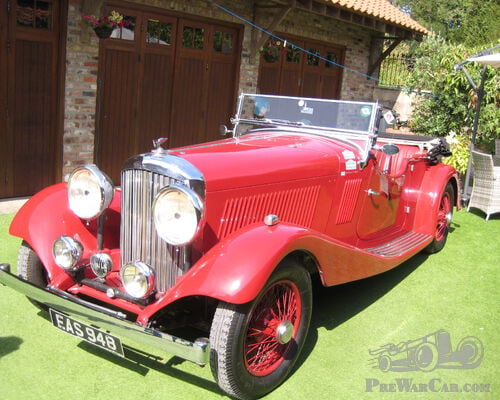
1935 Bentley 3.5 ltr. VDP 4str. Tourer
Chassis B 123 CW was first registered 14th March 1935, and in the late eighties underwent a " body-off" restoration and fitted with VANDEN PLAS
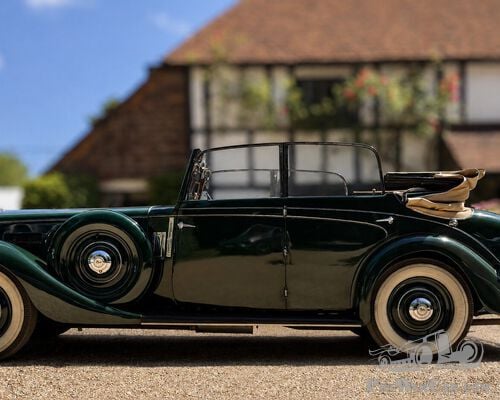
1936 Armstrong Siddeley 20/25 Cabriolet with Tickford coachwork by Salmons & Sons, Newport Pagnell
This exceptionally rare Armstrong Siddeley 20/25 Cabriolet with original Tickford coachwork by Salmons & Sons of Newport Pagnell was first reg..