The global magazine and marketplace for classic car enthusiasts, by enthusiasts.


Filter
Classic Du Pont, Mercer for sale - Du Pont, Mercer cars for sale
-

1929 Du Pont Model G Two-Passenger Speedster by Merrimac | RM Sotheby's | The Monterey Auction
To Be OFFERED AT AUCTION at RM Sothebys' The Monterey Auction event, 13 - 15 August 2026. $800,000 - $1,200,000 USD One of the most beautiful American automobiles of its generationThe 1929 New York International Automobile Show display carOne of three two-passenger “taper tail” models with an external spareOne .. -
1913 Mercer Model 35-J Raceabout | RM Sotheby's | The Monterey Auction
To Be OFFERED AT AUCTION at RM Sothebys' The Monterey Auction event, 13 - 15 August 2026. $2,750,000 - $3,500,000 USD America’s greatest and most legendary early sports carA genuine raceabout with exceptionally well-known historyFormerly owned by Paul Cadwell, Webster Knight II, and Burt UpjohnDesirable late-pr..


Du Pont
US, 1920 – 1932
(1) Du Pont Motors Inc, Wilmington, Del., 1920 – 1923
(2) Du Pont Motors Inc, Moore, Pa., 1923 – 1932
E. Paul du Pont’s company built quality cars in limited numbers, total production being 537 vehicles of all Du Pont types. First of the line was a Du Pont 4.1-litre sv four with their own engine, selling for $2.600, but this gave way to proprietary-engined sixes, initially powered by Herschell-Spillman. The 1925 Du Pont Model D had a 6-cylinder 5-litre Wisconsin engine with overhead valves that developed 75bhp, a constant-mesh gearbox, and Lockheed hydraulic brakes to all four wheels. Its successor, the Du Pont Model E, could be had with a supercharger, but the best-known, and best, Du Pont was the Du Pont Model G speedster introduced in 1928. With its narrow straight wings copied from the Amilcar, Woodlite headlamps and grille concealing the radiator, the last a pioneering feature, the Du Pont Model G was not a good-looking car, but it was a very effective one. Like all the DuPont speedsters it had four forward speeds. The 5.3-litre, sv straight-8 engine, by Continental, gave 114bhp at 3600rpm with catalogued modifications. With the latter, 100mph was guaranteed. In the 1929 Le Mans 24 Hours race the Du Pont Model G proved itself faster than the other American entries, Stutz and Chrysler. Touring bodywork was, of course, available on the Du Pont car, and in 1931 came the long wheelbase (12ft 2 in) Du Pont Model H, built in a Stearns Knight frame. The later Du Pont cars were assembled in the Indian motorcycle factory at Springfield, after E. Paul du Pont had acquired this concern.
Source: Georgano, encyclopedia of motorcar; TRN
The information is written with the greatest of care. However, if you have any suggested amendments please contact us at office@prewarcar.com
Mercer
US, 1910 – 1925; 1931
(1) Mercer Autocar Co, Trenton, N.J., 1910
(2) Mercer Automobile Co, Trenton, N.J., 1910 – 1925
(3) Elcar Motor Car Co, Elkhart, Ind., 1931
The Mercer car was named after Mercer County, New Jersey, where the Mercer car was made. The most famous Mercer car of all was the Mercer Type 35 Runabout of 1911, designed by Finlay R. Porter. The specification of this Mercer car was ordinary enough, embracing at first a 5-litre, 4-cylinder, Continental-built T-head engine that produced a little over 10bhp per litre at a leisurely 1.700rpm. There were 3 forward speeds. The classic ‘body work’ consisted of a bolster tank, two bucket seats, and a monocle windscreen. However, in common with other speedsters, the Mercer car weighed very little and could pull a high axle ratio, which helped the Mercer car to attain a guaranteed 70mph. In 1912, by contrast, a few Mercer cars were made with the Owen Magnetic’s Entz transmission. A more efficient, L-head engine giving up to 89bhp at 3.000rpm according to tune was substituted in 1915. Also, the Mercer car had a 4-speed gearbox. This 22 Series was designed by E.H. Delling. However, some of the old Raceabout’s character was lost, in that the body of the new version had sides and a bench-type front seat, instead of the two stark bucket seats of the first type. Indeed, full touring Mercer cars were offered as well. The Mercer Series 4 and 5, beginning in 1919, had yet another designer in A.C. Schultz, and even had an electric starter. Nevertheless, these Mercer cars were still European in concept in that the engines had a fixed head and a magneto, and drove through a plate clutch and, however much they had compromised with popular taste, the Mercer car could still attain 75mph. A six with an ohv engine made by Rochester was introduced at the same time, and sixes alone were made from 1923. The old line of Mercer cars finally died two years later. However magnificent they may have been, the Mercer car bore too little relation to what the public wanted to survive. Production never exceeded 500 Mercer cars a year. An attempt was made by the Elcar Motor Co and the engine by Continental. The latter was a straight-8 providing 140bhp and 100mph.
Source: Georgano, encyclopedia of motorcar; TRN
The information is written with the greatest of care. However, if you have any suggested amendments please contact us at office@prewarcar.com


Featured
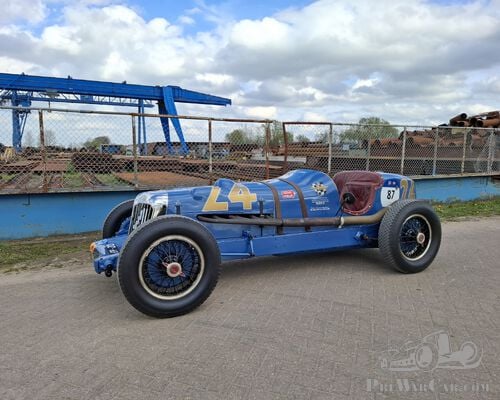
1932 - Graham " Lucenti " Indianapolis
Original participant of the 1932, 1934 and 1935 Indy 500. Best result: finishing 10th overall in the 1934 Indy 500 with driver “Herb” Ardinger...

Alfa 6C1750 Spider
Alfa 6C1750 Spider with complete history from delivery in 1930 to first owner in Firenze till today with copy Libretto/license plate all the years
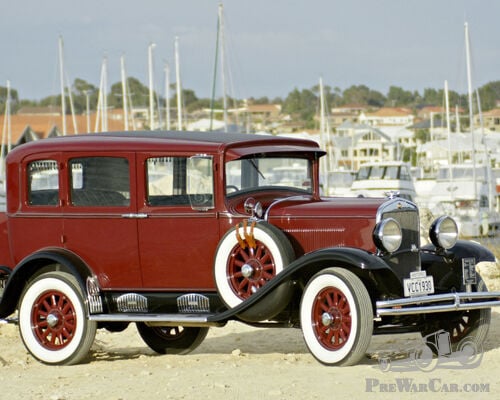
1930 Chrysler 66 Six-Wheel Equipped Royal Sedan
An exceptionally well restored and highly awarded Chrysler 66 Royal Sedan, with only two owners in nearly 97 years.The present owner ..