The global magazine and marketplace for classic car enthusiasts, by enthusiasts.


Filter
Classic Léon Bollee, Mercer for sale - Léon Bollee, Mercer cars for sale
-

1913 Mercer Model 35-J Raceabout | RM Sotheby's | The Monterey Auction
To Be OFFERED AT AUCTION at RM Sothebys' The Monterey Auction event, 13 - 15 August 2026. $2,750,000 - $3,500,000 USD America’s greatest and most legendary early sports carA genuine raceabout with exceptionally well-known historyFormerly owned by Paul Cadwell, Webster Knight II, and Burt UpjohnDesirable late-pr..

Léon Bollee
France, 1895 – 1933
(1) Automobiles Léon Bollée, Le Mans, 1895 – 1924
(2) Morris Motors Ltd, Usines Léon Bollée, Le Mans, 1925 – 1931
(3) Sté Nouvelle Léon Bollée, Le Mans, 1931 – 1933
Leon Bollee was a son of Amédée Bolllée père, the most important pioneer of steam road vehicles in France. Leon Bollee, however, turned to really small petrol Leon Bollee cars. He was the first to do so, and therefore had to invent a new name for his Leon Bollee car of 1895 – he called it a Leon Bollee voiturette. This Leon Bollee car was a tandem two-seater 3-wheeler that was faster than any other petrol-engined vehicle on the road when the Leon Bollee car was working, thanks to a powerful 3hp engine and light weight, but the power unit was unreliable on the Leon Bollee car. The Leon Bollee car had a single air-cooled cylinder of 650cc and used hot-tube ignition. There were 3 forward speeds on the Leon Bollee car, with belt final drive. The frame was tubular. Four years after the Leon Bollee voiturette appeared, Leon Bollee superseded it with a 4-wheeler with independent front suspension by double transverse leaf springs. This Leon Bollee car had a single-cylinder, water-cooled engine. Unlike the Leon Bollee voiturette, this Leon Bollee car made no mark. The design rights were sold to Darracq, and around 1901 the name of Leon Bollee cars vanished. Meanwhile, the term voiturette had been taken up by the trade and public in general as the name for a small light car.
The Leon Bollee car reappeared in 1903 as an entirely normal, full-sized car in the more expensive class, backed by Vanderbilt money and designed for the American market. This Leon Bollee car was made in 28hp (4.6-litres) and 45hp (8-litres) versions, with four cylinders and chain drive, and led on to a 11.9-litre six Leon Bollee car in 1907, in which year the first shaft driven Leon Bollee car appeared. From 1909 there was also a small modern four, the Leon Bollee 10/14hp. The 1910 range embraced 9 Leon Bollee cars, including 2 of over 10-litres capacity. Electric lighting became available on Leon Bollee cars in 1913, but the Leon Bollee grew increasingly old-fashioned after World War 1 despite the introduction of ohv in 1922 on Leon Bollee cars and front wheel brakes in 1923. Late in 1924 Sir William Morris bought the Le Mans Leon Bollee car factory. From making a wide range of conservative French Leon Bollee fours, it turned to thinly-disguised products of Cowley, Oxford, the idea being to breach the French tariff walls from the inside. The first Morris- Leon Bollee had a 12CV 2½-litre 4-cylinder unit-construction engine made by Hotchkiss, the engine manufacturers controlled by Morris, but it had push-rod overhead valves and bore little evidence of its parentage. Not so the 18CV Morris- Leon Bollee car of 1928. This was a 3-litre straight-8 with single overhead camshaft that reflected Morris’ takeover of Wolseley two years earlier. Morris’ own new six of 1928 was mirrored in the 15CV 2.6-litre Le Mans product of 1929. The bodies for the Morris- Leon Bollee car were all made in France and were usually considerably more dashing and attractive than their British counterparts. Chassis of this Morris- Leon Bollee car were made in France, and all cars had a 4-speed gearbox. At one time, 50 12CV Morris- Leon Bollee cars were being turned out each week. However, Morris’ enterprise was not a success, and he discontinued it in the hard times of the Depression. A new syndicate was formed in September 1931 to sell the same range of cars under the name of Leon Bollee cars. This lasted for less than two years and few Leon Bollee cars were made.
Source: Georgano, encyclopedia of motorcar; TRN
The information is written with the greatest of care. However, if you have any suggested amendments please contact us at office@prewarcar.com
Mercer
US, 1910 – 1925; 1931
(1) Mercer Autocar Co, Trenton, N.J., 1910
(2) Mercer Automobile Co, Trenton, N.J., 1910 – 1925
(3) Elcar Motor Car Co, Elkhart, Ind., 1931
The Mercer car was named after Mercer County, New Jersey, where the Mercer car was made. The most famous Mercer car of all was the Mercer Type 35 Runabout of 1911, designed by Finlay R. Porter. The specification of this Mercer car was ordinary enough, embracing at first a 5-litre, 4-cylinder, Continental-built T-head engine that produced a little over 10bhp per litre at a leisurely 1.700rpm. There were 3 forward speeds. The classic ‘body work’ consisted of a bolster tank, two bucket seats, and a monocle windscreen. However, in common with other speedsters, the Mercer car weighed very little and could pull a high axle ratio, which helped the Mercer car to attain a guaranteed 70mph. In 1912, by contrast, a few Mercer cars were made with the Owen Magnetic’s Entz transmission. A more efficient, L-head engine giving up to 89bhp at 3.000rpm according to tune was substituted in 1915. Also, the Mercer car had a 4-speed gearbox. This 22 Series was designed by E.H. Delling. However, some of the old Raceabout’s character was lost, in that the body of the new version had sides and a bench-type front seat, instead of the two stark bucket seats of the first type. Indeed, full touring Mercer cars were offered as well. The Mercer Series 4 and 5, beginning in 1919, had yet another designer in A.C. Schultz, and even had an electric starter. Nevertheless, these Mercer cars were still European in concept in that the engines had a fixed head and a magneto, and drove through a plate clutch and, however much they had compromised with popular taste, the Mercer car could still attain 75mph. A six with an ohv engine made by Rochester was introduced at the same time, and sixes alone were made from 1923. The old line of Mercer cars finally died two years later. However magnificent they may have been, the Mercer car bore too little relation to what the public wanted to survive. Production never exceeded 500 Mercer cars a year. An attempt was made by the Elcar Motor Co and the engine by Continental. The latter was a straight-8 providing 140bhp and 100mph.
Source: Georgano, encyclopedia of motorcar; TRN
The information is written with the greatest of care. However, if you have any suggested amendments please contact us at office@prewarcar.com


Featured
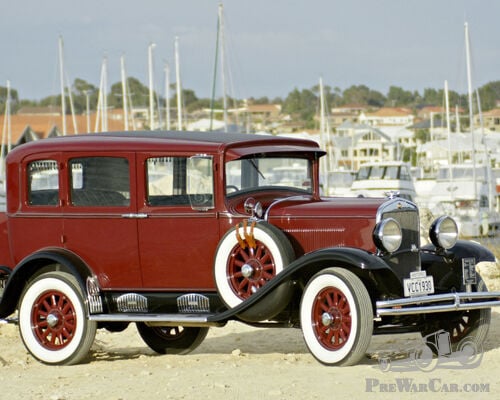
1930 Chrysler 66 Six-Wheel Equipped Royal Sedan
An exceptionally well restored and highly awarded Chrysler 66 Royal Sedan, with only two owners in nearly 97 years.The present owner ..
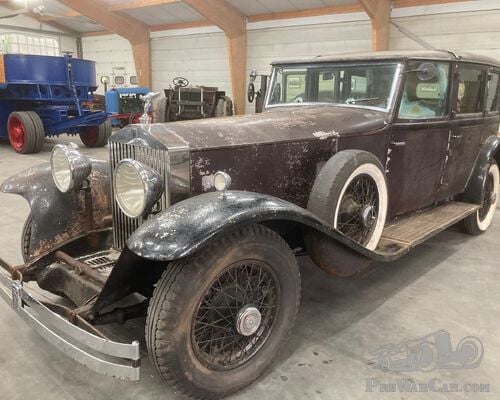
Rolls-Royce
Rolls-Royce Phantom ll chassisnummer 287 AJS. bouwjaar 1932, Links gestuurd, Brewster Keswick Sedance Towncar
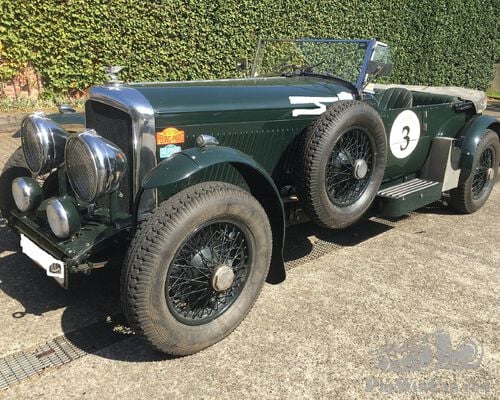
Bentley Derby Special Open Rally Car
This Bentley Derby, manufactured in 1935, has been rebuilt into a short and long-distance rally car. Full rebuilt engine in 2021, Since 2021 low mi..