The global magazine and marketplace for classic car enthusiasts, by enthusiasts.


Filter
Classic Miller for sale - Miller cars for sale
-

1931 Chevrolet 4 door special sedan
Model: Independence, AE series, 4-door special sedan Colour: Bordeaux red body with black trim and black mudguardsInterior: grey fabricEngine: 6 cylinder line, 194 cubic inches, 3.2 litres, 50 hpTransmission: 3-speed manual transmissionCondition: restoredPrice € : 29,500,- Description:This .. -
1930 Buick 4 door sedan
Model: 30-57, series 50 Colour: medium blue with black trim and black mudguardsInterior: blue fabricEngine: 6 cylinder inline,Transmission: manual, 3-speedCondition: restoredPrice € : 29,500,- Description:Nice and tight car, neat and tight sheet metal, good paint and nicely painted. Starts .. -
1913 Buick touring
Model: 3-door touring, model 25Colour: dark green with black trim, green pinstripe and black mudguardsInterior: black leatherEngine: 4 cylinder, 165 cubic inch, 2.7 litre, 22.5 hpTransmission: 3-speed manual transmissionCondition: restoredPrice € : 45,000,- Description:Very neat car with pa.. -
1929 Ford Model A sedan
Model: 2-door sedan Colour: blue body with black mudguardsInterior: grey marbled fabricEngine: 4 cylinder, 200.5 cubic inch, 3.3 litre, 40 hpTransmission: 3-speed manual transmissionCondition: completely body off restoredPrice € : Description:Fully restored A-Ford 2 door sedan with .. -
1919 Studebaker Chummy Roadster
Model: chummy roadsterColour: soft yellow body with black mudguardsInterior: dark brown leatherEngine: in-line 6 cylinderTransmission: 3-speed manual transmissionCondition: body off restoredPrice € : 49,500,- Description:Beautifully restored car. Very special model because of its tou.. -
1914 T-Ford runabout roadster
Model: runabout roadsterColour: black body with black mudguardsInterior: black leatherEngine: 4 cylinder, 176.7 cubic inches, 2.9 litres, 22.5 hpTransmission: planetary transmission, semi automatic, 2 speedCondition: body off restoredPrice € : 38,500,- Description:.. -
Chrysler Roadster Special
Chrysler Roadster Special, 1930, 3200cc, 6 cylinders, full aluminum, recently fully restored, FIA regularity passport present, cycle wings present, very powerful car. Contact us for more information. -
1924 Bentley 3-4 1/2 litre Lemans tourer.
1924 Bentley 3-4 1/2 litre Lemans tourer. Chassis number: 487Registration Number: XR3400 Under long term ownership for the past decade, this car was purchased from the late Stanley Mann who eloquently summed the car up in his usual ubiquitous style: "This Bentley is the most desirable spec for the old Ben.. -
1933 Rolls Royce Phantom 2 Continental.
1933 Rolls Royce Phantom 2 Continental.Chassis number: 7MWRegistration number: VV2142First time to market in decades; This Phantom 2 Continental has been in the current ownership for a very very long time sharing garage space with an assortment of Pre War Silver ghosts & a coach built Bentley amongst other cars.Th.. -
1931 Marmon Sedan 88
MARMON - SEDAN 88 Year 1931GasolineHistorical, 8 cylinders, very good condition.


Miller
US, 1912 – 1913
Miller Car Co, Detroit, Mich.
The Miller car was built on conventional lines with 30 and 40hp 4-cylinder engines. Roadsters and five-seater touring Miller cars were sold at prices ranging from $1.250 to $1.450.
US, 1915 – 1932
(1) Harry A. Miller Inc, Los Angeles, Calif., 1915 – 1929
(2) Rellimah Inc, Los Angeles, Calif., 1930 – 1932
Harry A. Miller, a recognized specialist in carburretors, first attracted notice in the world of motor cars when he built a replacement engine for Bob Burman’s GP Peugeot in 1915, following this up by a 4-cylinder ohc light aero engine which was installed in several cars, including Barney Oldfield’s Golden Submarine. During World War 1 Miller was associated with the Bugatti-Duesenberg aero-engine project, and his subsequent work reflects both this influence an that of Henry of Peugeot.
By 1920 MIller had siposed of his wartime interests to Leach-Biltwell and in conjunction with Fred Offenhauser and Leo Goossen was working on the first of his advanced racing power Miller cars, a 3-litre double ohc hemispherical-head straight-8 commissioned by Tommy Milton. This Miller car was not ready in time for the 1921 Indianapolis 500 Mile Race and though a complete Miller car did compete in 1922, ironically enough victory went to Milton’s great rival, Jimmy Murphy, at the wheel of a GP-type Duesenberg with Miller engine.
With the coming of the 2-litre Formula, Miller cars began to make themselves felt. Throughout its career the Miller car company concentrated on track-racing machines which dominated late-Vintage 500 Mile Races (apart from 1924, 1925, and 1927, when Duesenberg won), but the Miller cars lacked the handling and brakes to complete on equal terms with European Grand Prix cars on their home ground. In spite of this, a Miller car finished 3rd in the 1925 European G.P., but subsequent attempts by Leon Duray and Peter de Paolo to race the Miller cars in Europe proved abortive. The basic Miller car was still a straight-8 on the established lines, with dry-sump lubrication, eight carburetors, and Delco coil ignition: output was 120bhp. In 1924 appeared the first of the fwd Miller cars with engine reversed in the frame and De Dion front axle. Jimmy Murphy, who had commissioned this Miller car, was killed before he could take delivery, but the Miller car finished 2nd at Indianapolis in 1925. Miller cars were doing well in 1926, when America followed Europe in adopting the 91ci (1.500cc) capacity limit, and the new Miller car, the Miller 91 sold at $15.000 with front-wheel drive or $10.000 for a Miller car with conventional transmission. The engine of this Miller car was the old 2-litre unit with short-stroke crankshaft and magneto ignition: a centrifugal blower (as pioneered by Duesenberg) running at five times engine speed boosted power to 154bhp at 7.000rpm, and the 3-speed gearbox of the Miller car had ball change. All but one of the first ten finishers in that year’s Indianapolis were Miller cars, while in 1927 Frank Lockhart took the International Class Flying-Mile record at 164mph on an unstreamlined single-seater Miller 91 tuned to give 252bhp. Lou Meyer (later of Meyer-Drake, the firm that took over the development of the Miller racing engine from Fred Offenhauser) won the 1928 ‘500’ with a Miller car, and Ray Keech won in 1929. Experiments were also made with Miller engines and Miller cars in Europe. A Miller-powered Lea-Francis was prepared for record work in 1927. Ettore Bugatti purchased the two fwd Miller car racers that Leon Duray brought ot Europe in 1928 (it may be significant that Le Patron produced a 4x4 spring car, the Type 53, in 1932). Douglas Hawkes of Derby used a similar fwd Miller car as the basis for the successful Derby-Miller sprint and record cars of the early 1930s.
Though Miller cars won again at Indianapolis in 1930 and 1931, the advent of the ‘junk formula’ caused Harry Miller to sell out; but he was soon in partnership again with Goossen and Offenhauser at Rellimah, Inc. (‘H.A. Miller’ spelt backwards.). New designs Miller cars included as abortive plan for a World Land Speed Record machine for Barney Oldfield, and a fearsome 5.1-litre 4-wheel-drive 4-ohc V16 Miller car. More significant historically, however, was the 3-litre 4-cylinder double ohc Miller car with integral head which Shorty Cantlon drove into 2nd place at Indianapolis in 1930. The power unitof this Miller car was developed from a 1926 marine engine and formed the basis for the legendary Offenhauser (later Meyer-Drake) units which in 4½-litre unblown form with fuel injection dominated the Indianapolis scene until the 1960s.
The Miller car company built only two road-going sports Miller cars, a 325bhp V8 in 1928, and a 4-wheel-drive V16 in 1932. The latter cost $35.000, and the client had to have the Miller car finished elsewhere after bankruptcy forced Miller cars to close down in 1932.
Miller went on designing until his death in 1943. He ran three reworked 3.6-litre Ford V8s in the 1935 Indianapolis Race: the Miller cars had all-round independent suspension and front-wheel drive, but suffered from sheer lack of horse-power. Complexity killed the last of the Miller cars, the 1938 ‘Gulf Special’ which resembled the Auto Unions and had rear-mounted 300bhp double ohc 3-litre 6-cylinder engines, and all four wheels independently sprung and driven. In 1938 there was also a more conventional car with exposed lateral oil and water radiators and disc brakes.
Source: Georgano, encyclopedia of motorcar; MCS
The information is written with the greatest of care. However, if you have any suggested amendments please contact us at office@prewarcar.com


Featured
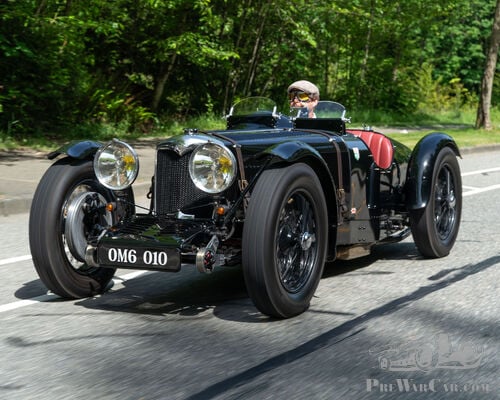
Riley 14/6 Special 1933
The ExperienceStep into the golden age of British motoring. This 1933 Riley 14/6 Special is a masterclass in pre-w..

K3 Replica on KN Chassis
"The K3 Magnette must rank in the history books as the most famous and successful of all the record breaking MGs. With only 33 examples produced durin..
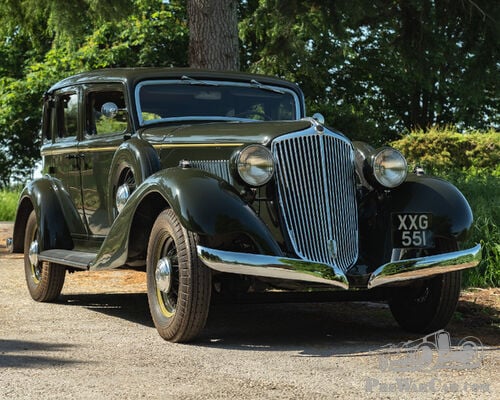
Graham Model 64 Standard Eight 'Blue Streak'
UK Registration No: XXG 551Chassis No: 1801069MOT: ExemptH&H ClassicsKelham Hall | Newark, Nottinghamshire