The global magazine and marketplace for classic car enthusiasts, by enthusiasts.


Filter
Classic Cadillac, Minerva for sale - Cadillac, Minerva cars for sale
-

1927 Cadillac V8 complete and restored rolling chassis
1927 Cadillac V8 complete and restored rolling chassis. With good radiator, beautiful original headlights, bonnet, cowling and dashboard. On restored wooden spoked wheels with the original hubcaps. Ideal car for racing and build your own body on ! We also have most of the dismantled original tourer body and the original fenders (guards) in good con.. -
Minerva Type GG Cunard Landaulette 1913
A rare opportunity to own a really nice piece of early Belgium motoring history.This beautifully preserved 1913 Minerva Type GG features an elegant Landaulette body build by Cunard Motor & Carriage Company.Powered by a robust 4-cylinder, 4396cc sleeve-valve 26HP engine and mated to a 4-speed gearbox, the car drives remarkably w.. -
Cadillac 1930 La Salle 340 Coupe
Beautifull Impresive Cadillac 1930 La Salle 340 Coupe with buffalo wire wheels, 2 spare wheels in the front wings, V8 engine 340 CID 5.600 cc with 90 HP. With a mother in law extra 2 seats in the trunk and a golf bag door for easy loading some stuff. This Cadillac / La Salle is in good original condition and great running. Frank Kennis Phone:.. -
1928 Cadillac Model 7980 convertible coupe
Cadillac is one of the pristine cars in American history, here we have a 1928 model 7980 convertible coupewith all options as twin wooden spare wheels, trunk rack, pilot ray lights (who follow the direction of the front wheels) etc.The engine is a V8 with 5588cc on a 3560 wheelbase. At 2200kg it is not a lightweight.We parti.. -
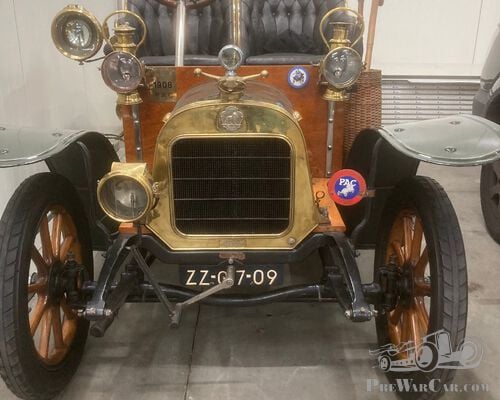
1908 Minerva Type AA 16H.P. Laundaulet
Make: Minerva Model: Type AA 16HP Chassis: 11242 Year: 1908 Vintage & Prestige is proud to offer this stunning example of Minerva Type AA 16H.P. This Beautiful Minerva is located in the north of Italy, sitting in a collection of cars that have all been restores by the late owner.. -
1938 Cadillac V16 Coupe Series 90 Coupe by Fleetwood
1938 Cadillac V16 Coupe Series 90 Chassis number: 702748 Registration Number: H1087BBB (Spain Historic) On January 4, 1930, Cadillac introduced a new top of the line automobile at the New York Auto Show with the introduction of its breathtaking new V-16. With this first V16 pro.. -
Cadillac 1934 Town Sedan serie 370D V12 Fleetwood Body
Cadillac 370D Town Sedan from Fleetwood with the V12 150HP engine and a wheelbase from 146" only 683 V12 where produced in 1934 by Cadillac This Impressive car has a weight from over 2500KG The Cadillac runs and drives well. Frank Kennis Phone: 00.31.622.420.766 or mail me: info@KennisCars.NL www.KennisCars.NL Classic Car Dealer for Europe Cad.. -
Cadillac V16 - Series 452 - 1930 - Imperial Sedan 4330
Offers invited a round € 200.000 - This ONE of 4 Survivors of Serie 4330 body style - book C.W. Cummings - 2014) ***excellent driving car, the V16 gives you a special experience, no other car has***https://www.prewarcar.com/a-stately-cadillac-v16-in-the-netherlandsBuilt; no 9 of 50 - Engine no. 700163Lengt..


Cadillac
US, 1903 to date
(1) Cadillac Automobile Co, Detroit, Mich., 1903 – 1905
(2) Cadillac Motor Car Co, Detroit, Mich., 1905 to date
The ‘Standard of the World’ started humbly as a single-cylinder car selling for $750. Henry M. Leland, its creator, had been associated with Henry Ford and has also built engines for Oldsmobile. The Model-A Cadillac was markedly similar to the early Fords in having a horizontal underfloor engine, 2-speed planetary transmission and central chain drive via a spur-type differential, but Cadillac’s 1½-litre inlet over exhaust power unit had one cylinder where Ford used two. There was no bonnet on the early Cadillac models. This very successful design remained in production until 1908, later improvements including rack-and-pinion steering, transverse front suspension and a dummy bonnet. The Cadillac marque was introduced to Britain by F.S. Bennett, who in 1908 conducted a ‘standardization test’ at Brooklands. Three single-cylinder Cadillac cars were dismantled and the parts mixed up – they were then reassembled and the vehicles run on the track. The R.A.C. awarded Cadillac the Dewar Trophy for this achievement.
A 30hp 4-cylinder Cadillac car with separate cylinders and copper jackets was announced for 1906 and 75.000 of this type Cadillac were sold before it was discontinued in 1914. The original planetary transmission gave way first to a conventional 3-speed box, and finally in 1914 to a 3-speed box with 2-speed back axle. Cadillac was one of the firms organized into the General Motors group in 1909 by W.C. Durant, and in 1910, when a 4-cylinder Cadillac tourer could be bought for $1600, the company was claiming that tolerance on 112 parts of the car were accurate to one-thousandth of an inch. 1912 saw a most important Cadillac innovation: the standardization of the Delco system of electric lighting and starting on the Cadillac, now of 5½-litres capacity and capable of 60mph. The first left-hand drive Cadillac of 1915 was also the first of the company’s V8s, to become as much a hallmark of the breed as were Buick’s overhead valves. Inspired by the De Dion Bouton of 1910 it had 5.1-litre engine and sold for $2700. 13.000 V8 Cadillac cars were sold in the first year of production and the model was widely used by the U.S. Army in World War 1. Cylinder heads were detachable from 1917 on, and 1924 Cadillac versions had Duco cellulose finish and front wheel brakes.
In 1927, when 47.000 Cadillac cars were sold, a less expensive companion make, La Salle appeared, and the cars were restyled in 1928. The synchromesh gearbox made its world debut with the 1929 Cadillac models, which also featured chromium plating and safety glass, with a price range from $3.295 to $5.995. 1930 saw the advent of the ohv Cadillac V16 of 7.4-litres, which gave 185bhp and had a wheelbase of 12ft 4in. This sold at an average rate of 500 Cadillac cars a year for eight seasons in the $6.000-$9.000 price backet. It was joined in 1931 by an equally impressive ohv 6-litre V12 Cadillac for sale. Improvements over the next few years included power brakes (1931), ride control (1932), no-draught ventilation (1933), Dubonnet type independent front suspension (1934) and ‘turret-top’ all-steel bodies (for sale in 1935). 1938 Cadillac models had column change as standard, a year ahead of other GM products, while the V12 and V16 were dropped in favour of a side-valve short-stroke Cadillac 16-cylinder model which was made until 1940. Another new model for Cadillac in 1938, the 8-cylinder Cadillac Sixty Special, anticipated GM’s 1940 styling with its absence of running boards and 4-light sedan bodywork. 5.7-litre side-valve V8s in three wheelbase lengths made up the 1941 Cadillac range, on which Hydramatic transmission was optional for the first time.
The post-war era was to see Cadillac outstrip all its competitors in the top-price class and become an international symbol of wealth. Sales climbed from 66.000 cars in 1941 to 103.857 Cadillac cars in 1950, and to a new record of 165.959 Cadillac cars in 1964. Tail fins made their first appearance on Cadillac’s 1948 fastback coupé, and in 1949 Cadillac, along with Oldsmobile, adopted overhead valves and oversquare cylinder dimensions, their new 5.4-litre engine developing 160bhp. Cadillacs were raced at Le Mans in 1950 by Briggs Cunningham and the Cadillac engine was also used in export editions of Britain’s J2. Allard. Power output increased steadily: 190bhp in 1952 (by which time manual transmission was no longer offered), 210bhp in 1953 (when a 12-volt electric system was standardized), and 230bhp in 1954, the year when panoramic wrap-around windscreens and power-assisted steering became standard on the Cadillac for sale.
The expensive Cadillac Eldorado Brougham of 1957 (it cost over $13.000) was the first car to have air suspension (dropped after a few seasons) as standard equipment, while Cadillac, along with Lincoln, started the fashion for four headlamps, that later became universal in the USA. 1966 Cadillac cars featured GM’s perimeter-type chassis frame, a 340bhp 7-litre engine, variable-rate power steering, full air conditioning, electric door locks and seat controls, a time switch for the headlamps and a six-position steering wheel. Prices started at $4.650. In 1967 Cadillac set a new sales record of 213.161 cars, bettered in 1969 with 266.798/ They introduced a fwd car on Oldsmobile Toronado lines, the Fleetwood Cadillac Eldorado with torsion-bar ifs, self-levelling suspension, and front disc brakes, these last being applied to the more expensive Cadillac Fleetwoods with conventional drive, and to all the 1969 Cadillac range. Capacity of the Cadillac V8 engine was increased – to 7.735cc in 1968 and to 8.2 litres in 1970, but otherwise there were no major changes. In 1973 Cadillac were one of the few firms offering a nine-seater limousine: the Cadillac 75 with a wheelbase of 12ft 7½in and an overall length of 20ft 8in.
Source: Georgano, encyclopedia of motorcar; MCS
The information is written with the greatest of care. However, if you have any suggested amendments please contact us at office@prewarcar.com
Minerva
Belgium, 1897 – 1939
(1) S. de Jong et Cie, Antwerp, 1897 – 1902
(2) Minerva Motors SA, Antwerp, 1903 – 1934
(3) Société Nouvell Minerva, Antwerp, 1934 – 1935
(4) SA des Automobiles Imperia-Excelsior, Antwerp; Nessonvaux, 1935 – 1939
Belgium’s greatest marque, the Minerva car, arose from humble beginnings – a bicycle factory opened in 1897 by Sylvain de Jong. He soon progressed to proprietary motorcycle engines (of which he became Europe’s leading supplier), and to complete motor-cycles in 1900, though a year earlier he had built a prototype voiturette and a primitive motor lorry. A 6hp 4-cylinder Minerva car on Panhard lines appeared in 1902, but serious Minerva car manufacture did not get under way until 1904. These early Minerva cars retained side-chain drive an armoured wood frames, but used mechanically-operated side valves in a T-head. The Minerva cars came in 1.6-litre 2-cylinder, 2.4-litre 3-cylinder and 3.2-litre 4-cylinder forms, and alongside them was an ingenious and successful cyclecar, the Minervette. Its 636cc single-cylinder engine was transversely mounted at the front, driving the offside rear wheel by chain via a 2-speed constant-mesh gearbox.. This little Minerva car cost only £106. A year later the Minerva car company had settle down to bevel-driving twins and fours, the latter being a 2.9-litre 14 with steel frame that was sold in London by the Hon C.S. Rolls.
The almost mandatory petrol brougham for Minerva cars came in 1906, but more successful were a 3.6-litre Minerva 22 and a rapid 6.2-litre six Minerva car introduced in 1907. This Minerva car had gate change, and its engine developed 6-bhp. Even faster were the Minerva carfirm’s 8-litre Kaiserpreis Minerva cars with 5-bearing ioe engine and chain drive; Minerva cars failed in the German race but won the Belgian Circuit des Ardennes. In 1909 there was a Minerva L-head monobloc four of 2½-litres’ capacity, but at the same time the Minerva car company adopted the Knight double-sleeve-valve engine, and thereafter all catalogued Minerva cars used Knights.
Though inevitably emphasis now shifted to chauffeur-driven carraiges and silence, Minerva’s Knights were by no means lethargic, as witness outright victories in the Swedish Winter Trials of 1911, 1913 and 1914 by Minerva cars, and distinguished performances in the Austrian Alpine Trials. The 3.3-litre Minerva cars that ran in the 1914 TT were good for 85mph and the Minerva carteam finished intact, in 2nd, 3rd and 5th places. Their success is reflected in the phasing-out of the motorcycles after 1910, and in a clientele of Minerva cars that included Henry Ford as well as the Kings of Belgium, Sweden and Norway.
The 1910 Minerva cars were all fours: a 2.234cc monobloc Minerva 16hp, a 4¼-litre Minerva 26hp, and a large Minerva 38 of 6.3-litre capacity. Electric lighting was available in 1912 on Minerva cars, when Citroën-type helical bevel gears made their appearance; two years later starters were an option and wire wheels were standardized on Minerva car, and the Minerva car range extended from a modest 2.1-litre worm-drive monobloc Minerva 14 (which was popular as a taxi in Sweden) up to an enlarged 7.4-litre Minerva 38.
De Jong was quick to set Minerva cars on their feet after the German occupation of 1914-1918, and by 1920 they were back in production with two Minerva cars, a 3.6-litre 4-cylinder Minerva 20 and a 6-cylinder 30CV of 5.344cc, both with monobloc engines, vacuum feed, cone clutches, 4-speed gearboxes, cantilever rear springing and rear-wheel and transmission brakes, though plate clutches were standardized Minerva cars after 1921. Minerva cars, like Daimler, made their own bodies, a new coachworks being opened at Mortsel, an Antwerp suburb, in 1922; the Minerva carcompany also supplied engines to other firms, among them Mors and the curious Anglo-American Crown Magnetic. (Émile Mathis’s 1913 sleeve-valve cars had been Minerva cars with Mathis radiators). Smaller Minerva cars followed: a 15CV 2-litre four in 1922, and a 20CV six of 3.4-litre capacity in 1923, this Minerva car having 4-wheel brakes as standard, and a wheelbase of nearly 12 feet. In 1925, 2.500 Minerva cars found buyers, and a year later all Minerva cars had 4-wheel brakes, with some necessary Dewandre servo assistance on the big ones. The 1927 Minerva carrange included a replacement for the 30CV, the magnificent 5.954cc Minerva AK six with alloy pistons, light steel sleeves, and a 12ft 5½in wheelbase. There was, however, a new small 6-cylinder Minerva car, the 2-litre Minerva 12-14CV; this came with a 3-speed unit gearbox, central ball change, and lhd, and sold for under £500 in England. This Minerva car was made until 1933.
The carriage trade was not forgotten, for there were three new big cars in 1930: a 150bhp sports edition of the Minerva AK with full-pressure lubrication, and two straight-8s. Of these the 6.6-litre Minerva AL was a vast 9-bearing affair with dual ignition and right-hand change, whereas its 4-litre companion, the 22CV Minerva AP, had coil ignition and central change, and could be bought for less than £900. In 1932 there was a 20CV six Minerva car with the same specification and cylinder dimensions of 75x112mm. However, none of these Minerva cars was suitable for the prevailing economic climate, and 1934 brought what was effectively the Minerva car company’s last model, the 2-litre Minerva M4, Minerva cars first four since 1927. The sleeve-valve engine was retained, but in other respects it was typical of the prevailing idiom, with 3-speed synchromesh gearbox, mechanical brakes and pillarless saloon bodywork.
The Minerva M4 was not a success and in October 1935 Minerva cars merged with the only other Belgian factory still making private cars, Imperia of Nessonvaux. The traditional Minerva cars were continued for another season, and the Minerva AP survived until 1938, but thereafter the only cars sold to the public under the Minerva car name were some fwd Imperias exported to France. Purely experimental was an astonishing Minerva car exhibited at the 1937 Brussels Salon. This featured all-independent springing by torsion bars, and a transversely-mounted 3.6-litre Ford V8 engine drove the front wheels via a torque converter. Only three prototypes were made.
In 1952 a comeback was planned with two Minerva car-models, both of foreign design. The smaller car was based on the 1947 Cemsa-Caproni, and the new luxury Minerva car was to use the mechanical elements of the Armstrong Siddeley Sapphire, but neither materialized. The last Minerva car was a jeep-type 4x4, the C20 of 1956. This Minerva car was powered by a 4-cylinder sv Continental engine.
Source: Georgano, encyclopedia of motorcar; MCS
The information is written with the greatest of care. However, if you have any suggested amendments please contact us at office@prewarcar.com


Featured
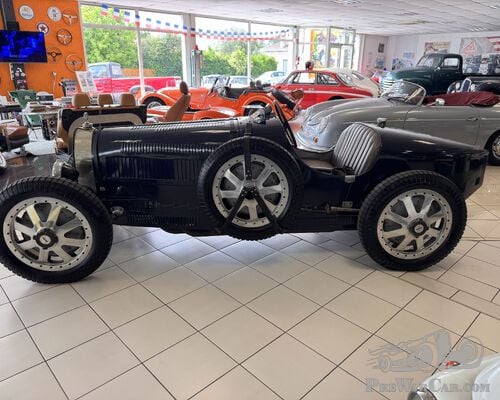
Bugatti 35 B Pur Sang
Bugatti 35 B Pur Sang,importée par un membre délégué de la FFVE il y’a une quinzaine d années.Participation à de nombreux Rallyes Bug..

Daimler Flat six 15 Saloon - Fluid Flywheel / pre-selector
The E20 was manufactured between 1935 and 1939. It offered the choice of a coachbuilt saloon, Sports Saloon, Fixedhead Coupé and Drophead Coupé bod..