The global magazine and marketplace for classic car enthusiasts, by enthusiasts.


Filter
Classic Mitchell, Donnet/ Donnet-Zédel for sale - Mitchell, Donnet/ Donnet-Zédel cars for sale
-

Mitchell Type R Raceabout 1911
Een “race” wagen uit de vroege jaren 1910 , Voorzien van een indrukwekkende kop klep motor die 30 PK leverd. De motor heeft een startmotor , en slaat makkelijk aan. De versnellingsbak heeft 3 versnelling en is normaal te bedienen. Deze Mitchell is goed rijdend. De Mithchell was ..

Mitchell
US, 1903 – 1923
(1) Mitchell Motor Car Co, Racine, Wisc., 1903 – 1910
(2) Mitchell-Lewis Motor Co, Racine, Wisc., 1910 – 1916
(3) Mitchell Motors Co Inc, Racine, Wisc., 1916 – 1923
Mitchell and Lweis had been wagon builders since 1834, and their first Mitchell car was a light two-seater powered by a 7hp air-cooled 2-cylinder engine, using single chain drive, and priced at $1.200. In 1905 a 9hp engine was used on the Mitchell car, and air or water cooling was available. 4-cylinder engines of 18 and 30hp appeared in the 1906 Mitchell car range, and in 1907 shaft drive was employed on all Mitchell car models. Until 1910, 20 and 35hp fours were made, having pair-cast cylinders in 1910 when they were joined by a 50hp 6-cylinder Mitchell car. In 1913 a new range of T-head engines was introduced in a Mitchell car designed by René Petard and known as the ‘American-built French car’. A 40hp four and 50 and 60hp sixes were made in this Mitchell car range, which had high-cowled torpedo-style bodies and electric starters. Piston strokes were very long at 7 inches. At this time it was said that the Mitchell car company made 96% of all components. In 1916 a short-lived Mitchell 48hp V8 was made, and the following year the Mitchell car company settled down to making a range of conventional sixes of no great distinction. In 1920 a sloping radiator gave rise to the epithet, ‘the drunken Mitchell’ and this was hastily replaced by a vertical radiator for 1921. However, the company had lost a lot of money on their 1920 Mitchell car models, and few of the redesigned Mitchell cars were sold, as they lacked any distinctive qualities.
The 6-cylinder engines of the Mitchell car had acapacity of 4.7-litres. After production ceased in 1923, the Mitchell car factory was bought by Nash.
Source: Georgano, encyclopedia of motorcar; GNG
The information is written with the greatest of care. However, if you have any suggested amendments please contact us at office@prewarcar.com
Donnet / Donnet-Zédel
France, 1924 – 1934
SA des Automobiles Donnet, Nanterre, Seine; Neuilly, Seine, Pontarlier, Doubs.
After Zédel and Vinot et Deguingand ceased production, Donnet, a new company constituted from them in 1924, offered two new cars called Donnet-Zédel. A light car was made, the 7CV Donnet-Zedel Type G, which had a side-valve 4-cylinder engine of 1100cc and (unusual for so small a vehicle) a 4-speed gearbox. It was a solidly-built machine, and a Donnet-Zedel sports model was listed. There was, in addition, a medium-sized four of about 2¼-litres. From 1926, the Donnet-Zedel firm came to concentrate upon a 2½-litre six, also with side valves, which proved a popular car. Another, smaller six with 1.3-litres (later 1.8-litre) Sainturat-designed engine was also offered by Donnet-Zedel. In the 1932 range however, was a new small Donnet-Zedel car in the shape of a 750cc 2-stroke. This, a violet design, had been sold as the Dequingand until 1930. A fwd 2-litre 6-cylinder Donnet-Zedel, shown at the 1931 Paris Salon came to nothing. With the demise of Donnet, Simca took over the Donnet-Zedel factory.
Source: Georgano, encyclopedia of motorcar; TRN
The information is written with the greatest of care. However, if you have any suggested amendments please contact us at office@prewarcar.com


Featured
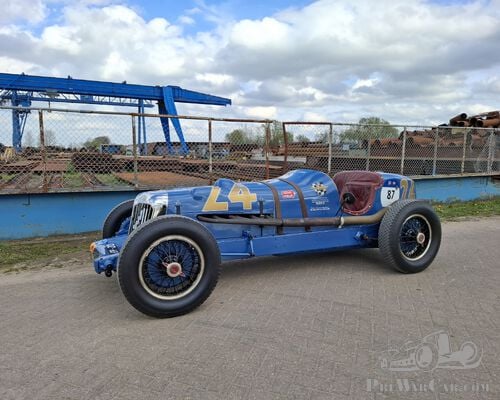
1932 - Graham " Lucenti " Indianapolis
Original participant of the 1932, 1934 and 1935 Indy 500. Best result: finishing 10th overall in the 1934 Indy 500 with driver “Herb” Ardinger...
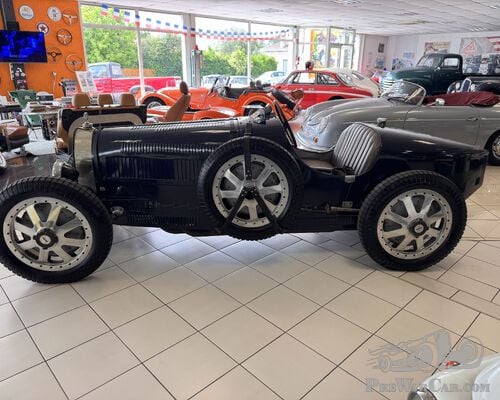
Bugatti 35 B Pur Sang
Bugatti 35 B Pur Sang,importée par un membre délégué de la FFVE il y’a une quinzaine d années.Participation à de nombreux Rallyes Bug..