The global magazine and marketplace for classic car enthusiasts, by enthusiasts.


Filter
Classic Mitchell, Motobloc for sale - Mitchell, Motobloc cars for sale
-

Mitchell Type R Raceabout 1911
A “racing” car from the early 1910s,Equipped with an impressive overhead valve engine that delivers 30 HP.The engine has a starter motor and starts easily.The gearbox has 3 gears and operates normally.This Mitchell rides well.The Mitchell was part of the famous Lindley Bothwell collection in Los Angeles (USA) f.. -
Mitchell Type R Raceabout 1911
A “racing” car from the early 1910s, Equipped with an impressive overhead valve engine that delivers 30 HP. The engine has a starter motor and starts easily. The gearbox has 3 gears and operates normally. This Mitchell rides well. The Mitchell was part of the famous Lindley Bo.. -
Motobloc Model O 1909 wanted
Technical information and contacts with other owners wanted for the Bordeaux-France made Motobloc-cars. We own a 1909 Model O in our museum, body by Audineau. Nous cherchons autres propriétaires des voitures Motobloc fabriquées à Bordeaux France. Nous avons un type O Coupé-Chauffeur-laundaulette par Audineau dans notre museé. Merci.CoridalementH..


Mitchell
US, 1903 – 1923
(1) Mitchell Motor Car Co, Racine, Wisc., 1903 – 1910
(2) Mitchell-Lewis Motor Co, Racine, Wisc., 1910 – 1916
(3) Mitchell Motors Co Inc, Racine, Wisc., 1916 – 1923
Mitchell and Lweis had been wagon builders since 1834, and their first Mitchell car was a light two-seater powered by a 7hp air-cooled 2-cylinder engine, using single chain drive, and priced at $1.200. In 1905 a 9hp engine was used on the Mitchell car, and air or water cooling was available. 4-cylinder engines of 18 and 30hp appeared in the 1906 Mitchell car range, and in 1907 shaft drive was employed on all Mitchell car models. Until 1910, 20 and 35hp fours were made, having pair-cast cylinders in 1910 when they were joined by a 50hp 6-cylinder Mitchell car. In 1913 a new range of T-head engines was introduced in a Mitchell car designed by René Petard and known as the ‘American-built French car’. A 40hp four and 50 and 60hp sixes were made in this Mitchell car range, which had high-cowled torpedo-style bodies and electric starters. Piston strokes were very long at 7 inches. At this time it was said that the Mitchell car company made 96% of all components. In 1916 a short-lived Mitchell 48hp V8 was made, and the following year the Mitchell car company settled down to making a range of conventional sixes of no great distinction. In 1920 a sloping radiator gave rise to the epithet, ‘the drunken Mitchell’ and this was hastily replaced by a vertical radiator for 1921. However, the company had lost a lot of money on their 1920 Mitchell car models, and few of the redesigned Mitchell cars were sold, as they lacked any distinctive qualities.
The 6-cylinder engines of the Mitchell car had acapacity of 4.7-litres. After production ceased in 1923, the Mitchell car factory was bought by Nash.
Source: Georgano, encyclopedia of motorcar; GNG
The information is written with the greatest of care. However, if you have any suggested amendments please contact us at office@prewarcar.com
Motobloc
France, 1902 – 1930
(1) G. Carde, Fils et Cie, Bordeaux
(2) SA Motobloc, Bordeaux
The Schaudel of 1898, which became the Motobloc car or Schaudel Motobloc car, featured unit construction of engine and gearbox, the earliest known instance of this form of design and the reason for the name Motobloc. Furthermore, the change-speed gears were actually in the crankcase. The power unit of the Schaudel Motobloc car was a transversely-mounted, inclined twin with chain drive. This odd little voiturette survived until 1904, after which it was perpetuated only as a van chassis, and a conventional vertical 4-cylinder engine – still made in unit with the gearbox – was substituted. This was a highly efficient unit that soon acquired overhead inlet valves, and it was also very smooth, thanks to the positioning of the flywheel between the two parts of cylinders. A mid-mounted flywheel was also used in the 6-cylinder engine of 1909 and on all Motobloc car models throughout the 1920s. Only fours were made up to 1927, ranging from 1.327cc to 3-litres in capacity. Independent front suspension was introduced on the Motobloc car in 1928, and the 1929/ 1930 range consisted of a Motobloc 9CV, 1.453cc four, and two sixes, a 10CV (1.683cc) and a 15CV (3.013cc).
Source: Georgano, encyclopedia of motorcar; TRN
The information is written with the greatest of care. However, if you have any suggested amendments please contact us at office@prewarcar.com


Featured
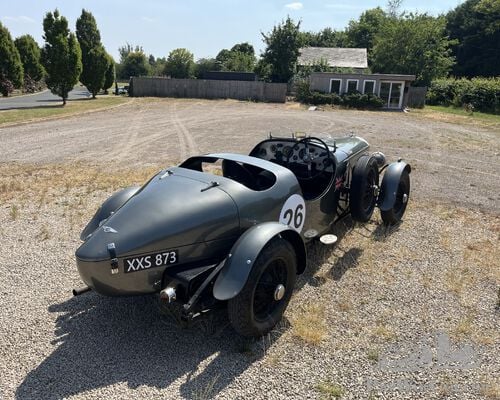
Derby Bentley Special 4-1/4
Sadly i am having to sell on my Bentley special ( Icarus) A great opportunity to be able to buy a Derby special to finish with your own touch..
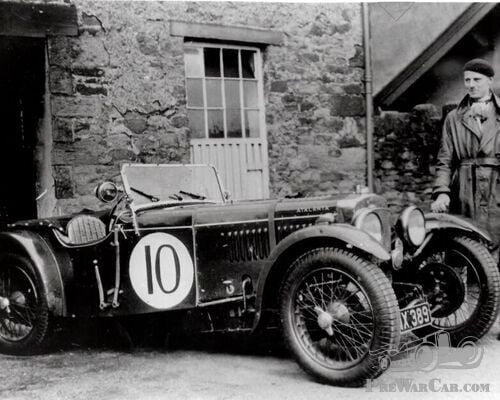
Fraser Nash TT Replica
AHX 389 ( chassis no. 2073, engine no. 10367).An important and correct short-chassis TT Replica with known history from new. Ex. H. P..
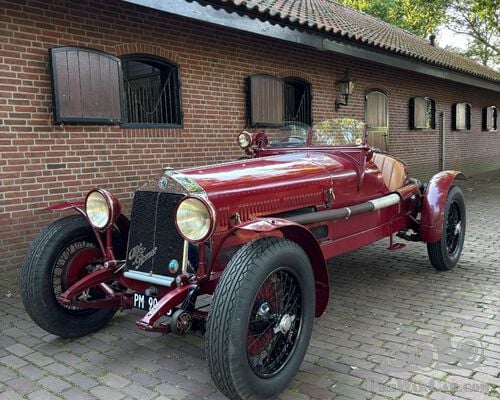
1930 Alfa Romeo 6C 1750 Spider
1930 Alfa Romeo 6C 1750 Spider with complete history from delivery to first owner in 1930 in Firenze till today with copy Libretto/license plate.