The global magazine and marketplace for classic car enthusiasts, by enthusiasts.


Filter
Classic Mercer, Morgan for sale - Mercer, Morgan cars for sale
-

Te koop Morgan Aero 1927
De Morgan Aero is geproduceerd van 1920 tot rond 1933. Dit voertuig met chassisnummer B718 is van 1927. De driewieler is in goed rijdbare en in originele staat, video’s hierover zijn het bewijs. De aandrijving (koppeling & bak) en dynamo zijn op kwalitatief gezien technisch verantwoorde wijze enigszins aangepast, waarmee de technische betrou.. -
1913 Mercer Model 35-J Raceabout | RM Sotheby's | The Monterey Auction
To Be OFFERED AT AUCTION at RM Sothebys' The Monterey Auction event, 13 - 15 August 2026. $2,750,000 - $3,500,000 USD America’s greatest and most legendary early sports carA genuine raceabout with exceptionally well-known historyFormerly owned by Paul Cadwell, Webster Knight, and Burt UpjohnDesirable late-produ..


Mercer
US, 1910 – 1925; 1931
(1) Mercer Autocar Co, Trenton, N.J., 1910
(2) Mercer Automobile Co, Trenton, N.J., 1910 – 1925
(3) Elcar Motor Car Co, Elkhart, Ind., 1931
The Mercer car was named after Mercer County, New Jersey, where the Mercer car was made. The most famous Mercer car of all was the Mercer Type 35 Runabout of 1911, designed by Finlay R. Porter. The specification of this Mercer car was ordinary enough, embracing at first a 5-litre, 4-cylinder, Continental-built T-head engine that produced a little over 10bhp per litre at a leisurely 1.700rpm. There were 3 forward speeds. The classic ‘body work’ consisted of a bolster tank, two bucket seats, and a monocle windscreen. However, in common with other speedsters, the Mercer car weighed very little and could pull a high axle ratio, which helped the Mercer car to attain a guaranteed 70mph. In 1912, by contrast, a few Mercer cars were made with the Owen Magnetic’s Entz transmission. A more efficient, L-head engine giving up to 89bhp at 3.000rpm according to tune was substituted in 1915. Also, the Mercer car had a 4-speed gearbox. This 22 Series was designed by E.H. Delling. However, some of the old Raceabout’s character was lost, in that the body of the new version had sides and a bench-type front seat, instead of the two stark bucket seats of the first type. Indeed, full touring Mercer cars were offered as well. The Mercer Series 4 and 5, beginning in 1919, had yet another designer in A.C. Schultz, and even had an electric starter. Nevertheless, these Mercer cars were still European in concept in that the engines had a fixed head and a magneto, and drove through a plate clutch and, however much they had compromised with popular taste, the Mercer car could still attain 75mph. A six with an ohv engine made by Rochester was introduced at the same time, and sixes alone were made from 1923. The old line of Mercer cars finally died two years later. However magnificent they may have been, the Mercer car bore too little relation to what the public wanted to survive. Production never exceeded 500 Mercer cars a year. An attempt was made by the Elcar Motor Co and the engine by Continental. The latter was a straight-8 providing 140bhp and 100mph.
Source: Georgano, encyclopedia of motorcar; TRN
The information is written with the greatest of care. However, if you have any suggested amendments please contact us at office@prewarcar.com
Morgan
GB, 1905 – 1906
Morgan and Co Ltd, Leighton Buzzard, Beds.
Made by a well-known firm of coachbuilders, the Morgan car was a conventional shaft-driven car with 5.8-litre T-head 4-cylinder Mutel engine, distinguished only by the Sparks-Boothby hydraulic clutch on the Morgan car, soon abandoned in favour of an ordinary leather cone. Only about five Morgan cars were made and their lack of success resulted in Morgan cars becoming Adler concessionaires in 1907, and abandoning motor manufacture.
GB, 1910 to date
Morgan Motor Co Ltd, Malvern Link, Worcs.
This Morgan car was the best-known, and best, of the British 3-wheelers that were popular while the horsepower tax gave the Morgan cars an advantage. H.F.S. Morgan’s tricycle was also the first of its type, this Morgan car going into production in 1910. At the front of a tubular chassis frame was an sv, air-cooled V-twin motor-cycle engine of 1.100cc by JAP, transversely mounted. Transmission of the Morgan car was by dog clutches and chains, providing two forward speeds. The steering was direct. The front wheels of the Morgan car, had independent front suspension, by sliding pillars and coil springs. There were two seats. A reasonable amount of power plus light weight meant an excellent performance of the Morgan cars. The Morgan car was safer than most 3-wheelers because its road-holding was above average. This recipe made the Morgan car popular with sportsmen, for whom the Morgan Grand Prix model was produced in 1914: the first catalogued competition Morgan car. Soon afterwards, an exiguous four-seater Morgan car, the forerunner of the Morgan Family model of the 1920s, was listed.
After World War 1, Morgan carscontinued to cater for all markets. Names changed, but the Morgan Sports or Morgan Standard model was the normal two-seater, also available in De Luxe form; the Morgan Family model was the more capacious type Morgan car, and the long-tailed Morgan Aero, later the Morgan Super Sports, was the Morgan car intended for serious speed work. Engines of Morgan cars were water- or air-cooled to choice, most being supplied by JAP, or by Blackburne in the case of the competition Morgan cars. From 1925 all the latter’s power units had overhead valves. By 1927 the Super Sports Morgan car could attain 80mph in standard trim, while the less sporting Morgan cars now had internal expanding front wheel brakes and electric starting. Geared-down steering and (if required) three forward speeds followed on Morgan cars in 1929. Even so, Morgan cars were losing customers to new, cheap sports cars such as the M-type MG. Three speeds and reverse in a normal gearbox (though still with chain final drive) were available from 1931 and standard on the Morgan car after 1932, and a modified 8hp Ford 4-cylinder engine could later be had in the Morgan car instead of the twin. Four years later the first 4-wheeled Morgan car was introduced, the excellent little Morgan 4/4. This Morgan car used an 1.122cc 4-cylinder Coventry-Climax engine with overhead inlet valves, developing 34bhp. The Morgan car was still light in weight, and retained the Morgan independent front suspension, so the performance and handling qualities of Morgan cars were well up to form. The Morgan car could attain 75mph. The twins were last catalogued in 1939.
Just before World War 2, a 1.267cc Standard 10hp engine with ohv head was substituted in the Morgan 4/4. When this was no longer available, from 1950, Morgan fitted a tuned Standard Vanguard unit in the Morgan car giving 70bhp. In this Morgan Plus Four, as the Morgan car was renamed, performance became still more lively, and when the 90bhp Triumph TR2 engine became available in 1954, maximum speed of the Morgan car rose to 100mph for the first time. With the advent of the Morgan Plus Four, there was no longer a small Morgan car, but this gap was made good in 1955, when the Morgan Series 2 4/4 arrived. This Morgan car used the very hard-wearing 1.172cc sv Ford Ten engine which had powered F4 Morgan. (The latter was the last 3-wheeler Morgan car, which had been made until 1950.) The result was a cheap, pleasant and reliable sports Morgan car of the old school. Later, the ohv Ford 105E engine was substituted. The latest version Morgan car had a 1.599cc 98bhp engine, a 4-speed all-synchromesh gearbox, front disc brakes, and the traditional Morgan suspension. The Morgan Plus Four kept pace with Triumph’s TR engine development, also acquiring disc brakes and, eventually, the 2.138cc 105bhp TR4 unit. A streamlined coupé, the Morgan Plus Four Plus of 1964, was a brief deviation from the classical Morgan car line which met with little approval and was discontinued after only 50 of these Morgan cars had been sold. When Triumph changed to a six during 1968, Morgan cars adopted a new engine for their bigger Morgan cars, and the Morgan Plus Four became the Morgan Plus Eight, powered by Rover’s 3 ½-litre 160bhp V8 and capable of 125mph. The 1973 versions of the Morgan car use the 4-speed all-synchromesh Rover gearbox in place of the Moss box previously fitted.
Source: Georgano, encyclopedia of motorcar; MCS, TRN
The information is written with the greatest of care. However, if you have any suggested amendments please contact us at office@prewarcar.com


Featured

Alfa 6C1750 Spider
Alfa 6C1750 Spider with complete history from delivery in 1930 to first owner in Firenze till today with copy Libretto/license plate all the years
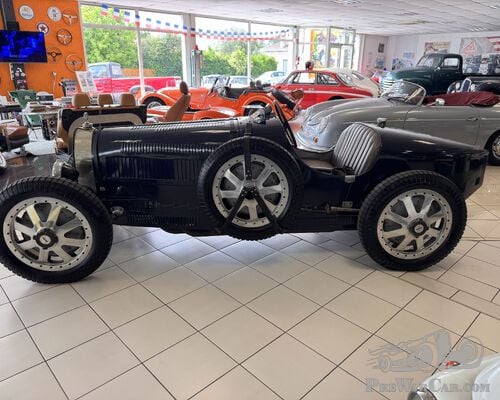
Bugatti 35 B Pur Sang
Bugatti 35 B Pur Sang,importée par un membre délégué de la FFVE il y’a une quinzaine d années.Participation à de nombreux Rallyes Bug..
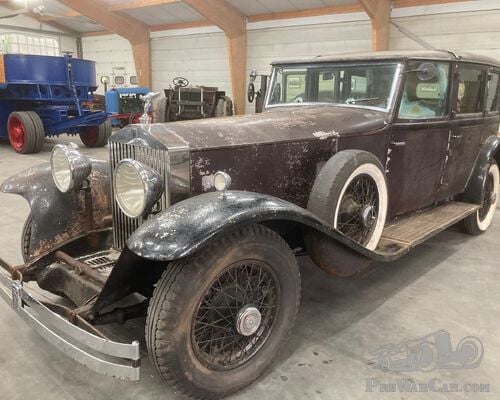
Rolls-Royce
Rolls-Royce Phantom ll chassisnummer 287 AJS. bouwjaar 1932, Links gestuurd, Brewster Keswick Sedance Towncar