The global magazine and marketplace for classic car enthusiasts, by enthusiasts.


Filter
Classic Adler, Morris for sale - Adler, Morris cars for sale
-

Adler 1913 Touring
Very unrestored . Is a real eye-catcher in the present condition. Previous owner has run it recently.Danish registration document .Price : please ask. -
Morris Eight Special Boattail – With an Eye for Detail
This 1936 Morris 8 Special "Spitzheck" (pointed-tail) is one of those vehicles that does not merely provide transportation, but tells a story. A story of a time when cars were still conceived, designed, and built by human hands.A time when every detail had a purpose, and driving pleasure came first.This Morris Special Spitzheck is .. -
Morris 8 1936 Rolling Chassis + Series E Engine + 4 speed Gearbox
Rare opportunity to acquire a Morris 8 1936 Rolling chassis to build a 1930s style special. Complete Rolling chassis includes following parts.Complete Chassis frame, Rear Axle with Crown Wheel & Pinion and Prop shaft, rear leaf springs, , front shock absorbers, 5 spoked 17” wheels, bishop cam Steering box (Overhauled), steering.. -
Morris Twenty Five. A very rare, large Morris.
This is your chance to acquire one of the few large Morris cars that were built. Connoisseurs know that Morris mainly built rather small to medium-sized vehicles. This Twenty-Five has the largest engine ever built by Morris in a passenger car, with a displacement of 3.5 litres and 6 cylinders. An incredible 10 litres of engine oil fit into the o.. -
Circa 1935 Morris Eight 2 door Saloon
Circa 1935 Morris Eight 2 door Saloon in approx 80 % restored condition but still dismantled.Carnumber 121660. All panels, guards, runningboards, doors etc were done ready to be painted. The whole upholstery was done as well. The chassis was fully restored as well as both axles, driveshaft and springs. The dashboard is also read..


Adler
D, 1900 – 1939
(1) Adler Fahrradwerke vorm. Heinrich Kleyer AG 1900 – 1906
(2) Adlerwerke vorm. Heinrich Kleyer AG, Frankfurt/Main 1906 – 1939
This well-known bicycle and typewriter firm had already built components for Benz as well as a few De Dion tricycles when their first car appeared in 1900. This closely resembled the contemporary Renault, with tubular frame, shaft drive, and front-mounted 400cc single-cylinder De Dion engine; suspension was full-elliptic all round and steering was by tiller, but both these archaisms had gone by 1901 when a bigger 510cc power unit was standardized. By 1902 the company were making their own engines, an 850cc single and a 1.7-litre twin, there were four forward speeds, and the lateral radiators continued the Renault idiom.
With the arrival of Edmund Rumpler in 1903 the Adler idiom crystallized, even if this experimental swing-axle suspension did not pass beyond the prototype stage. Characteristics of the new models were side valves in an L-head, dual ignition, pressed-steel frames, and rectangular radiators. Four cylinders were preferred, though singles were still offered in 1905, and twins as late as 1909. By 1905 there were 4-cylinder cars of 2.8-litres, 4-litres and 7.4-litres, this last figuring in Adler’s Herkomer Trophy entry, and attracting an order from Kaiser Wilhelm II in 1907. If the 1906 Kleinwagen, a 1.032cc aiv V-twin with water cooling and steel artillery wheels, marked a retrograde step, by 1907 the company had adopted the unit gearbox, and were experimenting with ioe engines, achieving a 3rd place in the Prince Henry trials. There were also some modest short-stroke fours. A 2-litre 8/15ps was followed a year later by the successful 1.555cc 7/15. This developed into the 1.8-litre 7/15, popular in England as the 12hp. These small Adlers had dual ignition, but foot accelerators were found only on the bigger cars as late as 1913. There was a fast 5.2-litre 76bhp ioe model for the 1910 Prince Henry Trials, and a smaller 3.2-litre version was offered to the public. It evolved into the 15/40 of 1913, with 3.8-litre and 69bhp, used as the basis for Adler’s unsuccessful 1914 T.T. racers. Their Knight-engined 1911 cars did not progress beyond the prototype stage, but very attractive was that year’s new model, the 1.3-litre K voiturette, initially with pair-cast cylinders, but offered in 1913 with Monobloc engine and a choice of side-by-side or tandem seats. Rear suspension was full-elliptic. It did 50mhp and 38mpg, and was well received by Britons, who bought it under the name of Morgan-Adler Carette. There were also some large sv fours, the 4.8-litre 19/45 appearing in 1911, followed in 1912 by a 7.8-litre 30/70, and in 1914 by a V-radiatored 9.1-litre monster, top of a nine-model range. Also new was an enlarged K, the 1.552cc KL with four-seater bodywork and semi-elliptic rear springs.
A selection of the more popular 1914 types reappeared in 1919, and even in 1922 a replacement for the KL, the 6/22PS, retained a fixed head and reverted to a separate gearbox. Adler’s first sixes came in 1925, these boasting alloy pistons, detachable heads, and front wheel brakes. The 10/50 had a 2.6-litre Monobloc engine, but the 4.7-litre 18/80 was of biblock type. Also new was an essay in the American idiom, Becker’s 1.550cc 4-cylinder Favorit. Three years later it had been joined by a 2.9-litre six and a 3.9-litre straight-8, both with hydraulic brakes, these being offered on an enlarged and modernized Favorit in 1929.
At the Geneva Show in 1932 Adler presented their new 1.5-litre Trumpf with front-wheel drive and independent wheel suspension, a design of H.G. Röhr. This first front-driven car was followed by the 1-litre Trumpf Junior, the 1.7-litre Trumpf and the 2-litre model. The competition versions of these models – very often fitted with aerodynamic bodies – were very successful in the years from their appearance to the outbreak of World War 2. Streamlined Trumpf and Trumpf Junior cars gained 22 international records in 1935 and 1936 on the Avus and the Darmstadt Autobahn. A win in the Leinster Trophy Race of 1934, a Team Prize at Spa in 1936 in the 2-litre class, a 2-litre class win and 6th place overall at Le Mans in 1937 were only a few of the victories. In 1937 Adler introduced a rear-wheel driven model again, the 2.5-litre with 6-cylinder 50bhp engine, aerodynamic body and swing axles. The sports version of this type developed 80bhp.
Production of private ceased in 1939. Some prototypes of the Trumpf Junior were produced after the war and were on show at the Hanover Fair 1948, but production was not taken up. Instead of this, production of motorcycles was resumed, lasting until 1957.
Source: Georgano, encyclopedia of motorcar; HON
The information is written with the greatest of care. However, if you have any suggested amendments please contact us at office@prewarcar.com
Morris
GB, 1913 to date
(1) W.R.M. Motors Ltd, Cowley, Oxford, 1913 – 1919
(2) Morris Motors Ltd, Cowley, Oxford, 1919 – 1970
(3) Austin-Morris Division, British Leyland Motor Corp Ltd, Cowley, Oxford, 1970 to date
W.R. Morris (later Lord Nuffield), an Oxford cycle and motor agent, launched his Morris-Oxford light car in 1913. This Morris car was made from proprietary parts, the engine being a 1-litre T-head four by White and Poppe. At £175 the Morris car was one of the best of the true light cars (as opposed to cyclecars) and over 1.000 Morris cars had been sold by the end of 1914. A larger model, the famous Morris Cowley, arrived on the scene in 1915; this Morris car was assembled from American components, the engine being by Continental. After World War 1 Morris cars marketed two 1½-litre L-head sv fours, with power units by Hotchkiss of Coventry; the Morris Cowley differed from the Morris Oxford mainly in its more austere equipment and the absence of a starter. In an inflationary climate, Morris cars was brave enough to reduce the prices of its Morris cars(a Morris Cowley two-seater cost £465 in October 1920, £299.10s a year later, and £225 in October 1922) and ensured a steady flow of Morris carproduction by acquiring his suppliers, such as Hotchkiss, Wrigley (transmissions) and Hollick and Pratt (bodies).
The Morris ‘bullnoses’ were soon best-sellers backed by a nation-wide service organization of Morris cars, and in 1925 Morris outsold all his competitors with 54.000 Morris cars. From 1924 to 1926 the staple Morris cars were the 1½-litre Morris Cowley and the 1.8-litre Morris Oxford, both with 3-speed gearboxes and the wet-plate clutches which persisted on some Morris carmodels right up to 1939. The Morris Oxford acquired front wheel brakes in 1925, and they were available as an option on Morris Cowleys a year later. 1927 Morris cars produced the flat radiator and also a venture into the export market with the unsuccessful Empire Oxford Morris car of 2½-litres, which had a 4-speed box and worm drive. Equally unsuccessful was a plan to market Gallicized Morris cars built in the Léon Bollée plant at Le Mans.
Meanwhile Cecil Kimber had produced the first of the Morris-Oxford-based MG sports cars, and a new name had been born. Morris had made a few six-cylinder Morris cars in the early 1920s, but his first serious attempt in this direction with Morris cars was a 2½-litre ohc model for 1928, the engine of this Morris car inspired by the Wolseley 16/45, a make which had come under Morris control the previous year. 1929 saw another ohc Morris car, the 847cc Morris Minor at £125. Never a best-seller, the Morris car none the less served as the basis for MG’s Midget. The 1930 6-cylinder Morris cars had hydraulic brakes, extended down the range until they were universal by 1934 on all Morris cars, and in 1931 Morris managed to offer a simplified sv two-seater version of the Morris Minor for £100. The early 1930s proved very difficult for the Morris car company, which had no obvious best-seller and too many different models of Morris cars. Sliding roofs and electric fuel pumps by the Morris-owned S.U. concern were innovations for 1932 and 1933 Morris cars pioneered the semaphore-type traffic indicator in Britain. That year Morris cars sv 1.3-litre Morris Ten-Four came out as an answer to Austin’s Ten and Hillman’s Minx. All 1934 Morris cars had synchromesh and the bigger sixes the added refinement of a free wheel.
The best-seller Morris car came at last in 1935 with the 918cc sv Series I Morris Eight, which retailed at £132.10s for a fully-equipped Morris car saloon and helped reach their first million Morris cars by the summer of 1939. In a bigger category were the Series II Morris carmodels with modern styling, 3-speed gearboxes, and built-in jacking systems, ranging from a revised Morris Ten-Four up to a 3½-litre 6-cylinder Morris Twenty-Five at £280. These Morris cars were contemporary with the Series I, though introduced some months after that Morris car. All 1938 Morris cars except for the Morris Eight had push-rod ohv engines (already applied to Wolseley and MG). Later that year Riley was absorbed into the Nuffield Morris car empire. Two 1939 winners were a revised Series E 8hp with a 4-speed gearbox and headlamps faired into the wings of the Morris car, and the 1.140cc ohv Series M Ten, which introduced integral construction to Cowley and this Morris car was made after World War 2 by Hindusthan in India.
Only the 8 and 10 Morris cars were made in the first post-war years, the first really new Morris car for ten years being the 1949 Morris cars designed by Alex Issigonis. Of these the MM series Morris Minor used the old 8hp sv engine, but boasted integral construction, rack-and-pinion steering and torsion-bar independent front suspension and set a new standard in popular car handling. A million of the basic design Morris cars had been sold by January 1961. Its companion Morris carmodels, also chassisless, and with independent front suspension were a new sv 1½-litre Morris Oxford and the 2.2-litre ohc Morris MS Type Six.
The amalgamation of Nuffield and Austin to form the British Motor Corporation in 1952 resulted in a gradual process of rationalization. First the Morris Minor went over to Austin’s 803cc ohv A30 engine in 1953. The Series II Oxford Morris car and its less powerful companion, the Morris Cowley, of 1954 had Morris hulls, but their engines were also ohv Austins. In 1955 the Morris carrange was completed by a new Isis using the 2.6-litre BMC 6-cylinder unit – this Morris car was discontinued in 1958. In the late 1950s some Morris cars were made and sold in Australia under the Morris car name which were in fact more closely akin to other makes in the BMC group. The 6-cylinder Morris Marshall was really an Austin A105, while both the Major and its Austin counterpart, the Lancer, were based on the Wolseley 1500.
With the arrival of the Farina-styled 1½-litre Morris car saloons in 1959, differences between Austin and Morris cars had been reduced to house colours and radiator emblems. The front-wheel-drive Mini (1960) was shared between the two makes and though its bigger stablemate, the 1100 of 1963 with Hydrolastic suspension, was initially a Nuffield monopoly Morris car, the inevitable Austin variant followed a year later. In the case of the third front-wheel-drive model, the 1800, Austin were ahead of Morris cars in introducing it by nearly eighteen months. The 1968 Morris car range comprised the fwd Mini, 1100/1300, and 1800 as well as the conventional 1.600cc Oxford and the indestructible Morris Minor 1000, now with 1.098cc engine and still selling close on 60.000 Morris cars a year. This sole survivor of independent Morris car design did not disappear until the end of 1970. Minis became a separate make that year. From 1971 Morris car versions of the 1100 and 1300 disappeared; the name was reserved for the Marina, an orthodox rear-wheel-driven family saloon with Minor 1000 front suspension, semi-elliptics at the rear, and drum brakes on the simpler variant Morris cars. Push-rod 1.300cc and 1.800cc B.L.M.C. 4-cylinder engines were used, and the original 2-door coupé and 4-door saloon were joined by a station wagon Morris car in 1973. The largest fwd cars were still available with Morris car badges – there was a version of the 6-cylinder 2200 in 1972.
Source: Georgano, encyclopedia of motorcar; MCS
The information is written with the greatest of care. However, if you have any suggested amendments please contact us at office@prewarcar.com


Featured
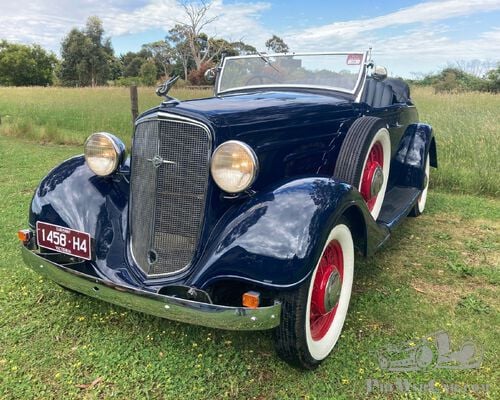
1934 Chevrolet Standard Roadster
1934 Chevrolet Standard Roadster This vehicle was delivered to Australia from Chevrolet and the body was manufactured by Holden Body Works w..
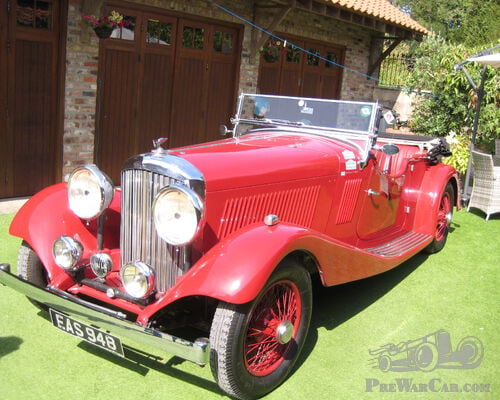
1935 Bentley 3.5 ltr. VDP 4str. Tourer
Chassis B 123 CW was first registered 14th March 1935, and in the late eighties underwent a " body-off" restoration and fitted with VANDEN PLAS
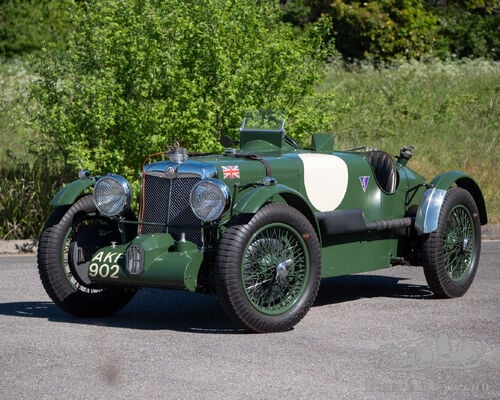
K3 Replica on KN Chassis
"The K3 Magnette must rank in the history books as the most famous and successful of all the record breaking MGs. With only 33 examples produced durin..