The global magazine and marketplace for classic car enthusiasts, by enthusiasts.


Filter
Classic Alfa Romeo, Morris for sale - Alfa Romeo, Morris cars for sale
-

1930 Alfa Romeo 6C 1750 Turismo
Technical Specification Mark & Model: Alfa Romeo 6C 1750 TurismoYear: 1930Registration plate: Guernsey registeredChassis Number: 0412325Engine Number: 0412352Engine Capacity: 1752 ccTransmissions: 4-speed manualBody style: 2-door tourerInterior color: RedExt.. -
1931 Alfa Romeo 6C 1750 James Young DHC Turismo
This attractive 1931 Alfa Romeo 6C, chassis no. 0412364, has remarkably been in current ownership since 1958, an impressive 67 years! It is in superb running order with a full engine rebuild (including the fitting of new conrods) being completed by ourselves over the past two years. This is a matching numbers car, still carrying its original and.. -
1933 Alfa Romeo 8c Monza
1933 Alfa Romeo 8c Monza Chassis Number: TBARegistration Number: TBA An original matching numbers Alfa 8c Monza with a newer Monza style body on the original chassis shortened some years ago by noted expert Paul Grist. A well known & nicely patinated car that absolutely looks the part & goes equally wel.. -
1937 Alfa Romeo 2300B Pescara
This ultra rare 1937 6C2300B Pescara was imported into the UK in 1961 from Tripoli, and bought by its previous owner in auction in 1973a rare matching numbers Pescara model with its original old log book and V5 registration. The original suspension components are stamped with PE (for Pescara) following by the correct part nu.. -
1939 Alfa Romeo 6C2500
This is a rare pre-war 6C2500 project, one of the first 6C2500 models to be built before Italy was at war.The rolling chassis is complete and partially reconditioned. The engine is the original matching number to the chassis, having had a full reconditioning recently.The car is fitted with a one off Pininfarina cabriolet body orig.. -
1924 Alfa Romeo RM Sport Zagato
This wonderful and rare early Alfa Romeo was one of the first Alfa cars bodies by Zagato. Mechanically restored several years ago, the car is in very good usable condition, keeping a beautiful original look.Please message or phone for more information. -
1938 Morris 12/4 Series III | Brightwells | Auction Ends: Wed 05th Aug
Produced for only a short period before the outbreak of the Second World War brought civilian car production to a halt; driven to the sale; powered by the model's 1,550cc overhead-valve four-cylinder engine with cross-flow cylinder head, driving through a four-speed gearbox with synchromesh on the upper three ratios Few pre-.. -
1936 Morris 8 Tourer | Brightwells | Auction Ends: Wed 05th Aug
Beautifully presented and full of period charm; the engine and gearbox have been replaced with a later Series E unit incorporating the desirable four-speed gearbox; particularly attractive interior which presents well and adds greatly to the car's overall appeal; a highly usable pre-war convertible Few pre-war cars offer suc.. -
1934 Morris 10/6 Saloon | Brightwells | Auction Ends: Wed 05th Aug
Charming vintage saloon; resprayed body; out of long tern ownership before being purchased through a deceased estate earlier on this year Elegant, practical and dependable, the Morris 10/6 was one of Britain's most popular family cars of the early 1930s. Powered by Morris's smooth six-cylinder engine, it offered noticeably m.. -
1929 Alfa Romeo 6C 1750 Super Sport
Created by legendary engineer Vittorio Jano, the Alfa Romeo 6C is rightly regarded as one of the greatest automobiles of all time. Launched in 1925 with an engine capacity of 1500cc the new model achieved many successes in top-flight motorsport. With the introduction of the 3rd Series in 1929 the engine was enlarged to 1750cc and the Super Sport..


Alfa Romeo
Italy, 1910 to date
(1) A.L.F.A. (Anonima Lombardo Fabbrica Automobili), Milan, 1910 – 1914
(2) SA Italiana Ing. Nicola Romeo & C, Milan, 1914 – 1930
(3) SA Alfa Romeo, Milan, 1930 – 1942
(4) Alfa Romeo SpA, Milan, 1942 to date
(5) Alfa Romeo SpA, Pomigliano d’Arco, Naples, 1971 to date
A.L.F.A. (Anonima Lombardo Fabbrica Automobili) was founded in 1909 by Cav. Ugo Stella, formerly managing director of the Società Italiana Automobili Darracq, to manufacture a completely new range of Italian cars at Portello on the outskirts of Milan where, since 1906, small French Darracq cars had been assembled.
By 1910 the last Darracq had left the factory, and production commenced of a sturdy range of Alfa cars designed from scratch by Cav. Giuseppe Merosi, a native of Piacenza, who had been Chief Technician with Bianchi in Milan.
The first Alfas were a 24hp 4.1-litre car, later known as the 20/30hp, and a 12hp, 2.4-litre, which became the 15/20hp. Both were well made, with side-valve 4-cylinder monobloc engines and shaft drive. In 1913 the sports 6.1-litre 40/60hp appeared with push-rod overhead valves operated by two camshafts in the crankcase. A one-off 4½-litre Grand Prix car was built in 1914 with a 4-cylinder twin ohc engine, but it never ran in international races.
In 1915 the factory was taken over by the industrialist Nicola Romeo, and after World War 1 the pre-war models were marketed as Alfa Romeos. The 20/30 ES Sport of 1921-22 was successful in Italian races, as was a special racing 40/60 driven by Campari, which scored the firm’s first victory at Mugello in 1920. A 6-cylinder luxury side-valve car called the G1 was not a success, but Merosi’s best remembered designs followed it; the 3-litre 6-cylinder push-rod ohv touring, sports and racing RL series cars which first appeared in 1921 and went into production in 1922. A racing version won the 1923 Targa Florio. The similar 4-cylinder 2-litre type RM was marketed in 1923-26, but the pointed radiator sports 22/90hp RLSS and the touring 21/70hp RLT, which had a flat radiator, were sold until 1927.
In 1924 Alfa Romeo won the very first Grande Epreuve they ever entered, an unparalleled achievement, when Campari was victorious in the 1924 French Grand Prix at Lyons in the new straight-eight supercharged P2 car, designed by Vittorio Jano, who came from Fiat. In 1925 Alfa Romeo were declared World Champions.
Jano took over from Merosi in 1926 and his first touring and sports car designs soon became world famous, these having single and twin overhead camshaft 6-cylinder engines, first in 1.500cc and then in 1.750cc form. When supercharged, these cars won all the great sports car races in the period 1928-1930, with the exception of Le Mans.
The latter omission was rectified from 1931 to 1934 when victory at Le Mans each year went to Jano’s next sports car design, which had a 2.3-litre straight-eight supercharged engine with a central drive to the overhead camshafts. This engine also powered the successful Grand Prix Alfa Romeo of 1931, known as the Alfa Romeo‘Monza’ model and raced for the factory by Scuderia Ferrari. In 1932 this engine, in 2.65-litre form, powered the Alfa Romeo Type B P3 Monoposte G.P. car, which proved virtually unbeatable and bore affinities with the Alfa Romeo Type A racing car of 1931 powered by two 1.750cc engines side by side. In 1933 Alfa Romeo came under State ownership and the Alfa Romeo Monopostos were withdrawn from racing until right at the end of the season. Ferrari continued F.O. racing with Alfa Romeo Monzas enlarged to 2.6 litres.
The Alfa Romeo Monopostos in 2.9-litre form were not powerful enough against the Mercedes and Auto Unions, although Chiron won the 1934 French G.P. for Alfa Romeo, whilst Nuvolari quite unexpectedly won the 1935 German G.P. in an Alfa Romeo 3.8-litre Monoposto fitted with Dubonnet independent front suspension. From 1936 to 1939 Alfa Romeo fielded independently sprung straight-eight, V-12, and V-16 cars in G.P. racing, but against the German cars only isolated victories in smaller races were attained, usually through the skill of Nuvolari. In 1935 Ferrari built two big bi-motore racing cars, with one Alfa Romeo P3 engine under the bonnet and another in the tail.
Some 2.9 P3 engines were put into all-independently sprung chassis in 1937-1939 to make expensive but exceedingly fast prestige sports cars. In sportscar racing Alfa Romeos won every Mille Miglia from 1928 to 1938 inclusive, except in 1931.
In 1934 Jano’s unsupercharged 6-cylinder twin ohc 2.3-litre car replaced the 1750 and 8C 2300, and, developed by Bruno Treviso, it later became the 2500 of 1939 and the early post-war years. It was recplaced in 1950 by the 4-cylinder 1900. This marked an important change in Alfa Romeo policy. Previously the touring Alfas had been expensive and semi-bespoke machines, whereas the 1900 and its successors were unitary construction saloons whose production has risen to about 30.000 units per annum at the present time. In 1954 was introduced the famous 1300ccc Giuletta, designed by Orazio Satta. From it were derived the successful 1600 Giulia and the 6-cylinder 2600, introduces in 1962. For 1968 the 1600s were replaced by the 1750 series, actually 1.779cc, available as a saloon(Berlina), coupé (1750 GT Veloce) or open sports (1750 Spider Veloce).
The remarkable Colombo-designed supercharged 1½-litre 8-cylinder Monoposto known as the Alfa Romeo ‘158’ was introduces in 1938 for voiturette racing. After the war it was eligible for the Grand Prix formula, and by remaining unbeaten in Grandes Epreuves in 1946-1948 and 1950 until mid-1951, it set up a record unequalled by any other G.P. design. In 1946 Alfa Romeo took the first three places in the G.P. des Nations at Geneva, and repeated this finishing order in 1947 in the Italian G.P., the G.P. d’Europe at Spa and the Swiss G.P.. The most successful drivers during these years were Jean-Pierre Wimille, Achille Varzi and Count Felice Trossi, but the deaths of all three took place before the 1949 season and Alfa Romeo withdrew from racing as they had done in 1933. The Alfa Romeo 158s returned to the tracks in 1950 with Giuseppe Farina and Juan Manuel Fangio as their star drivers, and after victories in every race the cars ran in, Farina was declared World Champion. In 1951 Fangio was World Champion on the 400bhp Alfa Romeo Type 159, though the cars had to concede their first defeat, by and unblown 4½-litre Ferrari.
At the end of the season Alfa Romeo withdrew from G.P. racing, and although the works Disco Volante sports racing 2½- and 3-litre cars of 1952-1953 were generally unlucky in racing, the Alfa Romeo Giulias have had G.T. successes in recent years.
Competition activities were resumed in 1967 with the Alfa Romeo T33, a rear-engined 2-litre 4ohc V8 with hemispherical combustion chambers, fuel injection, alternator ignition, and a 6-speed all-synchromesh gearbox. Until 1969 a tubular trellis frame was used, replaced for 1970 by an orthodox platform, and the disc brakes were mounted inboard. This Alfa Romeo T33 was catalogued at 9.750.000 lire but was primarily used by the Autodelta racing team; later cars had 2½-litre and 3-litre engines. In 1971 Alfa Romeos won the BOAC 1.000 Kilometers, the Targa Florio and the Watkins Glen 6 hours, but in 1972 they were powerless against the all-conquering Ferraris. In the touring-car range, the six disappeared in 1969, and in 1970 the fuel-injected dry-sump 2.6-litre V8 engine was applied to a conventional front-engined coupé, the Alfa Romeo Montreal.
Other new 1972 models were the Alfa Romeo 2000, an updated 1750, and the 1.750cc Alfa Romeo Alfetta saloon with 122bhp engine, a 5-speed De Dion transaxle, double wishbone independent front suspension, and inboard disc brakes. It was the angular rear-end treatment of Alfa Romeo’s new economy saloon. The Alfasud, made in the Naples factory opened during 1971. This car had a 1.186cc flat-4 engine with cogged-belt drive for its twin overhead camshafts, hypoid bevel drive to the front wheel, all-disc brakes, and four forward speeds.
Source: Georgano, encyclopedia of motorcar; PMAH
The information is written with the greatest of care. However, if you have any suggested amendments please contact us at office@prewarcar.com
Morris
GB, 1913 to date
(1) W.R.M. Motors Ltd, Cowley, Oxford, 1913 – 1919
(2) Morris Motors Ltd, Cowley, Oxford, 1919 – 1970
(3) Austin-Morris Division, British Leyland Motor Corp Ltd, Cowley, Oxford, 1970 to date
W.R. Morris (later Lord Nuffield), an Oxford cycle and motor agent, launched his Morris-Oxford light car in 1913. This Morris car was made from proprietary parts, the engine being a 1-litre T-head four by White and Poppe. At £175 the Morris car was one of the best of the true light cars (as opposed to cyclecars) and over 1.000 Morris cars had been sold by the end of 1914. A larger model, the famous Morris Cowley, arrived on the scene in 1915; this Morris car was assembled from American components, the engine being by Continental. After World War 1 Morris cars marketed two 1½-litre L-head sv fours, with power units by Hotchkiss of Coventry; the Morris Cowley differed from the Morris Oxford mainly in its more austere equipment and the absence of a starter. In an inflationary climate, Morris cars was brave enough to reduce the prices of its Morris cars(a Morris Cowley two-seater cost £465 in October 1920, £299.10s a year later, and £225 in October 1922) and ensured a steady flow of Morris carproduction by acquiring his suppliers, such as Hotchkiss, Wrigley (transmissions) and Hollick and Pratt (bodies).
The Morris ‘bullnoses’ were soon best-sellers backed by a nation-wide service organization of Morris cars, and in 1925 Morris outsold all his competitors with 54.000 Morris cars. From 1924 to 1926 the staple Morris cars were the 1½-litre Morris Cowley and the 1.8-litre Morris Oxford, both with 3-speed gearboxes and the wet-plate clutches which persisted on some Morris carmodels right up to 1939. The Morris Oxford acquired front wheel brakes in 1925, and they were available as an option on Morris Cowleys a year later. 1927 Morris cars produced the flat radiator and also a venture into the export market with the unsuccessful Empire Oxford Morris car of 2½-litres, which had a 4-speed box and worm drive. Equally unsuccessful was a plan to market Gallicized Morris cars built in the Léon Bollée plant at Le Mans.
Meanwhile Cecil Kimber had produced the first of the Morris-Oxford-based MG sports cars, and a new name had been born. Morris had made a few six-cylinder Morris cars in the early 1920s, but his first serious attempt in this direction with Morris cars was a 2½-litre ohc model for 1928, the engine of this Morris car inspired by the Wolseley 16/45, a make which had come under Morris control the previous year. 1929 saw another ohc Morris car, the 847cc Morris Minor at £125. Never a best-seller, the Morris car none the less served as the basis for MG’s Midget. The 1930 6-cylinder Morris cars had hydraulic brakes, extended down the range until they were universal by 1934 on all Morris cars, and in 1931 Morris managed to offer a simplified sv two-seater version of the Morris Minor for £100. The early 1930s proved very difficult for the Morris car company, which had no obvious best-seller and too many different models of Morris cars. Sliding roofs and electric fuel pumps by the Morris-owned S.U. concern were innovations for 1932 and 1933 Morris cars pioneered the semaphore-type traffic indicator in Britain. That year Morris cars sv 1.3-litre Morris Ten-Four came out as an answer to Austin’s Ten and Hillman’s Minx. All 1934 Morris cars had synchromesh and the bigger sixes the added refinement of a free wheel.
The best-seller Morris car came at last in 1935 with the 918cc sv Series I Morris Eight, which retailed at £132.10s for a fully-equipped Morris car saloon and helped reach their first million Morris cars by the summer of 1939. In a bigger category were the Series II Morris carmodels with modern styling, 3-speed gearboxes, and built-in jacking systems, ranging from a revised Morris Ten-Four up to a 3½-litre 6-cylinder Morris Twenty-Five at £280. These Morris cars were contemporary with the Series I, though introduced some months after that Morris car. All 1938 Morris cars except for the Morris Eight had push-rod ohv engines (already applied to Wolseley and MG). Later that year Riley was absorbed into the Nuffield Morris car empire. Two 1939 winners were a revised Series E 8hp with a 4-speed gearbox and headlamps faired into the wings of the Morris car, and the 1.140cc ohv Series M Ten, which introduced integral construction to Cowley and this Morris car was made after World War 2 by Hindusthan in India.
Only the 8 and 10 Morris cars were made in the first post-war years, the first really new Morris car for ten years being the 1949 Morris cars designed by Alex Issigonis. Of these the MM series Morris Minor used the old 8hp sv engine, but boasted integral construction, rack-and-pinion steering and torsion-bar independent front suspension and set a new standard in popular car handling. A million of the basic design Morris cars had been sold by January 1961. Its companion Morris carmodels, also chassisless, and with independent front suspension were a new sv 1½-litre Morris Oxford and the 2.2-litre ohc Morris MS Type Six.
The amalgamation of Nuffield and Austin to form the British Motor Corporation in 1952 resulted in a gradual process of rationalization. First the Morris Minor went over to Austin’s 803cc ohv A30 engine in 1953. The Series II Oxford Morris car and its less powerful companion, the Morris Cowley, of 1954 had Morris hulls, but their engines were also ohv Austins. In 1955 the Morris carrange was completed by a new Isis using the 2.6-litre BMC 6-cylinder unit – this Morris car was discontinued in 1958. In the late 1950s some Morris cars were made and sold in Australia under the Morris car name which were in fact more closely akin to other makes in the BMC group. The 6-cylinder Morris Marshall was really an Austin A105, while both the Major and its Austin counterpart, the Lancer, were based on the Wolseley 1500.
With the arrival of the Farina-styled 1½-litre Morris car saloons in 1959, differences between Austin and Morris cars had been reduced to house colours and radiator emblems. The front-wheel-drive Mini (1960) was shared between the two makes and though its bigger stablemate, the 1100 of 1963 with Hydrolastic suspension, was initially a Nuffield monopoly Morris car, the inevitable Austin variant followed a year later. In the case of the third front-wheel-drive model, the 1800, Austin were ahead of Morris cars in introducing it by nearly eighteen months. The 1968 Morris car range comprised the fwd Mini, 1100/1300, and 1800 as well as the conventional 1.600cc Oxford and the indestructible Morris Minor 1000, now with 1.098cc engine and still selling close on 60.000 Morris cars a year. This sole survivor of independent Morris car design did not disappear until the end of 1970. Minis became a separate make that year. From 1971 Morris car versions of the 1100 and 1300 disappeared; the name was reserved for the Marina, an orthodox rear-wheel-driven family saloon with Minor 1000 front suspension, semi-elliptics at the rear, and drum brakes on the simpler variant Morris cars. Push-rod 1.300cc and 1.800cc B.L.M.C. 4-cylinder engines were used, and the original 2-door coupé and 4-door saloon were joined by a station wagon Morris car in 1973. The largest fwd cars were still available with Morris car badges – there was a version of the 6-cylinder 2200 in 1972.
Source: Georgano, encyclopedia of motorcar; MCS
The information is written with the greatest of care. However, if you have any suggested amendments please contact us at office@prewarcar.com


Featured
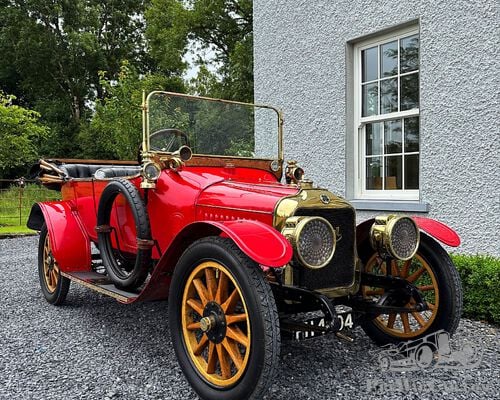
1914 Brasier
1914 Brasier Tourer 9ABrasier were a French manufacturer who were in business from 1901 until 1930, when the company became victim of the gr..
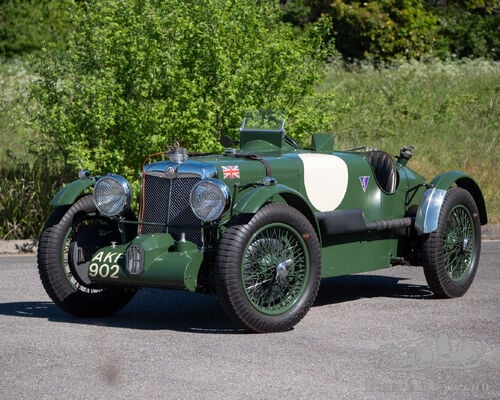
K3 Replica on KN Chassis
"The K3 Magnette must rank in the history books as the most famous and successful of all the record breaking MGs. With only 33 examples produced durin..
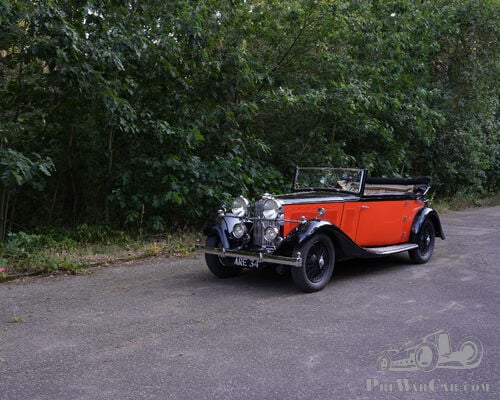
1934 Talbot AV105 Three Position Drophead Coupé
Registration no. ARE 34Chassis no. 35488 Much supporting paperworkRestored exampleVery usa..