The global magazine and marketplace for classic car enthusiasts, by enthusiasts.


Filter
Classic Packard, Morris for sale - Packard, Morris cars for sale
-

1930 Packard 745 Deluxe Eight Roadster | RM Sotheby's | Private Sales
Asking | $550,000 USD A superb example of one of the most desirable Classic PackardsReportedly purchased new by Philadelphia sporting icon John ShibeFormerly owned by noted collectors Mark Smith, Robert Thayer, and Joseph Cassini IIIAward-winning restoration by RM Auto Restoration; extensive cosmetic freshening .. -
1928 Packard 533 Golfers Coupe
1928 Packard 533 Golfers Coupe Chassis number 144148RRegistration number: UC1064 Vintage and Prestige Fine Motor Cars are proud to be offering this 1928 Packard 533 Golfers Coupe for sale. A spectacular Packard in mint order throughout. This right hand drive example was sold new to the UK in 1928 and has remained here since... -
Sehr authentischer Packard Single Six 133 von 1922
Wir verkaufen unseren Packard Single Six, der sich seit mehr als 30 Jahren in unserer Familie befindet. Der Packard gehört zu der Baureihe, die ab 1922 mit 6 Zyl., 4.400 ccm, 40 kW und einem Radstand von 3.378 mm ausgestattet wurde. Das Fahrzeug verfügt über 7 Sitze (incl. 2 Notsitze). Das Dach läßt sich zusammenfalten und die Seitenteile abnehm.. -
1 OF 1 BARKER COACHWORK, EXTRAORDINARY HISTORY!
INTRODUCTION:*CCCA Senior First Prize*Packard Automobile Classics National 1st Place*Pebble Beach Concours D'Elegance Best in Class*Shown in multiple concours events*Featured in 2 books In 1938 Harry Hatch, the man behind one of the largest and most successful distilleries in the world: Hiram Walk.. -
1929 Packard 640 Sport Phaeton
Elite definition: A select group that is superior to the rest of a group. Our Elite Collection is comprised of automobiles we consider to be superior in terms of significance, desirability, rarity, quality and beauty. These are cars that only a select group of privileged people will ever have the good fortune of owning. As care tak.. -
1936 Packard 1404 Super 8 956 Club Sedan
1936 Packard 1404 Super 8 956 Club Sedan Chassis Number: 757703 Registration Number: YXS196 Imported to the Uk a decade or so ago as a freshly restored mint car; since then the car has been sparingly but regularly used & is in really really fine condition. -
1940 Packard One Twenty Convertible Victoria by Darrin | The Quail Auction 2026
Please expect delays in obtaining the Lot's title beyond standard processing time as it has a Title in Transit or is subject to a loan, which will be satisfied with sale proceeds. Vehicle No. 1801-2025 Engine No. C317807C When Packard elected to officially offer Howard "Dutch" Darrin's designs as factory coachwork in its 1940 ca.. -
1938 Morris 12/4 Series III | Brightwells | Auction Ends: Wed 05th Aug
Produced for only a short period before the outbreak of the Second World War brought civilian car production to a halt; driven to the sale; powered by the model's 1,550cc overhead-valve four-cylinder engine with cross-flow cylinder head, driving through a four-speed gearbox with synchromesh on the upper three ratios Few pre-.. -
1936 Morris 8 Tourer | Brightwells | Auction Ends: Wed 05th Aug
Beautifully presented and full of period charm; the engine and gearbox have been replaced with a later Series E unit incorporating the desirable four-speed gearbox; particularly attractive interior which presents well and adds greatly to the car's overall appeal; a highly usable pre-war convertible Few pre-war cars offer suc.. -
1934 Morris 10/6 Saloon | Brightwells | Auction Ends: Wed 05th Aug
Charming vintage saloon; resprayed body; out of long tern ownership before being purchased through a deceased estate earlier on this year Elegant, practical and dependable, the Morris 10/6 was one of Britain's most popular family cars of the early 1930s. Powered by Morris's smooth six-cylinder engine, it offered noticeably m..


Packard
US, 1899 – 1958
(1) New York & Ohio Automobile Co, Warren, Ohio, 1899 – 1901
(2) Ohio Automobile Co, Warren, Ohio, 1901 – 1902
(3) Packard Motor Car Co, Warren, Ohio, 1902 – 1903
(4) Packard Motor Car Co, Detroit, Mich., 1903 – 1955
(5) Studebaker – Packard Corp, Detroit, Mich., 1955 – 1958
The brothers J.W. and W.D. Packard bought a Winton in 1898 and determined to improve upon it. The result was the first 12hp Packard car of 1899. This Packard car followed traditional early-American lines with a single horizontal cylinder, central chain drive, buggy styling and wire wheels, but the Packard car was more advanced than its competitors in having a 3-speed and reverse gearbox and automatic spark advance. This gave way to the wheel-steered Model C Packard car, which proved capable of 40mph. An even more powerful Packard car, a single old for $3.000 in 1903 and on one of these Fetch and Krarup Packard cars successfully drove from San Francisco to New York in 61 days. In the same year a very big Packard car four of over 12 litres’ capacity was designed on European lines by Charles Schmidt, late of Mors. This Packard car sold for $7.500 and led to the famous Packard Model L, the first Packard car to bear the classic Packard radiator. This Packard car had side valves in an L-head and the gearbox was mounted in unit with the back axle; a similar engine was used in the racing car Gray Wolf, a streamlined lightweight Packard car capable of 75mph. 1906 Packard cars had T-head engines and magneto ignition in place of coil; engine capacity was 5¾-litres, increasing to 7-litres Packard cars in 1907 with the introduction of the famous ‘Packard 30’, from which 60bhp was claimed. For the next few years these high-quality four-cylinder Packard cars engaged all Packard’s attentions, the ‘Packard 30’ at $4.200 being joined by a short-wheelbase Packard 18 intended for use as a town carriage. Dry-plate clutches were adopted on Packard cars in 1910 and in 1911 a third model joined the range: Packard cars first six, the 7¼-litre ‘Packard48’.
Six-cylinder Packard cars only were offered in 1913, when electric lighting and starting were standardized. Spiral bevel final drive followed in 1914. Revolutionary was the world’s first series-production 12-cylinder, the Packard Twin-Six, which Packard car was announced in 1915 for 1916: this Packard car was also the first American touring car to use aluminium pistons and was quite modestly priced at $2.600. First series Packard cars had the unusual combination of left-hand drive and left-hand gear-change, abandoned on later series Packard car which also had detachable cylinder heads. A special racing car version of the Packard car, the 905 with a much bigger engine, recorded 149.9mph in the hands of Ralph de Palma at Daytona in 1919. From 1916 to 1920 only the Packard Twin Six was made, but this Packard car was then joined by a straightforward sv Single-Six selling from $2.350 up. This Packard car was given front-wheel brakes as standard replaced the Packard Twin-six during 1923; the Packard car came in two wheelbase lengths. A tourer Packard car cost $3.750 and it was the ancestor of the whole line of ‘Senior’ Packard cars up to 1939. 1925 Packard cars had centralized chassis lubrication and over 40.000 sixes were sold, as against less than 5.700 eights. Innovations on Packard cars for 1927 were a hypoid back axle, and a bigger 8-cylinder engine of 6.3-litres’ capacity, developing 106bhp. Only eight-cylinder Packard car were made in 1929, in which year a 5.3-litre Standard model was catalogued at $2.435, while in 1930 a limited series of ‘Packard 734’ sports models with high axle ratio, 145 bhp engines and 4-speed gearboxes was introduced. 1932 Packard cars had V-radiators. An inexpensive Packard Light 8 at $1.750, using the 5.3-litre engine, proved uneconomic to make, but there was also an excellent 7-litre V12 and all Packard cars had synchromesh gearboxes and vacuum-servo brakes. The Packard car company’s styling with its traditional radiator shape continued up to 1939.
In 1935 the Packard car company made a bid for the low-priced market with the 3.7-litre straight-8 ‘Packard 120’ with hydraulic brakes and independent front suspension, priced from $980, as against $2.475 for the Packard Standard-eight, $2.990 for the Packard Super-eight and $3.820 for the Twelve. The new Packard car model accounted for 24.995 of the 31.889 cars sold by Packard cars that year and was joined two seasons later by a very similar 3.6-litre six, the ‘115’ at $860; this and the ‘120’, now enlarged to 4.6-litres, were made in a separate factory. In 1938, 50 percent of the Packard car company’s labour force was engaged in making the senior Packard cars which accounted for no more than 8 percent of total production.
In 1937 hydraulic brakes and independent front suspension were standardized on Packard cars throughout the range. 1939 was the last year of the true senior Packard cars; column change was introduced and overdrive was available on all Packard cars except the Twelve. Air conditioning was a 1940 option and 1941 brought the first of the handsome Packard Clipper line, made in 4-litre 6-cylinder and 4.6-litre straight-8 versions. Expensive Packard cars were still made, with custom bodywork by Rollson, Le Baron and Darrin available on the 5.8-litre chassis. During World War 2, body dies for the bigger, conventionally-bodied Packard cars were sold to the Soviet Government, the result being the 1945 Z.I.S.
Production of Packard cars was resumed with the Clipper 6 and 8 in 1946, but Packard never regained their former pre-eminence. Styling was unfortunate and the Packard car company retained the old straight-8 until 1954, though they evolved their own ‘Ultramatic’ automatic transmission in 1949 and had power brakes, steering and window lifts in 1954. Super-luxury Packard cars included the eight-seater Executive limousine at $6.900 in 1953 and the big Caribbean convertible.
The 1954 merger of Packard cars with Studebaker brought about a new 260bhp, ohv V8 with an ingenious inter-linked torsion-level suspension, while engines were sold to American Motors for their Nash and Hudson lines. Sales fell to a depressing 13.000 in 1956 and though the Packard lingered on until 1958, the last two seasons’ cars were nothing more than disguised Studebakers.
Source: Georgano, encyclopedia of motorcar; MCS
The information is written with the greatest of care. However, if you have any suggested amendments please contact us at office@prewarcar.com
Morris
GB, 1913 to date
(1) W.R.M. Motors Ltd, Cowley, Oxford, 1913 – 1919
(2) Morris Motors Ltd, Cowley, Oxford, 1919 – 1970
(3) Austin-Morris Division, British Leyland Motor Corp Ltd, Cowley, Oxford, 1970 to date
W.R. Morris (later Lord Nuffield), an Oxford cycle and motor agent, launched his Morris-Oxford light car in 1913. This Morris car was made from proprietary parts, the engine being a 1-litre T-head four by White and Poppe. At £175 the Morris car was one of the best of the true light cars (as opposed to cyclecars) and over 1.000 Morris cars had been sold by the end of 1914. A larger model, the famous Morris Cowley, arrived on the scene in 1915; this Morris car was assembled from American components, the engine being by Continental. After World War 1 Morris cars marketed two 1½-litre L-head sv fours, with power units by Hotchkiss of Coventry; the Morris Cowley differed from the Morris Oxford mainly in its more austere equipment and the absence of a starter. In an inflationary climate, Morris cars was brave enough to reduce the prices of its Morris cars(a Morris Cowley two-seater cost £465 in October 1920, £299.10s a year later, and £225 in October 1922) and ensured a steady flow of Morris carproduction by acquiring his suppliers, such as Hotchkiss, Wrigley (transmissions) and Hollick and Pratt (bodies).
The Morris ‘bullnoses’ were soon best-sellers backed by a nation-wide service organization of Morris cars, and in 1925 Morris outsold all his competitors with 54.000 Morris cars. From 1924 to 1926 the staple Morris cars were the 1½-litre Morris Cowley and the 1.8-litre Morris Oxford, both with 3-speed gearboxes and the wet-plate clutches which persisted on some Morris carmodels right up to 1939. The Morris Oxford acquired front wheel brakes in 1925, and they were available as an option on Morris Cowleys a year later. 1927 Morris cars produced the flat radiator and also a venture into the export market with the unsuccessful Empire Oxford Morris car of 2½-litres, which had a 4-speed box and worm drive. Equally unsuccessful was a plan to market Gallicized Morris cars built in the Léon Bollée plant at Le Mans.
Meanwhile Cecil Kimber had produced the first of the Morris-Oxford-based MG sports cars, and a new name had been born. Morris had made a few six-cylinder Morris cars in the early 1920s, but his first serious attempt in this direction with Morris cars was a 2½-litre ohc model for 1928, the engine of this Morris car inspired by the Wolseley 16/45, a make which had come under Morris control the previous year. 1929 saw another ohc Morris car, the 847cc Morris Minor at £125. Never a best-seller, the Morris car none the less served as the basis for MG’s Midget. The 1930 6-cylinder Morris cars had hydraulic brakes, extended down the range until they were universal by 1934 on all Morris cars, and in 1931 Morris managed to offer a simplified sv two-seater version of the Morris Minor for £100. The early 1930s proved very difficult for the Morris car company, which had no obvious best-seller and too many different models of Morris cars. Sliding roofs and electric fuel pumps by the Morris-owned S.U. concern were innovations for 1932 and 1933 Morris cars pioneered the semaphore-type traffic indicator in Britain. That year Morris cars sv 1.3-litre Morris Ten-Four came out as an answer to Austin’s Ten and Hillman’s Minx. All 1934 Morris cars had synchromesh and the bigger sixes the added refinement of a free wheel.
The best-seller Morris car came at last in 1935 with the 918cc sv Series I Morris Eight, which retailed at £132.10s for a fully-equipped Morris car saloon and helped reach their first million Morris cars by the summer of 1939. In a bigger category were the Series II Morris carmodels with modern styling, 3-speed gearboxes, and built-in jacking systems, ranging from a revised Morris Ten-Four up to a 3½-litre 6-cylinder Morris Twenty-Five at £280. These Morris cars were contemporary with the Series I, though introduced some months after that Morris car. All 1938 Morris cars except for the Morris Eight had push-rod ohv engines (already applied to Wolseley and MG). Later that year Riley was absorbed into the Nuffield Morris car empire. Two 1939 winners were a revised Series E 8hp with a 4-speed gearbox and headlamps faired into the wings of the Morris car, and the 1.140cc ohv Series M Ten, which introduced integral construction to Cowley and this Morris car was made after World War 2 by Hindusthan in India.
Only the 8 and 10 Morris cars were made in the first post-war years, the first really new Morris car for ten years being the 1949 Morris cars designed by Alex Issigonis. Of these the MM series Morris Minor used the old 8hp sv engine, but boasted integral construction, rack-and-pinion steering and torsion-bar independent front suspension and set a new standard in popular car handling. A million of the basic design Morris cars had been sold by January 1961. Its companion Morris carmodels, also chassisless, and with independent front suspension were a new sv 1½-litre Morris Oxford and the 2.2-litre ohc Morris MS Type Six.
The amalgamation of Nuffield and Austin to form the British Motor Corporation in 1952 resulted in a gradual process of rationalization. First the Morris Minor went over to Austin’s 803cc ohv A30 engine in 1953. The Series II Oxford Morris car and its less powerful companion, the Morris Cowley, of 1954 had Morris hulls, but their engines were also ohv Austins. In 1955 the Morris carrange was completed by a new Isis using the 2.6-litre BMC 6-cylinder unit – this Morris car was discontinued in 1958. In the late 1950s some Morris cars were made and sold in Australia under the Morris car name which were in fact more closely akin to other makes in the BMC group. The 6-cylinder Morris Marshall was really an Austin A105, while both the Major and its Austin counterpart, the Lancer, were based on the Wolseley 1500.
With the arrival of the Farina-styled 1½-litre Morris car saloons in 1959, differences between Austin and Morris cars had been reduced to house colours and radiator emblems. The front-wheel-drive Mini (1960) was shared between the two makes and though its bigger stablemate, the 1100 of 1963 with Hydrolastic suspension, was initially a Nuffield monopoly Morris car, the inevitable Austin variant followed a year later. In the case of the third front-wheel-drive model, the 1800, Austin were ahead of Morris cars in introducing it by nearly eighteen months. The 1968 Morris car range comprised the fwd Mini, 1100/1300, and 1800 as well as the conventional 1.600cc Oxford and the indestructible Morris Minor 1000, now with 1.098cc engine and still selling close on 60.000 Morris cars a year. This sole survivor of independent Morris car design did not disappear until the end of 1970. Minis became a separate make that year. From 1971 Morris car versions of the 1100 and 1300 disappeared; the name was reserved for the Marina, an orthodox rear-wheel-driven family saloon with Minor 1000 front suspension, semi-elliptics at the rear, and drum brakes on the simpler variant Morris cars. Push-rod 1.300cc and 1.800cc B.L.M.C. 4-cylinder engines were used, and the original 2-door coupé and 4-door saloon were joined by a station wagon Morris car in 1973. The largest fwd cars were still available with Morris car badges – there was a version of the 6-cylinder 2200 in 1972.
Source: Georgano, encyclopedia of motorcar; MCS
The information is written with the greatest of care. However, if you have any suggested amendments please contact us at office@prewarcar.com


Featured
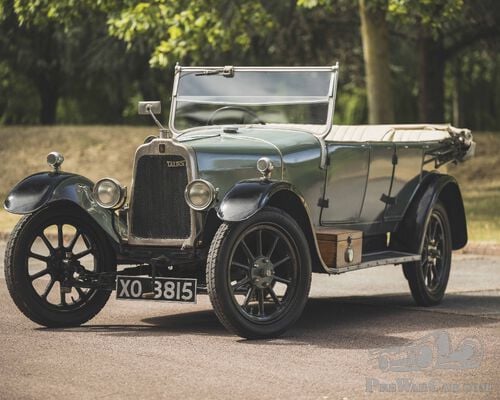
Rare RHD, low miles & great history file
This is an ONLINE-ONLY AUCTION at THE MARKET. The price shown here is the lower estimate. To see all the details, description, 250+ high-res photog..
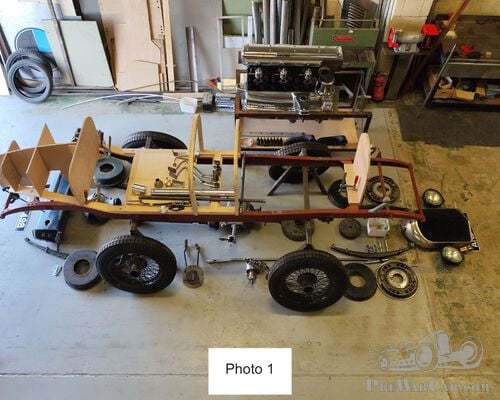
Bentley 3/6 litre sports racing car kit with V5C
I am a specialist vintage and classic car restorer with decades of hands-on experience. For some time I have been collecting parts for a special pr..
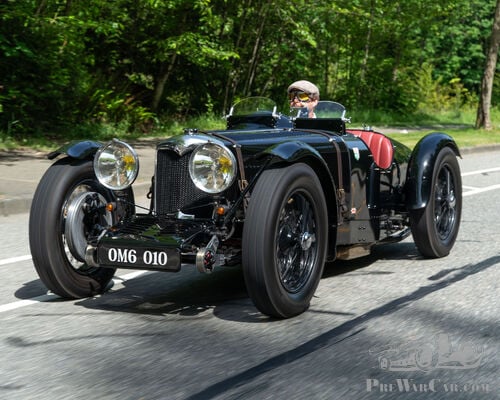
Riley 14/6 Special 1933
The ExperienceStep into the golden age of British motoring. This 1933 Riley 14/6 Special is a masterclass in pre-w..