The global magazine and marketplace for classic car enthusiasts, by enthusiasts.


Filter
Classic Morris, Talbot for sale - Morris, Talbot cars for sale
-

1933 Talbot AV105 Sports 2-Seater
As a Swiss, Talbot Chief Engineer, Georges Roesch, designed his cars with Alpine motoring in mind. With their combination of a strong and powerful push-rod six cylinder engine, powerful brakes, light and accurate steering and a compact, light yet sturdy chassis it is no surprise that Talbots excelled in the Alpine Trials of the 1930s, then undou.. -
Rare RHD, low miles & great history file
This is an ONLINE-ONLY AUCTION at THE MARKET. The price shown here is the lower estimate. To see all the details, description, 250+ high-res photographs and a video please go to our website - THE MARKET classic & collectable car auction. There is no charge to Register and start bidding. There is no Buy it Now, or Part-Exchange. This lot is a.. -
1938 Morris 12/4 Series III | Brightwells | Auction Ends: Wed 05th Aug
Produced for only a short period before the outbreak of the Second World War brought civilian car production to a halt; driven to the sale; powered by the model's 1,550cc overhead-valve four-cylinder engine with cross-flow cylinder head, driving through a four-speed gearbox with synchromesh on the upper three ratios Few pre-.. -
1936 Morris 8 Tourer | Brightwells | Auction Ends: Wed 05th Aug
Beautifully presented and full of period charm; the engine and gearbox have been replaced with a later Series E unit incorporating the desirable four-speed gearbox; particularly attractive interior which presents well and adds greatly to the car's overall appeal; a highly usable pre-war convertible Few pre-war cars offer suc.. -
1934 Morris 10/6 Saloon | Brightwells | Auction Ends: Wed 05th Aug
Charming vintage saloon; resprayed body; out of long tern ownership before being purchased through a deceased estate earlier on this year Elegant, practical and dependable, the Morris 10/6 was one of Britain's most popular family cars of the early 1930s. Powered by Morris's smooth six-cylinder engine, it offered noticeably m.. -
1929 Talbot K74 Limousine – Very comprehensive restoration project
For sale – 1929 Talbot K74 Limousine – Very comprehensive restoration projectAsking price: €19,950 A very rare 1929 Talbot K74 Limousine, offered as a comprehensive restoration project.This is not a ‘box of loose parts’, but an exceptionally complete car with virtually all its original parts present. Projects of this .. -
1928 Morris Cowley
The Morris Cowley as used in the new TV series (all creatures great and small) yes Tristians car, it’s a lovely barn find, all original and in usable condition, five new tyre and tubes, new exhaust system, new fan belt, new speedo cable, starts first time on the button, fully charging, all lights and indicators, brake lights etc work, loverly .. -
1933 Talbot AV105 Super Speed Saloon Coachwork by James Young
As a Swiss, Talbot Chief Engineer, Georges Roesch, designed his cars with Alpine motoring in mind. With their combination of a strong and powerful push-rod six cylinder engine, powerful brakes, light and accurate steering and a compact, light yet sturdy chassis it is no surprise that Talbots excelled in the Alpine Trials of the 1930s, then undou.. -
1934 Talbot AV105 Three Position Drophead Coupé
Registration no. ARE 34Chassis no. 35488 Much supporting paperworkRestored exampleVery usable A beautifully presented and very usable example of a rare long-wheelbase three-position drophead coupé, one of only 2,105 built. The car underwent.. -
1936 Morris 12 | Brightwells | Auction Ends: Wed 05th Aug
First registered in December 1936; 4 speed gearbox conversion; matching numbers; extensive work carries out 7000 miles ago This is a charming and increasingly rare 1936 Morris 12/4 Sliding Head Saloon, a delightful pre-war British classic that has benefitted from extensive mechanical restoration while retaining its period ch..


Morris
GB, 1913 to date
(1) W.R.M. Motors Ltd, Cowley, Oxford, 1913 – 1919
(2) Morris Motors Ltd, Cowley, Oxford, 1919 – 1970
(3) Austin-Morris Division, British Leyland Motor Corp Ltd, Cowley, Oxford, 1970 to date
W.R. Morris (later Lord Nuffield), an Oxford cycle and motor agent, launched his Morris-Oxford light car in 1913. This Morris car was made from proprietary parts, the engine being a 1-litre T-head four by White and Poppe. At £175 the Morris car was one of the best of the true light cars (as opposed to cyclecars) and over 1.000 Morris cars had been sold by the end of 1914. A larger model, the famous Morris Cowley, arrived on the scene in 1915; this Morris car was assembled from American components, the engine being by Continental. After World War 1 Morris cars marketed two 1½-litre L-head sv fours, with power units by Hotchkiss of Coventry; the Morris Cowley differed from the Morris Oxford mainly in its more austere equipment and the absence of a starter. In an inflationary climate, Morris cars was brave enough to reduce the prices of its Morris cars(a Morris Cowley two-seater cost £465 in October 1920, £299.10s a year later, and £225 in October 1922) and ensured a steady flow of Morris carproduction by acquiring his suppliers, such as Hotchkiss, Wrigley (transmissions) and Hollick and Pratt (bodies).
The Morris ‘bullnoses’ were soon best-sellers backed by a nation-wide service organization of Morris cars, and in 1925 Morris outsold all his competitors with 54.000 Morris cars. From 1924 to 1926 the staple Morris cars were the 1½-litre Morris Cowley and the 1.8-litre Morris Oxford, both with 3-speed gearboxes and the wet-plate clutches which persisted on some Morris carmodels right up to 1939. The Morris Oxford acquired front wheel brakes in 1925, and they were available as an option on Morris Cowleys a year later. 1927 Morris cars produced the flat radiator and also a venture into the export market with the unsuccessful Empire Oxford Morris car of 2½-litres, which had a 4-speed box and worm drive. Equally unsuccessful was a plan to market Gallicized Morris cars built in the Léon Bollée plant at Le Mans.
Meanwhile Cecil Kimber had produced the first of the Morris-Oxford-based MG sports cars, and a new name had been born. Morris had made a few six-cylinder Morris cars in the early 1920s, but his first serious attempt in this direction with Morris cars was a 2½-litre ohc model for 1928, the engine of this Morris car inspired by the Wolseley 16/45, a make which had come under Morris control the previous year. 1929 saw another ohc Morris car, the 847cc Morris Minor at £125. Never a best-seller, the Morris car none the less served as the basis for MG’s Midget. The 1930 6-cylinder Morris cars had hydraulic brakes, extended down the range until they were universal by 1934 on all Morris cars, and in 1931 Morris managed to offer a simplified sv two-seater version of the Morris Minor for £100. The early 1930s proved very difficult for the Morris car company, which had no obvious best-seller and too many different models of Morris cars. Sliding roofs and electric fuel pumps by the Morris-owned S.U. concern were innovations for 1932 and 1933 Morris cars pioneered the semaphore-type traffic indicator in Britain. That year Morris cars sv 1.3-litre Morris Ten-Four came out as an answer to Austin’s Ten and Hillman’s Minx. All 1934 Morris cars had synchromesh and the bigger sixes the added refinement of a free wheel.
The best-seller Morris car came at last in 1935 with the 918cc sv Series I Morris Eight, which retailed at £132.10s for a fully-equipped Morris car saloon and helped reach their first million Morris cars by the summer of 1939. In a bigger category were the Series II Morris carmodels with modern styling, 3-speed gearboxes, and built-in jacking systems, ranging from a revised Morris Ten-Four up to a 3½-litre 6-cylinder Morris Twenty-Five at £280. These Morris cars were contemporary with the Series I, though introduced some months after that Morris car. All 1938 Morris cars except for the Morris Eight had push-rod ohv engines (already applied to Wolseley and MG). Later that year Riley was absorbed into the Nuffield Morris car empire. Two 1939 winners were a revised Series E 8hp with a 4-speed gearbox and headlamps faired into the wings of the Morris car, and the 1.140cc ohv Series M Ten, which introduced integral construction to Cowley and this Morris car was made after World War 2 by Hindusthan in India.
Only the 8 and 10 Morris cars were made in the first post-war years, the first really new Morris car for ten years being the 1949 Morris cars designed by Alex Issigonis. Of these the MM series Morris Minor used the old 8hp sv engine, but boasted integral construction, rack-and-pinion steering and torsion-bar independent front suspension and set a new standard in popular car handling. A million of the basic design Morris cars had been sold by January 1961. Its companion Morris carmodels, also chassisless, and with independent front suspension were a new sv 1½-litre Morris Oxford and the 2.2-litre ohc Morris MS Type Six.
The amalgamation of Nuffield and Austin to form the British Motor Corporation in 1952 resulted in a gradual process of rationalization. First the Morris Minor went over to Austin’s 803cc ohv A30 engine in 1953. The Series II Oxford Morris car and its less powerful companion, the Morris Cowley, of 1954 had Morris hulls, but their engines were also ohv Austins. In 1955 the Morris carrange was completed by a new Isis using the 2.6-litre BMC 6-cylinder unit – this Morris car was discontinued in 1958. In the late 1950s some Morris cars were made and sold in Australia under the Morris car name which were in fact more closely akin to other makes in the BMC group. The 6-cylinder Morris Marshall was really an Austin A105, while both the Major and its Austin counterpart, the Lancer, were based on the Wolseley 1500.
With the arrival of the Farina-styled 1½-litre Morris car saloons in 1959, differences between Austin and Morris cars had been reduced to house colours and radiator emblems. The front-wheel-drive Mini (1960) was shared between the two makes and though its bigger stablemate, the 1100 of 1963 with Hydrolastic suspension, was initially a Nuffield monopoly Morris car, the inevitable Austin variant followed a year later. In the case of the third front-wheel-drive model, the 1800, Austin were ahead of Morris cars in introducing it by nearly eighteen months. The 1968 Morris car range comprised the fwd Mini, 1100/1300, and 1800 as well as the conventional 1.600cc Oxford and the indestructible Morris Minor 1000, now with 1.098cc engine and still selling close on 60.000 Morris cars a year. This sole survivor of independent Morris car design did not disappear until the end of 1970. Minis became a separate make that year. From 1971 Morris car versions of the 1100 and 1300 disappeared; the name was reserved for the Marina, an orthodox rear-wheel-driven family saloon with Minor 1000 front suspension, semi-elliptics at the rear, and drum brakes on the simpler variant Morris cars. Push-rod 1.300cc and 1.800cc B.L.M.C. 4-cylinder engines were used, and the original 2-door coupé and 4-door saloon were joined by a station wagon Morris car in 1973. The largest fwd cars were still available with Morris car badges – there was a version of the 6-cylinder 2200 in 1972.
Source: Georgano, encyclopedia of motorcar; MCS
The information is written with the greatest of care. However, if you have any suggested amendments please contact us at office@prewarcar.com
Talbot
1903 – 1938
Clement-Talbot Ltd, North Kensington, London W.10
From 1903, Clement-Talbot Ltd, a company backed by the Earl of Shrewsbury and Talbot, began importing the French Clément car into Britain; in spite of its name and an interest held by Adolphe Clément, the concern was British, and by the end of the year its cars were called Talbot cars. The 1904 models Talbot cars were a 6hp single, and 11hp twin, and two big fours. All of the Talbot cars had shaft drive and side valves in T-heads, except for the biggest, the 27hp voiture de luxe Talbot car, which used overhead inlet valves and a single camshaft. Trucks, buses and boats were also advertised, next to Talbot cars. Promotion of the Talbot car, which was at first in the hands of the managing director, D.M. Weigel, was energetic and successful.
By the end of 1904, an impressive Talbot car factory had been built, complete with test track, and in the following year British-assembled, and partly British-made Talbot cars emerged from it. A wide variety of types Talbot cars was listed, from an 11hp twin to a great 50hp 4-cylinder Talbot car. One model that was to be famous, the 12/16hp Talbot car, had already been designed. French cars were still being imported by the Talbot car company. However, the 20hp Talbot car of 1906 was the first British-made Talbot car. It was designed by C.R. Garrard, and while still conventional, this Talbot car had an unusually efficient engine of 3.8 litres’ capacity. Both this and the 2.7-litre ‘12/16’ Talbot car were fast cars that quickly made a name for themselves in competitions; the slogan for the Talbot cars became ‘The Invincible Talbot’. For 1907 a 3-litre 15hp, a Talbot car in the same mould, superseded the ‘12/16’. By 1908 this Talbot car was the only British chassis offered, into which could be installed 15hp, 25hp or 35hp engines. The Talbot car popularity was due to a combination of smoothness, reliability, speed and reasonable price. The French range Talbot cars was still listed. A six was introduced for 1910, and the 4½-litre 25hp was revised by G.W.A. Brown with an L-head valve arrangement. This model Talbot car, highly tuned and lightened, and fitted with a racing body, became the first car to cover 100 miles in an hour, at Brooklands in 1913 in the hands of Percy Lambert. In the same year a new model Talbot car, the 2.6-litre 15/20hp, was introduced. This Talbot car and the 25hp, now called the ‘25/50’, were the famous cars that kept the Talbot car name before the public eye in competitions. A sports model Talbot car of the latter was also listed. By this time, the French range Talbot cars had been dropped.
In 1919 Clement-Talbot was taken over by another French-sounding, but in fact British-owned firm, the Société Alexandre Darracq of Paris. Darracq proceeded to acquire Sunbeam as well, but private Talbot car policy was at first unaffected. The 25/50hp and 15/20hp Talbot cars were continued. For 1922, however, the new 1-litre Darracq light car was offered as the 8/18hp Talbot car. In the Talbot tradition, this Talbot car was a solid car with above-average performance and handling. The push-rod overhead valve engine had coil ignition, there were only two seats in the Talbot car, there was no differential, and suspension was by quarter-elliptic springs all round. Both acceleration and brakes of the Talbot car were excellent; in other words, this Talbot car was a light car more typical in France than of England. Georges Roesch, who had been Chief Engineer since 1916 and had already devised the Talbot 12hp of 1919, a Talbot car which was never put on the market, quickly revised the ‘8/18’ Talbot car as the 10/23hp, which was more ‘English’ in that the Talbot car had a long, wide, roomy body, and a differential, with an enlarged bore and 1100cc to cope with the added weight.
From 1923 to 1926, the Talbot car company tried to exist on the ‘10/23’ Talbot car and a series of obscure small sixes of which few Talbot cars were made. The pre-war big four Talbot cars had been dropped, but nothing as popular had been found. Clement-Talbot cars were at a very low ebb when Georges Roesch saved them with a one-model policy, based on a small six of the type just becoming fashionable. However, the 14/45hp Talbot car was better than the rest because the Talbot car combined efficiency and high quality with comfort, roominess and smoothness. Considering all this, the price of the Talbot car was not high. It was, in fact, Roesch’s intention to provide the characteristics of the Rolls-Royce 20hp to the Talbot car but with half the engine size, weight and price. The cubic capacity was only 1665cc (61x95mm). The reciprocating parts, including the overhead valves, were very light, and the compression ratio was notably high, enabling revolutions and power output to be high also. Even so, the engine of the Talbot car was an unusual combination of silence and flexibility. The brakes were excellent, though it was suprising to find only quarter-elliptic springs at the rear of the Talbot car. The car’s main drawback was weight: bodies of these Talbot cars were very spacious, mounted on a deep, stiff but heavy frame with a long wheelbase. However, most Talbot car customers did not want ultra-high performance; the 60-65mph of the ‘14/45’ Talbot car was very good for such a large car with so small an engine.
The Talbot car company’s crisis had allowed no time for development, so the new Talbot car came straight off the drawing board to the public; but the Talbot car was so good in design that there were no major snags, and the Talbot car firm sold all they could make. The engine of the Talbot car was very difficult to work on without garage equipment, but the ‘14/45’ Talbot car was designed for replacement rather than repair of parts: another very modern, if not entirely desirable, feature. The design was obviously capable of great development, and during 1930 the first stages were announced – the Talbot 75 and 90. Both Talbot cars had the same size of engine; the ‘14/45’ Talbot car with an enlarged bore, providing 2¼ litres. The ‘75’ Talbot car was a touring model available alongside the ‘14/45’ to those who wanted a little more performance, while the ‘Talbot AM90’ was a more highly-tuned sports Talbot car, giving over 80mph with the same refinement. This Talbot car was sold in closed as well as open form, but the most handsome body was the standard sports tourer. Additionally, a cheaper Light Six 14/45 Talbot car with a shorter chassis was added at the lower end of the range.
With the ‘Talbot AM90’ began Talbot cars second lease of life as a distinguished sporting make. Third and fourth places in the Le Mans 24 Hour Race were followed by class wins of Talbot cars in the Irish Grand Prix, the Ulster Tourist Trophy Race and the Brooklands 500 Miles Race. In spring 1931 the Talbot 105 was introduced with a new, 75x112mm engine providing 3-litres. To improve the breathing, the valves were in a staggered arrangement instead of bing in line as hitherto. All types of body, from saloon to four-seater sports, were offered on this Talbot car chassis. The last Talbot car was a 100mph machine. The bigger engine of the Talbot car was difficult to start, in spite of assistance from two 12-volt batteries, for the starter was not geared down. It was no help when the optional Wilson self-changing gearbox was fitted from 1933. In competitions, the Talbot car name went from strength to strength. The ‘Talbot 105’ came 3rd in the Irish Grand Prix and at Le Mans, 4th in the Tourist Trophy and 2nd in the 500 Miles Race. A 105 tourer Talbot car took home a Coupe des Glaciers after a fault-free performance in the Alpine Trial. The Coupe des Alpes team prize was won in 1932 by Talbot 105s, and in that year came a 2nd place in the Brooklands 1000 Miles Race (which replaced the Double Twelve), and 3rd place at Le Mans and in the 500 Miles Race with a Talbot car.
These racing successes were won by Talbot cars prepared by Fox & Nicholl Ltd with works support; in spite of the fame and success of the Talbot car, the Sunbeam-Talbot-Darracq group had been in financial trouble since 1930 and earlier, and racing was a luxury. At the end of 1932, however, Fox & Nicholl’s participation was discontinued and the great run of triumphs for Talbot cars ended. The normal production Talbot cars continued to do well. In 1932 the Talbot 65, a new model basically the same as the ‘14/45’, was announced. The ‘Talbot 95’, consisting of the ‘Talbot 105’ engine in a longer wheelbase for more sedate use, was introduced for 1933. In the following year Talbot cars with the self-changing gearbox were given a centrifugal clutch to avoid drag, and for 1935 there appeared the last developments of the standard type Talbot car, the ‘Talbot 110’. This superb Talbot car had a larger bore than the 105, giving 3½-litres. Early in 1935, however, Rootes gained control of Clement-Talbot. The ‘Talbot 65’ was dropped for 1936 in favour of the Rootes Talbot Ten, a Hillman Minx-based design, and by 1938 the last Roesch survivor, the ‘Talbot 110’ was gone.
Source: Georgano, encyclopedia of motorcar; TRN
The information is written with the greatest of care. However, if you have any suggested amendments please contact us at office@prewarcar.com


Featured
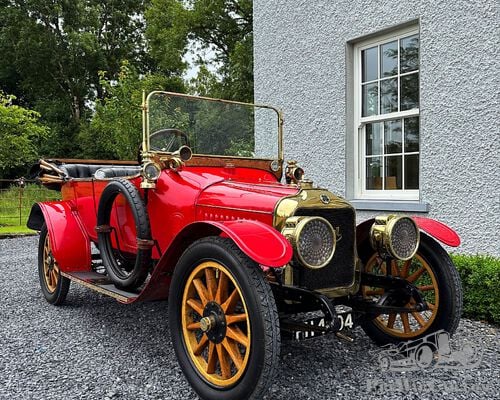
1914 Brasier
1914 Brasier Tourer 9ABrasier were a French manufacturer who were in business from 1901 until 1930, when the company became victim of the gr..
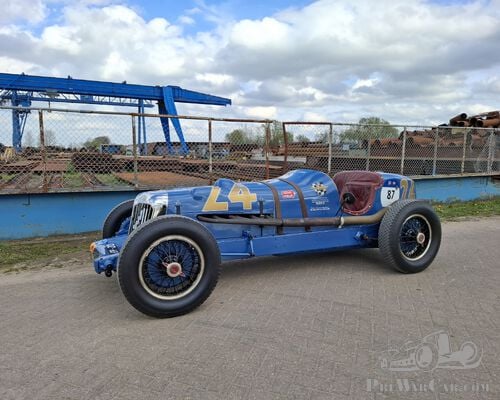
1932 - Graham " Lucenti " Indianapolis
Original participant of the 1932, 1934 and 1935 Indy 500. Best result: finishing 10th overall in the 1934 Indy 500 with driver “Herb” Ardinger...
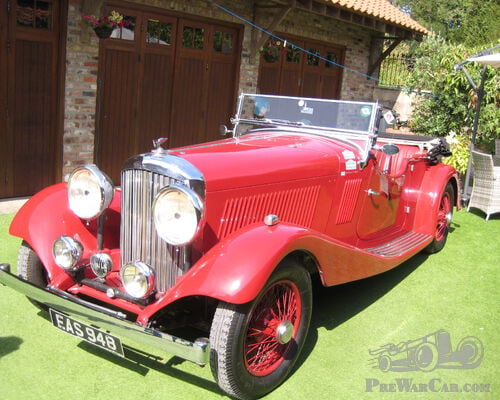
1935 Bentley 3.5 ltr. VDP 4str. Tourer
Chassis B 123 CW was first registered 14th March 1935, and in the late eighties underwent a " body-off" restoration and fitted with VANDEN PLAS