The global magazine and marketplace for classic car enthusiasts, by enthusiasts.


Filter
Classic Arrol-Johnston, Mors for sale - Arrol-Johnston, Mors cars for sale
-

1936 Austin 7 Ruby | Brightwells | Auction Ends: Wed 24th Jun
Highly original with a wonderful history file; a proper time capsule; further photos and details to follow -
1925 Bean 14HP Tourer | Brightwells | Auction Ends: Wed 24th Jun
Bean 14 HP Tourer; Member of the Bean Car Club; 1,701cc engine; converted to 12 volts; showing just 5 owners in totalUp for auction is a 1925 Bean 14HP, a true vintage vehicle and a rare piece of British automotive history. This delightful beige example, currently owned since August 2024, has had five former keepers and boasts a 1,.. -
1928 Austin 7 Chummy | Brightwells | Auction Ends: Wed 24th Jun
In the current ownership for 17 years; expertly restored in c.2002 by Ray Edge and only 1,100 miles since; in light regular use; full set of weather gear; original number plate; very smart indeedUnveiled in October 1922, the Austin Seven did not go on sale until early-1923 and was initially only available as a two-door, four-seat t.. -
1921 AC Empire | Brightwells | Auction Ends: Wed 24th Jun
From a deceased estate; current owner 50+ years; last driven about seven years ago; Anzani engine; bespoke coachwork based on an AC prototype; interesting history file; further details to follow -
1927 Austin 20/4 Drophead Coupe | Brightwells | Auction Ends: Wed 24th Jun
In regular use and driven 20 miles to the sale; an impressive example of this powerful and dependable Austin Austin introduced its big 20hp model in 1919, a car heavily influenced by the Hudson Super Six that Herbert Austin drove during the war.Incorporating many of the Hudson features that had so impressed the Austin boss, .. -
1910 Buick Model 10
Beautiful 1910 Buick Model 10 RunaboutThis was the first mass-produced Buick. It was marketed as a "light 4-cylinder roadster for gentlemen" and quickly became one of Buick’s bestsellers.Its respectable performance of 22.5 hp from the 4-cylinder “valve-in-head” engine with a 2.7-liter displacement earned it the nickname "The White ..


Arroll-Johnston (Arrol-Aster)
GB, 1897 – 1931
(1) The Mo-Car Syndicate Ltd, Bluevale, Camlachie, Glasgow, 1897 – 1906
(2) The New Arrol-Johnston Car Co Ltd, Paisley, Renfrewshire, 1906 – 1913
(3) Arrol-Johnston & Aster Heathhall, Dumfries, 1913 – 1927
Arrol-Johnston was one of the famous makes of Scotland. It was born when George Johnston, Sir William Arrol (the civil engineer) and others, produced their first Arrol-Johnston Dogcart, a strong reliable vehicle with an underfloor flat-twin, opposed-piston engine and chain drive. Its high-wheeled, solid-tyred, horse-carriage type of body was retained well into the 1900s, a more modern 12hp machine was introduced alongside the Arrol-Johnston Dogcart for sale in 1905, with a front-mounted 3-cylinder engine and unit construction of engine and gearbox, but even the Dogcart outlived this one. The Arrol-Johnston make received a new lease of life, however, with the arrival of J.S. Napier as chief engineer and the formation of a new company under Sir William beardmore. Napier won the first Tourist Trophy Race in 1905 with an 18hp car of his own design. By 1908 it was making conventional cars only – three 4-cylinder models. T.C. Pullinger became general manager in 1909 and the company’s most popular pre-war model, the 2 ½-litre 1 Arrol-Johnston 5.9hp appeared. It, too, was normal, except for its dashboard radiator and Allen-Liversidge front-wheel brakes. The latter were unsatisfactory, and lasted only until 1912. By that year, there were also a smaller four Arrol-Johnston for sale and a big six in the range. Experiments were made with an electric car, the Arrol-Johnston-Edison.
Arrol-Johnston planned to impress the post-war market with their advanced Arrol-Johnston Victory model, designed by G.W.A. Brown. The single ohc engine, developed 40bhp from 2.6 litres. However, the car was too expensive and insufficiently developed. It broke down when on a Royal tour of the West of England, so that the publicity attending its début was not of the kind it needed. Hurriedly Arrol-Johnston resuscitated the old Arrol-Johnston 15.9hp. It was cheaper, but this was at the cost of such unpopular American cost-cutting expedients as a black-painted radiator and fixed ignition. All the same, it saved the Arrol-Johnston company for the time being, and a more modern version, the Arrol-Johnston 20hp, was introduced alongside the Arrol-Johnston 15.9hp in 1922. It had a Monobloc engine with an detachable head. In 1926 overhead valves and front-wheel brakes were added.
In 1927 Arrol-Johnston were merged with Aster and complication set in. The Arrol-Johnston 15.9hp was retained. So were the two current Asters. Both the latter were given Burt-McCollum single sleeve-valve engines in the interests of silence, but the 21/60hp Aster was also available in its original ohv form, renamed the Arrol-Aster. Another completely new Arrol-Aster for sale was the 2½-litre 6-cylinder 17/50hp with sleeve valves. The 21/60hp Arrol-Aster and the 15.9hp Arrol-Johnston were dropped for 1929, and a straight-8 Arrol-Aster substituted. It had a 3.3-litre sleeve valve engine consisting of the 17/50 unit with two extra cylinders and was available in supercharged form. This was a fast car intented as a sports mdoel, but unlike the French sleeve-valve designs it could not produce high outputs as revolutions were limited.
Source: Georgano, encyclopedia of motorcar; TRN
The information is written with the greatest of care. However, if you have any suggested amendments please contact us at office@prewarcar.com
Mors
France, 1895 – 1925; 1941 – 1943
(1) Société d’Electricité et d’Automobiles Mors, Paris, 1895 – 1907
(2) Société Nouvelle des Automobiles Mors, Paris, 1908 – 1943
Emile Mors was an electrical engineer, which may account for the ingenious ignition system (by low-tension coil and dynamo) found on his first Mors cars with aiv V4 engines, dry-sump lubrication, water-cooled heads and air-cooled barrels. These power units were rear-mounted, and the belt-and-pulley change-speed gear on the Mors car was in the Benz idiom. Production in 1898 was running at 200 Mors cars a year and front-mounted engines made their appearance on the Mors Petit Duc, an 850cc flat-twin with partial water cooling, cone clutch and final drive of the Mors car was by side chains. Steering was by handlebar and the Mors car cost £294 in England in 1900. The Mors car was still listed in 1901, though later examples were wheel-steered.
The Mors racing cars designed by Brasier at first rivalled and then surpassed the hitherto invincible Panhards, winning the Paris-st. Malo and Paris-Bordeaux in 1899, following this with victories of Mors cars in the Paris-Toulouse-Paris and Bordeaux-Périgeux-Bordeaux in 1900, and the Paris-berlin and Paris-Bordeaux in 1901. In 1902 the Mors 60hp 9.2-litre competition machines had shock absorbers and in 1903 capacity of the Mors car had gone up to 11.6-litres, with mechanically-operated overhead inlet valves and streamlined bodywork of the upturned-boat type. Gabriel won the Paris-Madrid race on one of these Mors cars, while the Hon. C.S. Rolls recorded 84,68mph over the kilometer at Welbeck on a similar Mors car. The 1904 racers saw a reversion to T-head power units, but this was the last year in which Mors cars made any impression on the circuits. Though Jenatzy drove a Mors car for the team in the 1908 Grand Prix, he took 9th place, and the 2½-litre Mors cars prepared for the cancelled 1914 Coupe de l’Auto never reappeared.
Though full water cooling was not adopted till 1902 on Mors cars, vertical 4-cylinder engines made their appearance late in 1899, followed in 1900 by low-tension magneto ignition. 1901 Mors cars had what amounted to one carburetter per cylinder, with a huge central float chamber. From 1902 onwards the Mors cars followed conventional lines; 1903 Mors carmodels retained the chain drive, but had mechanically-operated sv in a T-head, pressed-steel frames, Dubrulle lubrications and Mercedes-style honey-comb radiators. Brasier had already departed the Mors car company to work for Georges Richard. In 1904 Charles Schmidt, also of Mors cars, went to design European-style cars for Packard in America – this had no connection with the American Mors cars made from 1906 to 1909. Also new on Mors cars in 1904 was the ‘shouldered’ radiator shell which persisted on the Mors carmarque almost to the end. 4-cylinder Mors cars only were made in 1905; they came in 2.3-litre, 3.2-litre, 4.3-litre, 5.7-litre and 8.1-litre sizes, and the largest Mors car, rated at 40/52hp, had an auxiliary transverse spring at the rear and cost £1.224. In 1906 the aluminium water jacketing introduced on Mors cars in 1903 was abandoned, while cone clutches gave way to the contracting-band type which Mors cars never departed from. Ignition was now by high-tension magneto and options included the Huillier windscreen (patented by a Mors car company’s director) and compressed-air starting. A cab-over-engine petrol brougham was listed on the 17hp Mors car chassis. In 1907 L-head monobloc engines arrived with the small 10hp Mors car and 15hp models, which Mors cars also had shaft drive and pressure lubrication: at the top of the range was an 50hp 6-cylinder Mors car with gate change and low-tension magneto ignition and this Mors car sold at £1.375 in England.
The 1908 depression was a blow from which the Mors car company never really recovered, though the company was reconstructed under André Citroën’s management and in 1909 they made 2.000 Mors cars, sales being aided by bigger shaft-driven 2.5-litre and 3.7-litre models. Chain drive and make-and-break ignition were to persiste on the biggest Mors cars until 1912, though there was a shaft-driven 3.6-litre 6-cylinder Mors car in 1911 and the L-head monobloc 12/15hp with 4-speed gearbox was quite popular in 1913/1914. Poppet and Knight sleeve-valve models in great diversity were offered on Mors cars during the last two pre-World War 1 seasons, the latter coming in 2.1-litre, 3.7-litre, 4.4-litre and 7.2-litre sizes with engines by Minerva. By 1914 only the small Mors cars retained sv power units; Citroën double helical bevels were standard, and an sv sports 17/20hp Mors cars was offered with electric lighting. Only Minerva-built Knight engines were used in Mors cars after 1918, the radiators wearing a triple-S monogram as a riposte to Panhard’s double-S (for sans soupages). Mors cars, however, had fewer resources than their former rivals, and not even good looks and a 70mph performance (plus front wheel brakes in 1921) could save the 3.6-litre Sporting 20 Mors car. A 2-litre Mors car, also Minerva-engined, appeared in 1922, but by 1925 most, if not all the Mors car company’s facilities had been absorbed by Citroën. There was a brief renaissance by Mors cars with electric cars during World War 2, but the last vehicles to bear the name of Mors were the Speed motor scooters made from 1952 to 1956.
Source: Georgano, encyclopedia of motorcar; MCS
The information is written with the greatest of care. However, if you have any suggested amendments please contact us at office@prewarcar.com


Featured
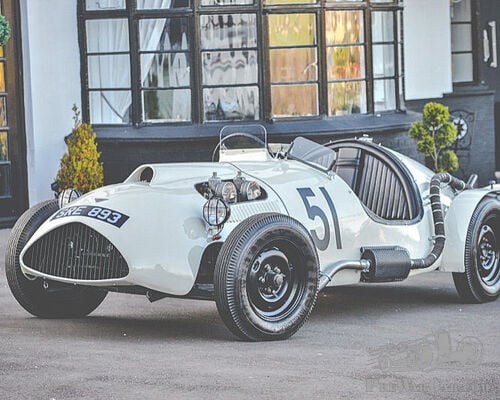
1933 Alvis 3.0 Special - One-Off Alloy Body | Period Competition Car | Featured in “Alvis – A Century of Drivers”
1933 Alvis 3. 0 Special - One-Off Alloy-Body | Period Competition Car | Featured in “Alvis – A Century of Drivers”

Alfa 6C1750 Spider
Alfa 6C1750 Spider with complete history from delivery in 1930 to first owner in Firenze till today with copy Libretto/license plate all the years

Lagonda LC Tourer 1934
The Lagonda story began in 1901 in Staines, a small town in the UK. The company enjoyed its greatest successes around 1935. During this period, the..