The global magazine and marketplace for classic car enthusiasts, by enthusiasts.


Filter
Classic Motobloc, Du Pont for sale - Motobloc, Du Pont cars for sale
-

1929 Du Pont Model G Two-Passenger Speedster by Merrimac | RM Sotheby's | The Monterey Auction
To Be OFFERED AT AUCTION at RM Sothebys' The Monterey Auction event, 13 - 15 August 2026. $800,000 - $1,200,000 USD One of the most beautiful American automobiles of its generationThe 1929 New York International Automobile Show display carOne of three two-passenger “taper tail” models with an external spareOne .. -
Motobloc Model O 1909 wanted
Technical information and contacts with other owners wanted for the Bordeaux-France made Motobloc-cars. We own a 1909 Model O in our museum, body by Audineau. Nous cherchons autres propriétaires des voitures Motobloc fabriquées à Bordeaux France. Nous avons un type O Coupé-Chauffeur-laundaulette par Audineau dans notre museé. Merci.CoridalementH..


Motobloc
France, 1902 – 1930
(1) G. Carde, Fils et Cie, Bordeaux
(2) SA Motobloc, Bordeaux
The Schaudel of 1898, which became the Motobloc car or Schaudel Motobloc car, featured unit construction of engine and gearbox, the earliest known instance of this form of design and the reason for the name Motobloc. Furthermore, the change-speed gears were actually in the crankcase. The power unit of the Schaudel Motobloc car was a transversely-mounted, inclined twin with chain drive. This odd little voiturette survived until 1904, after which it was perpetuated only as a van chassis, and a conventional vertical 4-cylinder engine – still made in unit with the gearbox – was substituted. This was a highly efficient unit that soon acquired overhead inlet valves, and it was also very smooth, thanks to the positioning of the flywheel between the two parts of cylinders. A mid-mounted flywheel was also used in the 6-cylinder engine of 1909 and on all Motobloc car models throughout the 1920s. Only fours were made up to 1927, ranging from 1.327cc to 3-litres in capacity. Independent front suspension was introduced on the Motobloc car in 1928, and the 1929/ 1930 range consisted of a Motobloc 9CV, 1.453cc four, and two sixes, a 10CV (1.683cc) and a 15CV (3.013cc).
Source: Georgano, encyclopedia of motorcar; TRN
The information is written with the greatest of care. However, if you have any suggested amendments please contact us at office@prewarcar.com
Du Pont
US, 1920 – 1932
(1) Du Pont Motors Inc, Wilmington, Del., 1920 – 1923
(2) Du Pont Motors Inc, Moore, Pa., 1923 – 1932
E. Paul du Pont’s company built quality cars in limited numbers, total production being 537 vehicles of all Du Pont types. First of the line was a Du Pont 4.1-litre sv four with their own engine, selling for $2.600, but this gave way to proprietary-engined sixes, initially powered by Herschell-Spillman. The 1925 Du Pont Model D had a 6-cylinder 5-litre Wisconsin engine with overhead valves that developed 75bhp, a constant-mesh gearbox, and Lockheed hydraulic brakes to all four wheels. Its successor, the Du Pont Model E, could be had with a supercharger, but the best-known, and best, Du Pont was the Du Pont Model G speedster introduced in 1928. With its narrow straight wings copied from the Amilcar, Woodlite headlamps and grille concealing the radiator, the last a pioneering feature, the Du Pont Model G was not a good-looking car, but it was a very effective one. Like all the DuPont speedsters it had four forward speeds. The 5.3-litre, sv straight-8 engine, by Continental, gave 114bhp at 3600rpm with catalogued modifications. With the latter, 100mph was guaranteed. In the 1929 Le Mans 24 Hours race the Du Pont Model G proved itself faster than the other American entries, Stutz and Chrysler. Touring bodywork was, of course, available on the Du Pont car, and in 1931 came the long wheelbase (12ft 2 in) Du Pont Model H, built in a Stearns Knight frame. The later Du Pont cars were assembled in the Indian motorcycle factory at Springfield, after E. Paul du Pont had acquired this concern.
Source: Georgano, encyclopedia of motorcar; TRN
The information is written with the greatest of care. However, if you have any suggested amendments please contact us at office@prewarcar.com


Featured
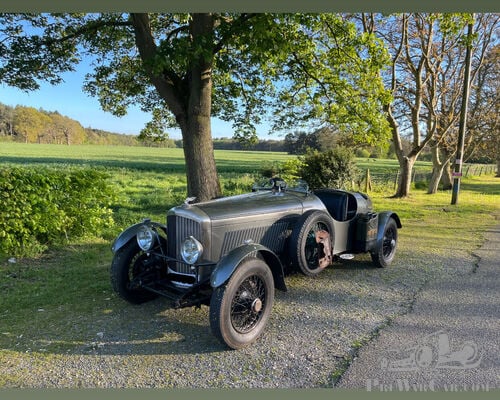
Derby Bentley Special 4-1/4
Sadly i am having to sell on my Bentley special ( Icarus). It is currently a work in progress and still needs finalising/ refining. A great o..

Alfa 6C1750 Spider
Alfa 6C1750 Spider with complete history from delivery in 1930 to first owner in Firenze till today with copy Libretto/license plate all the years