The global magazine and marketplace for classic car enthusiasts, by enthusiasts.


Filter
Classic Napier for sale - Napier cars for sale
Change your filters to get results, or show all
Sorry, there are no results with your filters Cars
.
Napier
GB, 1900 – 1924
(1) D. Napier and Son Ltd, Lambeth, London S.E., 1900 – 1903
(2) D. Napier and Son Ltd, Acton, London W., 1903 – 1924
The precision-engineering firm Napier was founded in 1808 and among the products of Napier were printing presses. In 1899 Montague Napier sought to revive its declining fortunes by experimenting with cars, his first Napier car product being a vertical-twin engine with coil ignition built as a replacement unit for an 1896 Panhard owned by his fellow-cyclist S.F. Edge. In 1900 Edge formed the Motor Power Company to distribute cars, and for the next twelve years he was to act as Napier cars sole distributor, racing captain, and super-publicist, bludgeoning the Napier car into the headlines. In the same year the first complete Napier car successfully competed in the British 1.000-Mile Trial. This Napier car was a 2.4-litre front-engined aiv twin on Panhard lines (its rear-mounted radiator apart) with 4-speed gearbox, side-chain drive and armoured wood frame, soon followed by the Napier car company’s first four, the 4.9-litre 16hp, noted for its triple automatic inlet valves and substantial aluminium content (this Napier car, however, retired in the Paris-Toulouse-Paris race).
In 1901 Napier and Edge produced a more serious racing contender, the 17.157cc Napier 50 (its engine developed 103bhp at 800rpm). This two-ton Napier car was disqualified from the Gordon Bennett Cup becauce no British-made tyres could stand up to its weight, but the Napier car was actually catalogued (at £1.500) though not more than two of these Napier cars were made. In the same year the Amerian Charles J. Glidden set off on the first of his globe-circling tours were to last until 1908: he used Napier cars throughout, starting with a 16hp. In 1902 there was a small 2½-litre four rated at 12hp, as well as a new light 6½-litre shaft-driven racer Napier car, still with aiv and flitchplate frame, with which Edge scored a luchy win in the Gordon Bennett Cup, and put Napier cars (and Britain’s motor industry) on the map. Within a year production had soared to 250 Napier cars per annum, and Napier cars were established in a new and bigger factory at Acton.
In 1904, however, came the introduction of the world’s first commercially successful six of Napier cars, the 18hp with 5-litre engine and mechanically-operated overhead inlet valves, and before the year was out a 15.1-litre racing version of that Napier car was on the road. This Napier car, the famous Napier L48, was an excellent spring machine (Arthur Macdonald took the World Mile Record at 104.65mph in January 1905 with the Napier car) but its 2-speed gearbox restricted its usefulness in circuit racing. Overhead inlet valves also featured in Napier’s new 1904 4-cylinder racer Napier car, and a year later automatic inlets had been discarded, apart from an abortive Napier 18hp four built for the first Tourist Trophy.
With a new trademark in the shape of the ‘water tower’ radiator filler cap, the Napier car company was moving towards the luxury 6-cylinder market, with chassis prices approaching the £1.500 mark, and reaching £2.500 with the vast Napier car with oversquare 90hp by 1907. If Edge’s American venture in Boston never produced a Napier car, San Giorgio of Italy offered a variety of Napier car types between 1906 and 1909. Side valves in L-heads and pressed-steel frames were now standard practice, with a 6-cylinder 60hp of 7.7-litre capacity as the best-known Napier car, though a chain-driven four of 40hp was still offered in 1909. In July 1907 Edge celebrated the opening of Brooklands Track with a Napier car by covering 1.582 miles in 24 hours on a stripped Napier Sixty, and his Napier cars had two very successful seasons there. In 1908 Edge withdrew his team of 11½-litre 6-cylinder Napier cars from that year’s Grand Prix when the ACF refused to countenance his Rudge-Whitworth quick-detachable wire wheels. This marked Napier cars official retirement from racing.
New for 1908 was a Napier car with an improved L-head 5-litre six with square cylinder dimensions, dual ignition, a 3-speed gearbox, and shaft drive, as well as the first Napier Colonial models with raised ground clearances and hoods convertible into tents. The smaller four Napier cars sold steadily, but so commited was Edge to the 6-cylinder concept that he consested (and won) the 1908 TT with a team of fours Napier cars running under the no de guerre of Hutton. Some even more modest Napier cars appeared in 1909: a 1.3-litre 10hp twin-cylinder taxicab chassis with 3-speed unit gearbox; and the 15hp, a straightforward 2.7-litre four with pair-cast cylinders, offered with bevel or worm drive. Sales boomed, reaching their peak in 1911 with 801 Napier cars delivered, though an 11-model range of Napier cars could no longer compete against Rolls-Royce’s solitary Silver Ghost in the luxury market, in spite of Napier cars award of the RAC Dewar Trophy in 1910 for a run from London to Edinburgh in top gear. The big Napier 65 and Napier 90 were still offered in 1912, and the 6.840cc 6-cylinder Napier 45 lasted until World War 1, but more typical of latter-day Napier car companies thinking was the 4.7-litre Napier 30/35, a six with 3-speed gearbox and wire wheels. This Napier car had acquired electric lighting by 1914, when its companion models were a pair of fours, the faithful Napier 15 and a bigger, 4-speed 3.2-litre Napier 16/22.
The Napier car company’s post-war showing was half-hearted; Edge’s departure from the Napier car firm in 1912 was an event from which they never recovered. The new Napier 40/45hp T75 six of 1919 had a 6.2-litre ohc monobloc engine with aluminium cylinders and steel liners and dual ignition, other features being a 4-speed separate gearbox with central change, cantilever suspension, and a foot transmission brake. Though 4-wheel brakes and balloon tyres made their appearance on Napier cars in 1924, production ceased in the latter part of that year after only 187 Napier cars had been delivered. Of the 4.258 Napier cars built since 1900, no fewer than 1.800 dated from the Napier car peak period of 1909 – 1911.
More than one attempt was made to revive the Napier car make. In 1931 Napier were the underbidders (to Rolls-Royce) for the Bentley assets, and even after World War 2 there were rumours of a super-car to bear the Napier car name. The last motor vehicle sponsored by the Napier car company was, however, a 3-wheeler tractive unit of 1931 that was subsequently marketed by Scammell as the Mechanical horse.
Source: Georgano, encyclopedia of motorcar; MCS
The information is written with the greatest of care. However, if you have any suggested amendments please contact us at office@prewarcar.com


Featured

Daimler Flat six 15 Saloon - Fluid Flywheel / pre-selector
The E20 was manufactured between 1935 and 1939. It offered the choice of a coachbuilt saloon, Sports Saloon, Fixedhead Coupé and Drophead Coupé bod..
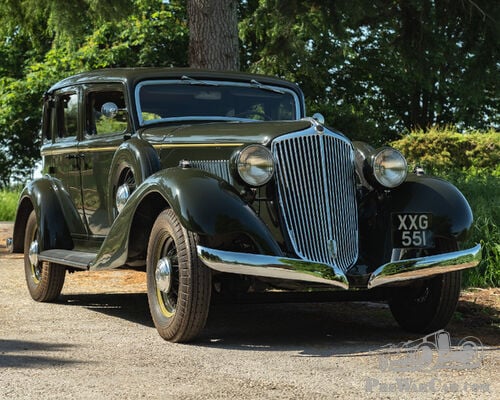
Graham Model 64 Standard Eight 'Blue Streak'
UK Registration No: XXG 551Chassis No: 1801069MOT: ExemptH&H ClassicsKelham Hall | Newark, Nottinghamshire
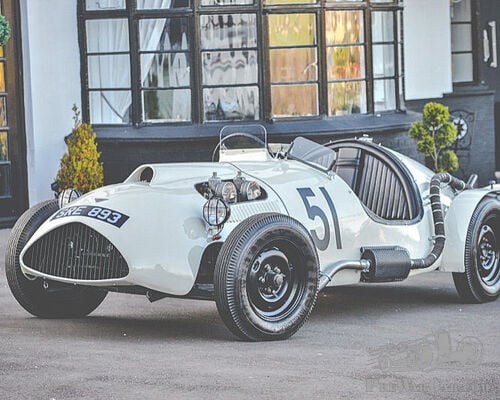
1933 Alvis 3.0 Special - One-Off Alloy Body | Period Competition Car | Featured in “Alvis – A Century of Drivers”
1933 Alvis 3. 0 Special - One-Off Alloy-Body | Period Competition Car | Featured in “Alvis – A Century of Drivers”