The global magazine and marketplace for classic car enthusiasts, by enthusiasts.


Filter
Classic Nash, Crossley for sale - Nash, Crossley cars for sale
-

1931 Nash 4 door special sedan
Model: series 870, model 877-1560, 4-door special saloon Colour: dark blueInterior: beige fabricEngine: 8-cylinder in-line, 227.5 cubic inches, 78 hpTransmission: manual, 3 gearsCondition: unrestoredPrice: € 25,000 Description:Incredibly beautiful unrestored car in superb condition. .. -
1931 Nash 480-455 Landaulette Sedan
Nash 480-455 Landaulette from 1931 only a few from these Landaulettes are made they say about 29 cars are produced like this. Frank Kennis Phone: 00.31.622.420.766 or mail me: info@KennisCars.NL www.KennisCars.NL Classic Car Dealer for Europe Cadillac ; Mercedes ; Rolls-Royce ; Delage ; Bugatti ; Bentley ; Dodge ; Opel.. -
Nash 1933 Club Sedan Big Six 1127
Beautifull Nash 1127 Club Sedan with 6 cylinder engine 3835 CC with 75 HP. The Nash has dutch documents and is in a good running condition. This could be your ultimate Bony and Clide car. Frank Kennis Phone: 00.31.622.420.766 or mail me: info@KennisCars.NL www.KennisCars.NL Classic Car Dealer for Europe Cadillac ; Mercedes ; Rolls-Royce ; ..


Nash
US, 1917 – 1957
(1) Nash Motor Co, Kenosha, Wisc., 1917 – 1954
(2) American Motors Corp, Kenosha, Wisc., 1954 – 1957
Charles W. Nash, the former President of General Motors, acquired the Thos. B. Jeffery Co in July 1916, and from the 1918 season onwards the cars were marketed under his name, Nash cars. The first Nash car was a 4-litre six with push-rod-operated overhead valves, followed in 1922 by a 4-cylinder Nash car which also had overhead valves at a time when most American manufacturers adhered to the L-head. Rubber-mounted engines appeared in the same year on Nash cars, when Nash sold 41.000 medium-priced Nash cars (the Nash four cost $985, the Nash six about $500 more). In 1924 Nash cars acquired the defunct Mitchell concern at Racine and the ailing Lafayette Co of Milwaukee, producers of a luxury V8 (when the latter name was revived in 1934 it was used for an uninspired sv 6-cylinder machine selling for under $600). They also produced, in 1925 – 1926, the 6-cylinder Nash Ajax, an sv Nash cars that they developed into a cheap line. During the latter part of the Vintage era the Nash carcompany concentrated on 6-cylinder Nash cars, with side valves in the cheaper Nash car models and overhead valves in the higher-priced range, though 1930 saw a Nash car with a 4.9-litre straight-8 with dual coil ignition and overhead valves, a type that was progressively developed until 1942. Engines of this type Nash car were used in the British Jensen of 1939.
The Nash car company successfully rode out the Depression though sales dropped to below 15.000 Nash cars in 1933, when the Nash car company were building a really big eight Nash car with an 11ft 10in wheelbase and a capacity of 5.3-litres as well as two sixes and a smaller straight-8. Synchromesh had been adopted on Nash cars in 1932, and overdrive became an option in 1935, when the bigger Nash cars had the fashionable fastbacks and spatted rear wheels. Other options on the Nash car widely publicized in the later 1930s were seats convertible into a bed and the Nash car firm’s ‘Weather Eye’ system of air conditioning. Coil-spring independent front suspension and steering-column gear-change followed in 1939, in which year a version of the Nash Ambassador Six was available in England with the option of a Perkins 4.7-litre diesel engine in place of the usual push-rod ohv petrol unit. Unitary construction appeared for the first time on the inexpensive sv 6-cylinder 600 Nash car sedan, introduced for 1941 at $785. This Nash car was the ancestor of the famous Rambler series and reappeared in 1945. Only 6-cylinder Nash cars were made from 1945 until 1954, and with the advent of the Nash Airflyte range in 1949 unitary construction was standardized. These Nash cars had all four wheels enclosed, and a one-piece wrap-around windscreen.
In 1950 there came the experimental NXI Nash car convertible with an Austin A40 engine, later made for Nash cars by Austin of Birmingham as the Metropolitan, while in 1951 there appeared the 3.8-litre Nash-Healey roadster, a British Healey with an ohv 6-cylinder Nash car engine. From 1950 onwards the Rambler accounted for most of Nash cars production, but the original Nash carname survived the amalgamation with Hudson and the creation of American Motors in 1954. In 1955 the big Nash cars were fitted with an ohv 5.244cc V8 engine, this and its Ultramatic transmission being made by Packard. A 5.8-litre AMC-built eight was adopted in 1957 by Nash cars, but sales were negligible and the 1958 Nash cars were known as Rambler Ambassadors.
Source: Georgano, encyclopedia of motorcar; MCS
The information is written with the greatest of care. However, if you have any suggested amendments please contact us at office@prewarcar.com
Crossley
GB, 1904 – 1937
(1) Crossley Brothers Ltd, Gorton, Manchester, 1904 – 1910
(2) Crossley Motors Ltd, Gorton, Manchester, 1910 – 1937
The name of Crossley was famous on engines before it was famous on cars; in fact the Crossley company was the first in Britain to make 4-stroke internal combustion engines on the Otto principle. Later, Daimler engines were made under licence. The first Crossley car for sale, a chain-driven 22hp 4-cylinder, appeared for the 1904 season. A Crossley 28hp and Crossley 40hp followed, all three cars being of normal design and foreign inspiration. Their designer was J.S. Critchley, formerly of Daimler. Shaft drive appeared in 1906, and late in 1909, some were fitted with Allen-Liveredge front-wheel brakes, but Crossley cars, though excellent machines, made little impression until after 1910. The 4-litre 20hp Crossley which then made its bow was a well-constructed, durable and very popular car. Designed by A.W. Reeves, it lived on in modified form until 1925. Crossley’s finest hour came in World War 1, when, as the Crossley 20/25hp it achieved fame as a staff car in the Royal Flying Corps, and as an ambulance and light truck. The Crossley model was extremely popular with the British Royal Family after the war in its 25/30hp version. In its early years, however, it was rivalled by the 15hp. The efficiency of the latter’s otherwise conventional engine, a side-valve four like the rest, gave this Crossley a better performance than most cars in its class and encouraged the makers to offer a special sporting variant, the Crossley Shelsley.
The Crossley Fifteen was discontinued after 1914, but a new Crossley arrived for 1921. This Crossley 19.6hp was a rather more modern design, having a detachable cylinder head, and it was cheaper and lighter on fuel than its 25/30hp companion. The performance was about the same. It was also made in sporting form as the Crossley 20/70hp, but this model was heavy, like the ’Crossley 19.6’ itself, and the brakes were not good enough for the 75mph that was available. Crossley did not make a serious attempt to invade the middle-class market until 1923, when the Crossley 12/14hp, later called the Crossley Fourteen, was introduced. Like its brothers, this was a simple side-valve four, in this case of 2.4 litres, but was more modern, with its unit construction of engine and gearbox and central gear-change. The Crossley Fourteen was a very successful model, being flexile and, thanks to its light weight, both roomy and economical. It survived until 1927. By this time the two bigger Crossley cars were giving way to a much more up-to-date car; the Crossley company’s first six and its first overhead-valve machine. This Crossley 18/50hp model was a spacious, heavy 2.6-litre car with good brakes but somewhat lacking in power. Its engine was enlarged to 3.2-litres and 20.9hp for 1928. At the same time a new small Crossley of similar design, the 2-litre Crossley 15.7hp was introduced, to which a sporting alternative reviving the Shelsley name was added in 1929. Lagonda’s 16/80 model used this engine later. The 6-cylinder Crossley 15.7hp continued until 1934 and the Crossley 20.9hp until 1937. Wilson pre-selector gearboxes were fitted from 1934.
In 1932, the Crossley company had introduced a light car, the Crossley Ten. This was an assembled vehicle powered by an 1100cc Coventry-Climax engine with overhead inlet valves. It was too heavy (a drawback compounded by the pre-selector gearbox), it was very low-geared and its brakes were mediocre. Another mistake was Crossley’s attempt to market the Burney rear-engined car with all-independent suspension. It was given a 15.7hp Crossley engine and a Wilson box, but it was too unconventional in appearance and handling. Very few were made. In 1935, Crossley introduced its new Regis range of small cars with handsome bodies styled by C.F. Beauvais. They consisted of the Crossley Ten and a new Crossley 1½-litre six of the same design also powered by Coventry-Climax, both with a new lowered frame. Both cars, together with the last Crossley 20.9s, disappeared after 1937.
Crossley assembled other people’s cars as well as making their own, beginning with the Willys-Overland Model 4 in 1920. The Gorton-produced Willys came to include more and more British-made parts, such as a Morris Oxford engine. A less likely diversion was an attempt of Crossley in 1921 to make the Type 22 Bugatti in England, but only a handful of these Crossley-Bugattis appeared. In 1922-1933 the Crossley factory made the AJS as well.
Source: Georgano, encyclopedia of motorcar; TRN
The information is written with the greatest of care. However, if you have any suggested amendments please contact us at office@prewarcar.com


Featured
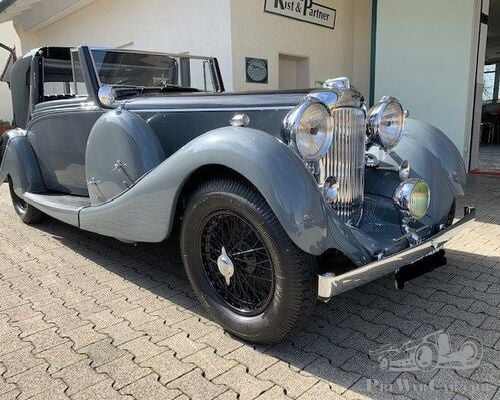
Lagonda LG 45 Coupe de Ville Sedanca by Mayfair
The successor to the M45, the LG45 was built around the same highly capable, competition-proven 4.5-litre Meadows inline-six engine, but featured r..
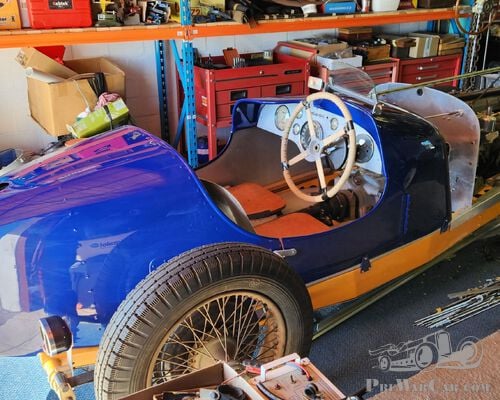
Riley TT Sprite
1935 6-cylinder TT Sprite replica. Chassis # 46A2722. Engine # 6A2722. Original Ulster Imp body. Restoration nearing completion. Engine, G..
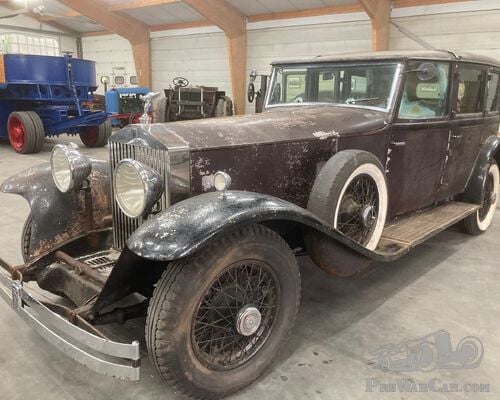
Rolls-Royce
Rolls-Royce Phantom ll chassisnummer 287 AJS. bouwjaar 1932, Links gestuurd, Brewster Keswick Sedance Towncar