The global magazine and marketplace for classic car enthusiasts, by enthusiasts.


Filter
Classic Nash, DeSoto for sale - Nash, DeSoto cars for sale
-

1931 Nash 4 door special sedan
Model: series 870, model 877-1560, 4-door special saloon Colour: dark blueInterior: beige fabricEngine: 8-cylinder in-line, 227.5 cubic inches, 78 hpTransmission: manual, 3 gearsCondition: unrestoredPrice: € 25,000 Description:Incredibly beautiful unrestored car in superb condition. .. -
1931 Nash 480-455 Landaulette Sedan
Nash 480-455 Landaulette from 1931 only a few from these Landaulettes are made they say about 29 cars are produced like this. Frank Kennis Phone: 00.31.622.420.766 or mail me: info@KennisCars.NL www.KennisCars.NL Classic Car Dealer for Europe Cadillac ; Mercedes ; Rolls-Royce ; Delage ; Bugatti ; Bentley ; Dodge ; Opel.. -
Nash 1933 Club Sedan Big Six 1127
Beautifull Nash 1127 Club Sedan with 6 cylinder engine 3835 CC with 75 HP. The Nash has dutch documents and is in a good running condition. This could be your ultimate Bony and Clide car. Frank Kennis Phone: 00.31.622.420.766 or mail me: info@KennisCars.NL www.KennisCars.NL Classic Car Dealer for Europe Cadillac ; Mercedes ; Rolls-Royce ; .. -
1931 Nash ”Eight-70” 871 2d Convertible Sedan Landau
The car has undergone a complete renovation regarding chassis, engine, driveline and convertible topThe engine is drilled, new pistons and connecting rod bearings and new frame bearings.The body is in new condition and the convertible top is newly manufactured. Some minor work remains to complete it for registration and inspection...


Nash
US, 1917 – 1957
(1) Nash Motor Co, Kenosha, Wisc., 1917 – 1954
(2) American Motors Corp, Kenosha, Wisc., 1954 – 1957
Charles W. Nash, the former President of General Motors, acquired the Thos. B. Jeffery Co in July 1916, and from the 1918 season onwards the cars were marketed under his name, Nash cars. The first Nash car was a 4-litre six with push-rod-operated overhead valves, followed in 1922 by a 4-cylinder Nash car which also had overhead valves at a time when most American manufacturers adhered to the L-head. Rubber-mounted engines appeared in the same year on Nash cars, when Nash sold 41.000 medium-priced Nash cars (the Nash four cost $985, the Nash six about $500 more). In 1924 Nash cars acquired the defunct Mitchell concern at Racine and the ailing Lafayette Co of Milwaukee, producers of a luxury V8 (when the latter name was revived in 1934 it was used for an uninspired sv 6-cylinder machine selling for under $600). They also produced, in 1925 – 1926, the 6-cylinder Nash Ajax, an sv Nash cars that they developed into a cheap line. During the latter part of the Vintage era the Nash carcompany concentrated on 6-cylinder Nash cars, with side valves in the cheaper Nash car models and overhead valves in the higher-priced range, though 1930 saw a Nash car with a 4.9-litre straight-8 with dual coil ignition and overhead valves, a type that was progressively developed until 1942. Engines of this type Nash car were used in the British Jensen of 1939.
The Nash car company successfully rode out the Depression though sales dropped to below 15.000 Nash cars in 1933, when the Nash car company were building a really big eight Nash car with an 11ft 10in wheelbase and a capacity of 5.3-litres as well as two sixes and a smaller straight-8. Synchromesh had been adopted on Nash cars in 1932, and overdrive became an option in 1935, when the bigger Nash cars had the fashionable fastbacks and spatted rear wheels. Other options on the Nash car widely publicized in the later 1930s were seats convertible into a bed and the Nash car firm’s ‘Weather Eye’ system of air conditioning. Coil-spring independent front suspension and steering-column gear-change followed in 1939, in which year a version of the Nash Ambassador Six was available in England with the option of a Perkins 4.7-litre diesel engine in place of the usual push-rod ohv petrol unit. Unitary construction appeared for the first time on the inexpensive sv 6-cylinder 600 Nash car sedan, introduced for 1941 at $785. This Nash car was the ancestor of the famous Rambler series and reappeared in 1945. Only 6-cylinder Nash cars were made from 1945 until 1954, and with the advent of the Nash Airflyte range in 1949 unitary construction was standardized. These Nash cars had all four wheels enclosed, and a one-piece wrap-around windscreen.
In 1950 there came the experimental NXI Nash car convertible with an Austin A40 engine, later made for Nash cars by Austin of Birmingham as the Metropolitan, while in 1951 there appeared the 3.8-litre Nash-Healey roadster, a British Healey with an ohv 6-cylinder Nash car engine. From 1950 onwards the Rambler accounted for most of Nash cars production, but the original Nash carname survived the amalgamation with Hudson and the creation of American Motors in 1954. In 1955 the big Nash cars were fitted with an ohv 5.244cc V8 engine, this and its Ultramatic transmission being made by Packard. A 5.8-litre AMC-built eight was adopted in 1957 by Nash cars, but sales were negligible and the 1958 Nash cars were known as Rambler Ambassadors.
Source: Georgano, encyclopedia of motorcar; MCS
The information is written with the greatest of care. However, if you have any suggested amendments please contact us at office@prewarcar.com
DeSoto
US, 1913 – 1916
DeSoto Motro Car Co, Auburn, Ind.
The DeSoto appears to have succeeded the Zimmerman. This was a large car with a 55hp, 6-cylinder engine, which was furnished with a compressed-air starter. The DeSoto model Six-55 five-seater touring car sold for $2185.
US, 1928 – 1960
Chrysler Motors Corp, Detroit, Mich.
The DeSoto was launched in 1928 as a 3.2-litre side valve six to compete with Oldsmobile, Pontiac and the cheaper Nashes. Styling and general design of the DeSoto were in line with the 1929 Chryslers, and at $885 for a DeSoto sedan 90.000 were sold in the first twelve months. A 3.4-litre straight-8 DeSoto on a 9ft 6in wheelbase was announced for 1930 as the world’s cheapest 8-cylinder car. However, DeSoto suffered badly in the Depression, and in 1932, when flexible rubber engine mountings and free wheels were made available, sales dropped to 26.000 DeSoto cars.
The DeSoto disappeared from the British market about this time, though certain ‘Chrysler’ models listed in England (the Mortlake, Croydon, and some of the Richmonds) were in fact DeSoto cars in all but name. A 6-cylinder version of Chrysler’s advanced unitary-construction Airflow, the SE-type with a 4-litre engine, was brought out in 1934, but was an unsuccessful as its bigger sister. Later DeSotos followed regular Chrysler lines closely though in later years there was a tendency for DeSoto to move into a higher price class than Dodge; by 1952 DeSotos started $300 higher than the companion make.
By 1939 the DeSoto cars for sale were being made with independent front suspension, hypoid back axles and column change. There was a choice at DeSoto of two 6-cylinder engines and three wheelbase lengths, the longest of these being reserved for seven-seater bodywork – DeSoto continued to offer a really roomy family car right up to 1954. A 4-speed semi-automatic Vacumatic transmission became an option in 1941, but DeSoto’s big post-war change of models did not take place until 1952, when the division followed Chrysler’s lead in adopting the oversquare ohv V8; the DeSoto version was of 4½-litre capcity and developed 16-bhp. With the advent of Chrysler’s ‘flight sweep’ styling in 1955, the side-valve sixes were dropped and the standard engine in a DeSoto was now a 4.8-litre eight, giving 185bhp in Firedome guise, and 200bhp in Fireflite form. Though this redesigning saved Chrysler sales generally, the slump in the medium-price class had an adverse effect on DeSoto and in 1959 the DeSoto division was merged with Plymouth. Last of the DeSotos were the 1961 models, unitary-construction cars with a choice of three engines: Plymouth’s 145bhp ohv ‘slant six’ as used in the Valiant, and V8s of 230 and 265bhp, the two former only in Canadian DeSotos. Production of DeSoto cars ceased in November 1960 after only a few had been delivered.
Source: Georgano, encyclopedia of motorcar; MCS
The information is written with the greatest of care. However, if you have any suggested amendments please contact us at office@prewarcar.com


Featured
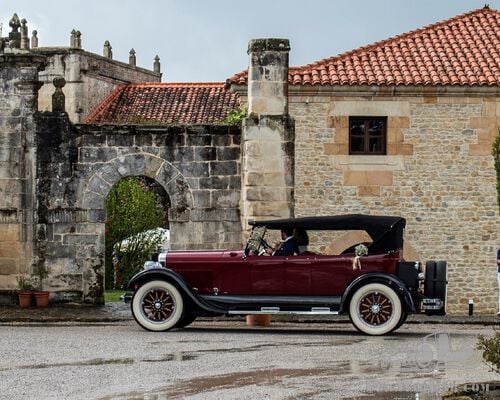
1925 Lincoln Model L Phaeton by Brunn - Excellent provenance
Retaining its original matching-numbers engine and chassis (both numbered 24576), the car benefits from an extensively documented history and..
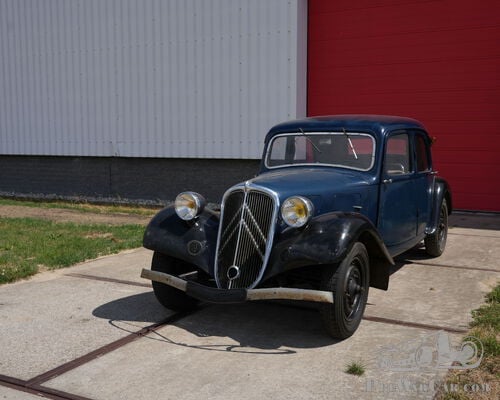
1935 Citroën Traction Avant
Early-production Traction AvantExceptionally original, unrestored conditionRecently part of a major museum collection
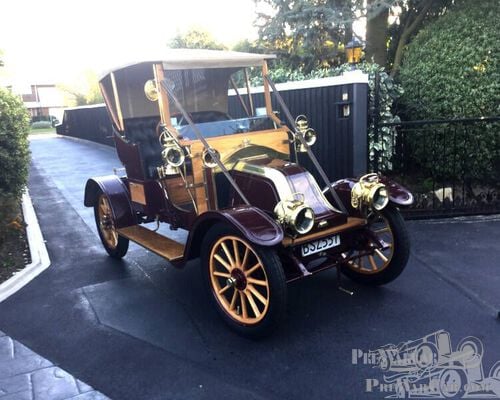
Renault /AX 1913 - named Gigi
Purchased fully renovated from New Zealand and imported to the UK. We have owned her for over10 years. Gigi is currently living in France where she..