The global magazine and marketplace for classic car enthusiasts, by enthusiasts.


Filter
Classic Nash, Stoewer for sale - Nash, Stoewer cars for sale
-

1931 Nash 4 door special sedan
Model: series 870, model 877-1560, 4-door special saloon Colour: dark blueInterior: beige fabricEngine: 8-cylinder in-line, 227.5 cubic inches, 78 hpTransmission: manual, 3 gearsCondition: unrestoredPrice: € 25,000 Description:Incredibly beautiful unrestored car in superb condition. .. -
1931 Nash 480-455 Landaulette Sedan
Nash 480-455 Landaulette from 1931 only a few from these Landaulettes are made they say about 29 cars are produced like this. Frank Kennis Phone: 00.31.622.420.766 or mail me: info@KennisCars.NL www.KennisCars.NL Classic Car Dealer for Europe Cadillac ; Mercedes ; Rolls-Royce ; Delage ; Bugatti ; Bentley ; Dodge ; Opel.. -
Nash 1933 Club Sedan Big Six 1127
Beautifull Nash 1127 Club Sedan with 6 cylinder engine 3835 CC with 75 HP. The Nash has dutch documents and is in a good running condition. This could be your ultimate Bony and Clide car. Frank Kennis Phone: 00.31.622.420.766 or mail me: info@KennisCars.NL www.KennisCars.NL Classic Car Dealer for Europe Cadillac ; Mercedes ; Rolls-Royce ; .. -
1924 Stoewer type D3 roadster
Rare opportunity to buy a vintage 1924 Stoewer type D3 roadster in fully restored condition. More than € 50K were spent in 2018 and 2019 on its restoration . Detailed work invoices come with the car. A video can be sent on request . Price € 64000 ex Eibergen Netherlands imported EEC.


Nash
US, 1917 – 1957
(1) Nash Motor Co, Kenosha, Wisc., 1917 – 1954
(2) American Motors Corp, Kenosha, Wisc., 1954 – 1957
Charles W. Nash, the former President of General Motors, acquired the Thos. B. Jeffery Co in July 1916, and from the 1918 season onwards the cars were marketed under his name, Nash cars. The first Nash car was a 4-litre six with push-rod-operated overhead valves, followed in 1922 by a 4-cylinder Nash car which also had overhead valves at a time when most American manufacturers adhered to the L-head. Rubber-mounted engines appeared in the same year on Nash cars, when Nash sold 41.000 medium-priced Nash cars (the Nash four cost $985, the Nash six about $500 more). In 1924 Nash cars acquired the defunct Mitchell concern at Racine and the ailing Lafayette Co of Milwaukee, producers of a luxury V8 (when the latter name was revived in 1934 it was used for an uninspired sv 6-cylinder machine selling for under $600). They also produced, in 1925 – 1926, the 6-cylinder Nash Ajax, an sv Nash cars that they developed into a cheap line. During the latter part of the Vintage era the Nash carcompany concentrated on 6-cylinder Nash cars, with side valves in the cheaper Nash car models and overhead valves in the higher-priced range, though 1930 saw a Nash car with a 4.9-litre straight-8 with dual coil ignition and overhead valves, a type that was progressively developed until 1942. Engines of this type Nash car were used in the British Jensen of 1939.
The Nash car company successfully rode out the Depression though sales dropped to below 15.000 Nash cars in 1933, when the Nash car company were building a really big eight Nash car with an 11ft 10in wheelbase and a capacity of 5.3-litres as well as two sixes and a smaller straight-8. Synchromesh had been adopted on Nash cars in 1932, and overdrive became an option in 1935, when the bigger Nash cars had the fashionable fastbacks and spatted rear wheels. Other options on the Nash car widely publicized in the later 1930s were seats convertible into a bed and the Nash car firm’s ‘Weather Eye’ system of air conditioning. Coil-spring independent front suspension and steering-column gear-change followed in 1939, in which year a version of the Nash Ambassador Six was available in England with the option of a Perkins 4.7-litre diesel engine in place of the usual push-rod ohv petrol unit. Unitary construction appeared for the first time on the inexpensive sv 6-cylinder 600 Nash car sedan, introduced for 1941 at $785. This Nash car was the ancestor of the famous Rambler series and reappeared in 1945. Only 6-cylinder Nash cars were made from 1945 until 1954, and with the advent of the Nash Airflyte range in 1949 unitary construction was standardized. These Nash cars had all four wheels enclosed, and a one-piece wrap-around windscreen.
In 1950 there came the experimental NXI Nash car convertible with an Austin A40 engine, later made for Nash cars by Austin of Birmingham as the Metropolitan, while in 1951 there appeared the 3.8-litre Nash-Healey roadster, a British Healey with an ohv 6-cylinder Nash car engine. From 1950 onwards the Rambler accounted for most of Nash cars production, but the original Nash carname survived the amalgamation with Hudson and the creation of American Motors in 1954. In 1955 the big Nash cars were fitted with an ohv 5.244cc V8 engine, this and its Ultramatic transmission being made by Packard. A 5.8-litre AMC-built eight was adopted in 1957 by Nash cars, but sales were negligible and the 1958 Nash cars were known as Rambler Ambassadors.
Source: Georgano, encyclopedia of motorcar; MCS
The information is written with the greatest of care. However, if you have any suggested amendments please contact us at office@prewarcar.com
Stoewer
D, 1899 – 1939
(1) Gebrüder Stoewer, Fabrik für Motorfahrzeuge, Stettin, 1899 – 1916
(2) Stoewer-Werke AG vorm. Gebr. Stoewer, Stettin, 1916 – 1939
The Stoewer car factory developed out of the Stoewer ironworks and was among the pioneers of the German car industry. After manufacturing motor cycles, tricycles and quadricycles for two years, Stoewer turned to cars in 1899. The first Stoewer car had a rear-mounted 2-cylinder engine. 4-cylinder Stoewer cars followed in 1901, and electric Stoewer cars were also produced. Best known were the 2-cylinder Type T Stoewer car (2.280cc and 3/12PS), the 4-cylinder Stoewer P4 (3.052cc and 11/22PS), the Stoewer G4 (1.500cc and 6/12PS) and the 6-cylinder Stoewer P6 (8.820cc and 34/60PS), evolved in the 1905-1907 period all Stoewer cars with shaft-drive. The Stoewer B1 of 6/16PS and the Stoewer B6 of 9/22PS which appeared in 1910 were also built by Mathis under licence. The G4 Stoewer car was the basis for the Stoewer B5, which Stoewer car in 1912 became famous by setting up a record at Brooklands with 67.7mph. The new range of Stoewer cars which appeared in 1913 was also based on successful earlier cars. They were the Stoewer C1 (6/18PS), Stoewer C2 (10/28PS) and C3 Stoewer car (6-cylinder and 19/45PS). Shortly before the outbreak of World War 1 the Stoewer car range was headed by the F4 Stoewer car with a 4-cylinder, 8.8-litre 33/100PS ohc engine. After the war an enormous Stoewer car appeared, the Stoewer D7, using a 6-cylinder 11.2-litre 42/120PS aero engine, as well as some conservative sv 4- and 6-cylinder Stoewer cars with rear wheel and transmission brakes. Front wheel brakes appeared on Stoewer cars in 1925. Stoewer introduced 8-cylinder Stoewer cars in 1928. These were the Stoewer Superior, Stoewer Marschall, Stoewer Gigant and Stoewer Repräsentant with engines ranging from 2-litres and 45bhp to 4.9-litres and 100bhp. The Stoewer car firm re-entered the economy class in 1931 with the V5, a front-driven Stoewer car with a V4 1.188cc engine, followed by the front-drive models R140 (1.369cc), R150 (1.488cc) and R180 (1.769cc). Another 8-cylinder was the front wheel drive Greif V8 with a 2.488cc engine, which was replaced by the conventional 6-cylinder 3.609cc Arcona Stoewer car in 1938. In 1934 the 1½-litre 4-cylinder Stoewer car and 2½-litre V8 Stoewer car were shown at the Brussels Salon by Monsieur Dewaet under the name D.S. (Dewaet-Stoewer). The Greif Junior was built under Tatra licence with an opposed 4-cylinder 1.474cc engine. It succeeded the Röhr Junior. In the middle of the range was the Stoewer Sedina with a 4-cylinder engine of 2.4-litres.
Production of private Stoewer cars was given up at the outbreak of World War 2 in 1939. The Stoewer car factory was destroyed during the war and production of Stoewer cars was not resumed.
Source: Georgano, encyclopedia of motorcar; HON
The information is written with the greatest of care. However, if you have any suggested amendments please contact us at office@prewarcar.com


Featured
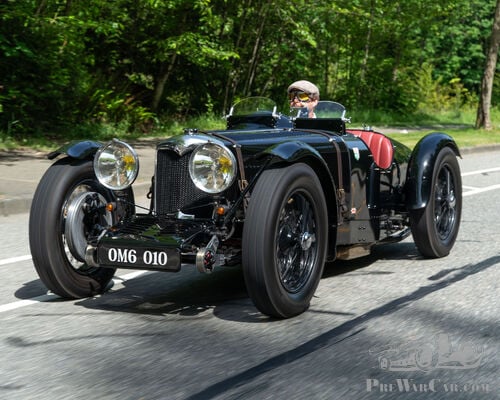
Riley 14/6 Special 1933
The ExperienceStep into the golden age of British motoring. This 1933 Riley 14/6 Special is a masterclass in pre-w..
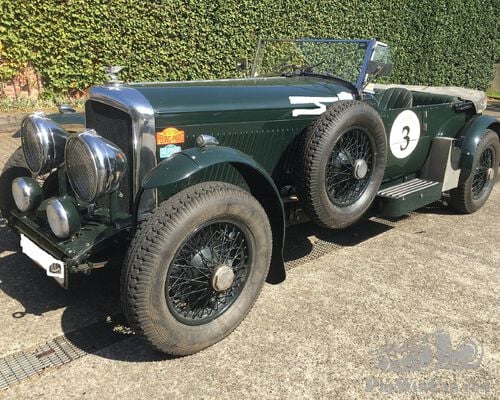
Bentley Derby Special Open Rally Car
This Bentley Derby, manufactured in 1935, has been rebuilt into a short and long-distance rally car. Full rebuilt engine in 2021, Since 2021 low mi..
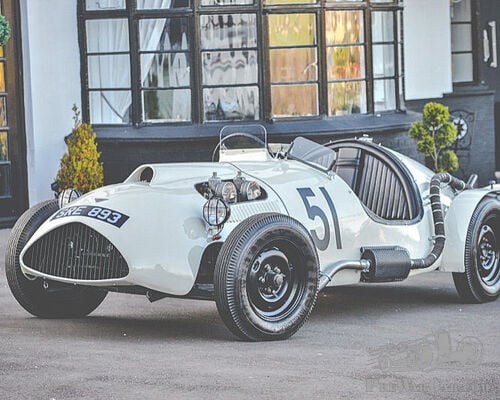
1933 Alvis 3.0 Special - One-Off Alloy Body | Period Competition Car | Featured in “Alvis – A Century of Drivers”
1933 Alvis 3. 0 Special - One-Off Alloy-Body | Period Competition Car | Featured in “Alvis – A Century of Drivers”