The global magazine and marketplace for classic car enthusiasts, by enthusiasts.


Filter
Classic Hansa, O.M. for sale - Hansa, O.M. cars for sale
-

1931 Bugatti Type 46 'Superprofilée' Coupe
1931 Bugatti Type 46 'Superprofilée' Coupe Chassis no. 46491 Engine no. 345 One of two chassis purchased from Roland Bugatti by Richard Baudens in the 1950s & wearing its first coachwork ever fitted to the car. 5,359cc SOHC Inline 8-Cylinder Eng.. -
Riley TT Sprite
1935 6-cylinder TT Sprite replica. Chassis # 46A2722. Engine # 6A2722. Original Ulster Imp body. Restoration nearing completion. Engine, Gearbox and Diff have been rebuilt.Requires aluminium bonnet (material supplied), wiring, seat upholstery and fettling to finish.Comes with many spares including complete pre-select and m.. -
Mercedes Benz 500K Cabriolet A
For sale is an original 1936 Mercedes-Benz 500K Cabriolet A. This vehicle is one of the few remaining examples with a spare wheel on the rear and stands out for its high level of originality. The Cabriolet is in very good condition and has been meticulously maintained. It is an authentic vehicle, not a replica.. -
1931 Nash 4 door special sedan
Model: series 870, model 877-1560, 4-door special saloon Colour: dark blueInterior: beige fabricEngine: 8-cylinder in-line, 227.5 cubic inches, 78 hpTransmission: manual, 3 gearsCondition: unrestoredPrice: € 25,000 Description:Incredibly beautiful unrestored car in superb condition. .. -
1938 Rolls Royce Phantom 3 Windovers Limousine
1938 Rolls Royce Phantom 3 Windovers LimousineChassis number: 3-CM-33Registration number: DUR255A pleasingly proportioned Rolls Royce Phantom 3 with coachwork by Windovers. The coachwork is rakish & quite streamlined when compared with some of the more ponderous coachwork found on these Phantom 3's. This is a low mileag.. -
Chevrolet Fleetmaster 'Woodie' Station Wagon
Chevrolet Fleetmaster 'Woodie' Station Wagon ***in absolute new state***European Car Registration in EU-Netherlands reg.no. DZ-87-00Chassis no. CL8434• The most expensive Chevrolet of its day• Imported from South Africa• Original right-hand drive model• Partially renovated in 2013 Footnote.. -
Mercedes Benz 320D convertible 4 door
Arie-Jean Engineering are proud to offer this incredibly rare Mercedes Benz 320D convertible 4 door in stunning condition. Extensively restored approx. 20 years ago in Berlin, Germany with very little use since (photographic record available). This W142 sports a powerful 6 cylinder 3. 2 Engine and desirable overdrive. (Rated at 78bhp, top speed.. -
1931 Rolls-Royce Phantom II Continental DHC
-In excellent condition with recent work by ourselves-Unique Park Ward DHC coachwork-Equipped with overdriveLike all Phantoms, the Continental was built for high-speed touring, offering a breath-taking ability to cover long distances in sublime comfort at high speed.Of the 1400 Phantom IIs produced, only 280 Continent.. -
Te koop Morgan Aero 1927
De Morgan Aero is geproduceerd van 1920 tot rond 1933. Dit voertuig met chassisnummer B718 is van 1927. De driewieler is in goed rijdbare en in originele staat, video’s hierover zijn het bewijs. De aandrijving (koppeling & bak) en dynamo zijn op kwalitatief gezien technisch verantwoorde wijze enigszins aangepast, waarmee de technische betrou.. -
1939 Daimler E4 Labourdette
1939 Daimler E4 "Light Eight" , body "Labourdette"Not restored, complete.Aluminum body made by "Labourdette"The chassis was commenced in 1938 and completed in March 1939 before being fitted with the body by Labourdette, which was known as a 'Vutotal' design. Very interesting, unique car, ideal for a project "Concourse d'Ele..


Hansa
D, 1906 – 1939
(1) Hansa Automobil – Gesellschaft mbH, Varel, 1906 – 1914, Bielefeld, 1913 – 1914
(2) Hansa-Lloyd-Werke AG, Varel, 1914 – 1929, Bremen, 1929 – 1931
(3) Hansa-Lloyd und Goliath-Werke Borgward & Tecklenborg, Bremen, 1931 – 1937
(4) Hansa Lloyd-Goliath-Werke Carl F.W. Borgward, Bremen, 1937 – 1939
The Hansa works were founded with the intention of producing small cars. The first was a Hansa 7/9ps car with a single-cylinder 720cc De Dion engine based on the French Alcyon. The Hansa appeared in 1906, and was sold under the name HAG. After a few more models with proprietary engines such as Fafnir the Hansa 6/14ps appeared in 1907 with a 4-cylinder engine of the Hansa company’s own design. A wide range of models was offered during the following years. Among them were the Hansa Types D (10/30PS, 2.612cc) and Hansa E (15/50PS, 3.815cc) of 1911 with overhead valves, a feature which was rare at that time. Hansa cars were produced in considerable numbers and Hansa cars were renowned for their high technical standard and their good workmanship.
In 1913 Hansa took over the Westfalia works at Bielefeld and Hansa cars were built there in 1913 and 1914. The Hansa Type F (2.515cc) took part successfully in the 1914 Austrian Alpine Trial. In 1914 Hansa merged with Lloyd, the firm adopting the name Hansa-Lloyd. The production of Hansa cars was carried on until World War 1. After the war Hansa concentrated on light and medium-sized cars which were marketed as Hansa. The Lloyd factory specialized in the heavier cars and commercials, which were sold as Hansa-Lloyds. Post-war models were the Hansa P 8/36PS with a 4-cylinder 2.063cc engine, also available in a short-wheelbase sports version, and two cars, a 13/60PS (6-cylinder, 3.262cc) and a 16/70PS (8-cylinder, 3.996cc) which were equipped with American Continental engines.
In 1929 Hansa was taken over by Borgward-Goliath. Production in the Varel works ceased and Hansa private cars were subsequently built only in Bremen. The Hansa Konsul, Hansa Senator, Hansa Matador and Hansa Imperator were family and prestige cars with 4-, 6-, and 8-cylinder engines with capacities up to 5.8-litres and outputs to 100bhp. The 3.2-litre Hansa Senator was an unusually large four for the period, and the Hansa Matador had a 2.6-litre Continental engine, and the combination of independent rear suspension and a backbone frame. In 1933 the small Hansa 400 was introduced. It had a 2-cylinder 2-stroke rear engine of 400cc and was later available with a 500cc engine. A new model, the Hansa 1100, with all independent suspension appeared in 1934. It was in production until 1939 and became very popular. Other models were the 6-cylinder ‘Hansa 1700’ (also available in a twin-carburettor sports version), the ‘Hansa 2000’ and the ‘Hansa 3500’ Privat.
After 1938 Hansa cars were marketed as Borgwards. In 1958 the Hansa name was revived for the flat-four Goliath; it had previously been used as a type name for some Borgwards.
Source: Georgano, encyclopedia of motorcar; HON
The information is written with the greatest of care. However, if you have any suggested amendments please contact us at office@prewarcar.com
O.M.
Italy, 1918 – 1934
(1) SA Officine Meccaniche, Brescia, 1918 – 1928
(2) O.M. Fabbrica Bresciana di Automobili, Brescia, 1928 – 1934
The Officine Meccaniche (OM cars) was a locomotive-building firm that absorbed Züst in 1918, and continued the production of that firm’s 4.7-litre sv 4-cylinder 25/35hp until 1923. Alongside this, however, they introduced their own design OM cars, with conventional sv monobloc engines, detachable heads, 12-volt coil ignition, thermos-syphon cooiling, and single-plate clutches. The OM cars were the work of an Austrian named Barratouché and changed little with the years, so much so that it is true that only one OM car theme reached the public – first as a four, and then as the famous 2-litre 6-cylinder OM Superba. The OM carcompany showed, but did not market, a 3-litre straight-8 OM car development in 1928. First of the OM car series was the OM 465, a 1.327cc four rated at 12/15hp in Italy. Output of this OM car was 18bhp and there were three forward speeds. In 1921 came the 1.410cc OM 467, and a year later this OM car gave way to the 1½-litre OM 469, available from the start with 4-wheel brakes and (until 1925) with straight bevel back axle. Initially developing a modest 40bhp, this OM car was giving 60bhp in single-carburettor touring form by 1926, and sports model OM cars were capable of 75mph. Competition successes of OM cars included the 1925 Tripoli GP, 4th at Le Mans in 1925 and 1926, and a victory at Minoia and Morandi in the first Mille Miglia of 1927.
In 1926 OM cars built a dohc straight-8 OM car for the 1.500cc Grand Prix Formula, but its 3-speed gearbox was against it, and the best showing of this OM car was a 2nd place in the 1927 European GP. The OM 665 was extensively modified for the British market by Rawlences, the concessionaires in London, and OM cars appeared with dual ignition, 12-plug heads of Ricardo type, 4-speed gearboxes of ENV make with right-hand change, and Dewandre servo brakes. In 1929 Rawlence produced an ohv conversion of the OM car with three carburetors and dual ignition that ran in the TT and the Double-Twelve. This OM car was catalogued in England, though never in Italy, where in the same year some works-built supercharged 80bhp sv OM cars appeared with raked radiators and underslung frames, followed by improved 1930 OM car versions on which capacity was increased to 2.350cc. This OM car was nog offered to the public, though standard 1930 OM cars had 2.2-litre engines; this size persisted until 1934 and supercharged sports editions of OM cars were also listed.
Though OM cars could still race to some purpose (there was a 2nd with an OM car in the 1931 Mille Miglia), the emphasis of OM cars was shifting towards commercial vehicles powered by Saurer diesel engines made under licence, and in 1930 the stock of private OM cars on hand was sold to the Esperia concern, run by two former OM car executives, Coletta and Mangano. It seems unlikely that they built any vehicles, and when Fiat acquired OM cars in 1933 the private cars were doomed.
Curiously, a new design for the OM car was announced in 1934; this one, the OMV or Alcyone, had synchromesh, hydraulic brakes, and overhead exhaust valves, but though the OM car did the round of the shows, this OM car was not made in series. A 1½-litre ohc four designed by Olivio Pellegatti did not even get off the drawing-board. O.M. still exist as makers of trucks, tractors and railway rolling-stock, but since 1968 they have been a sezione of Fiat.
Source: Georgano, encyclopedia of motorcar; MCS
The information is written with the greatest of care. However, if you have any suggested amendments please contact us at office@prewarcar.com


Featured

K3 Replica on KN Chassis
"The K3 Magnette must rank in the history books as the most famous and successful of all the record breaking MGs. With only 33 examples produced durin..
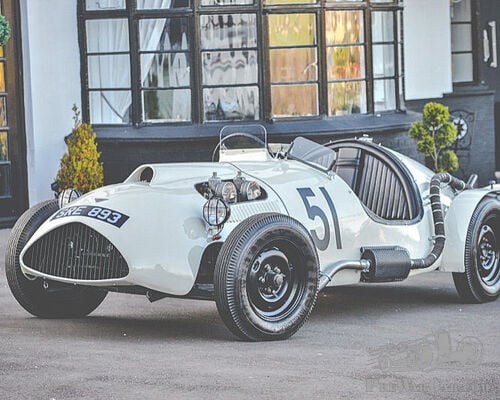
1933 Alvis 3.0 Special - One-Off Alloy Body | Period Competition Car | Featured in “Alvis – A Century of Drivers”
1933 Alvis 3. 0 Special - One-Off Alloy-Body | Period Competition Car | Featured in “Alvis – A Century of Drivers”

1939 Wanderer W 23 Gläser(Dresden) Convertible
Wanderer W 23 Gläser(Dresden) Convertible in original condition Built in 1939 for sale. Ready to drive with TÜV and approval as a historic vehicle..