The global magazine and marketplace for classic car enthusiasts, by enthusiasts.


Filter
Classic Jawa, O.M. for sale - Jawa, O.M. cars for sale
-

Chevrolet KD Pickup 1940, nice original
For sale is this nice original Chevrolet KD Pickup. Built in 1940, it comes with its original 3,5 litre six cylinder engine, coupled to a four speed gearbox. We made it running after years of storage and it runs and drives as can be seen in the video on our Youtube channel. Rust is mainly on the fenders whereas the rest of the frame and body see.. -
1937 Austin 10 Cambridge Saloon | The Ernie Warren Collection Auction | 13th June 2026
A 1937 Austin 10 Cambridge Saloon.Reg No. BPW 8456.Car No. GRL115941.Engine No. 115941.Black with brown interior.The Austin 10 was part of Austin’s best-selling model range. Fitted with a 1125cc side-valve engine, it continued in production with several upgrades along the way until 1947. -
1936 Daimler Light 15 Six-Light Saloon | The Ernie Warren Collection Auction | 13th June 2026
A 1936 Daimler Light 15 Six-Light Saloon.Reg No. AAP 586.Car No. 43965.Engine No. 26495.Black with brown interior.Mulliners were major contractors to Daimler, supplying a variety of body styles of which this Six-Light example was a popular choice. The 2L 6-cyl OHV engine and pre-selector g.. -
1914 Swift Cyclecar | The Ernie Warren Collection Auction | 13th June 2026
A 1914 Swift Cyclecar.Reg No. W 3150.Car No. 1304.Engine No. E5473.Grey with brown interior.Exploiting the fashion for cyclecars in the pre-WWI period, Swift replaced their single-cylinder 7hp car with the twin-cylinder 972cc engine. Featuring thermos-syphon cooling, magneto ignition, leat.. -
1929 Rover 10/25 Sportsman Coupe | The Ernie Warren Collection Auction | 13th June 2026
A 1929 Rover 10/25 Sportsman Coupe.Reg No. UU823.Car No.59810.Engine No. 58910.Black with red interior.Further enlarged from the 9hp models of 1924 onwards, in 1928 the ‘sporting’ engine achieved 1185cc with an OHV configuration. The Weymann style fabric body ensured a lightness that the e.. -
1920 Humber 10.5hp two-seat tourer | The Ernie Warren Collection Auction | 13th June 2026
A 1920 Humber 10.5hp two-seat tourer.Reg No. AH 3975.Car No. K3829.Engine No. 3865.Blue with black interior.Humber virtually stopped production of civilian cars during WWI and the ‘Ten’ emerged after the cessation of hostilities with electric lighting and dynamo starting. Along with the ‘F.. -
1932 Austin 7 RN Box Saloon | The Ernie Warren Collection Auction | 13th June 2026
A 1932 Austin 7 RN Box Saloon.Reg No. 939 YUG.Car No.161630.Engine No. M162918.Red and black with red interior.The Box saloons were a popular alternative to the motorcycle and sidecar. 4 wheel brakes and a four-speed gearbox made for a tractable light car.First registered in Edinburgh in 1.. -
1923 Talbot 8/18 two-seat tourer | The Ernie Warren Collection Auction | 13th June 2026
A 1923 Talbot 8/18 two-seat tourer. Reg No. XK 153.Car No. 15135.Engine No. 1133HB.Maroon with black interior.Originally a design of the Sunbeam engineer, Louis Coatalen, the 8/18 was regarded as one of the higher quality light cars of the 1920’s.With its 970cc OHV engine, the car is not p.. -
1932 Hillman Minx with a rare Tickford body | The Ernie Warren Collection Auction | 13th June 2026
A 1932 Hillman Minx with a rare Tickford body.Reg No. YY 9613.Car No. 7533.Engine No. 7590.Cream and black with grey interior.In 1929, Hillman was taken over by the Rootes Group and some of its offerings included the Sunshine Coachwork by Salmons & Sons. Christened the Tickford Foursome Coupe..


Jawa
CS, 1934 – 1939
Zbrojovka Ing. Janecek, Prague
The name Jawa originates from a combination of Janecek and Wanderer, adopted after the Czech firm had acquired a licence to produce German Wanderer motor-cycles. In 1934 Jawa started to build DKW cars under licence. The Jawa 700 had the DKW 2-cylinder 2-stroke 684cc engine, front drive and chassisless wood-frame body, but used a longer wheelbase. The Jawa car was available with various bodies, later versions having steel ones. Streamlined specimens of the Jawa in open and closed form were quite successful in numerous sports events. A new model, the Jawa Minor, built to Tatra designs but based on DKW principles, was introduced in 1937. This Jawa car had a 2-cylinder 2-stroke 615cc engine and front drive. At first it was available as a very attractive two-seater roadster; later a saloon version was also offered. The Jawa Minor was the basis for the post-war Aero Minor. Motorcycle production of Jawa continued after the war, and a number of prototype Jawa minicars were built between 1953 and 1956.
Source: Georgano, encyclopedia of motorcar; HON
The information is written with the greatest of care. However, if you have any suggested amendments please contact us at office@prewarcar.com
O.M.
Italy, 1918 – 1934
(1) SA Officine Meccaniche, Brescia, 1918 – 1928
(2) O.M. Fabbrica Bresciana di Automobili, Brescia, 1928 – 1934
The Officine Meccaniche (OM cars) was a locomotive-building firm that absorbed Züst in 1918, and continued the production of that firm’s 4.7-litre sv 4-cylinder 25/35hp until 1923. Alongside this, however, they introduced their own design OM cars, with conventional sv monobloc engines, detachable heads, 12-volt coil ignition, thermos-syphon cooiling, and single-plate clutches. The OM cars were the work of an Austrian named Barratouché and changed little with the years, so much so that it is true that only one OM car theme reached the public – first as a four, and then as the famous 2-litre 6-cylinder OM Superba. The OM carcompany showed, but did not market, a 3-litre straight-8 OM car development in 1928. First of the OM car series was the OM 465, a 1.327cc four rated at 12/15hp in Italy. Output of this OM car was 18bhp and there were three forward speeds. In 1921 came the 1.410cc OM 467, and a year later this OM car gave way to the 1½-litre OM 469, available from the start with 4-wheel brakes and (until 1925) with straight bevel back axle. Initially developing a modest 40bhp, this OM car was giving 60bhp in single-carburettor touring form by 1926, and sports model OM cars were capable of 75mph. Competition successes of OM cars included the 1925 Tripoli GP, 4th at Le Mans in 1925 and 1926, and a victory at Minoia and Morandi in the first Mille Miglia of 1927.
In 1926 OM cars built a dohc straight-8 OM car for the 1.500cc Grand Prix Formula, but its 3-speed gearbox was against it, and the best showing of this OM car was a 2nd place in the 1927 European GP. The OM 665 was extensively modified for the British market by Rawlences, the concessionaires in London, and OM cars appeared with dual ignition, 12-plug heads of Ricardo type, 4-speed gearboxes of ENV make with right-hand change, and Dewandre servo brakes. In 1929 Rawlence produced an ohv conversion of the OM car with three carburetors and dual ignition that ran in the TT and the Double-Twelve. This OM car was catalogued in England, though never in Italy, where in the same year some works-built supercharged 80bhp sv OM cars appeared with raked radiators and underslung frames, followed by improved 1930 OM car versions on which capacity was increased to 2.350cc. This OM car was nog offered to the public, though standard 1930 OM cars had 2.2-litre engines; this size persisted until 1934 and supercharged sports editions of OM cars were also listed.
Though OM cars could still race to some purpose (there was a 2nd with an OM car in the 1931 Mille Miglia), the emphasis of OM cars was shifting towards commercial vehicles powered by Saurer diesel engines made under licence, and in 1930 the stock of private OM cars on hand was sold to the Esperia concern, run by two former OM car executives, Coletta and Mangano. It seems unlikely that they built any vehicles, and when Fiat acquired OM cars in 1933 the private cars were doomed.
Curiously, a new design for the OM car was announced in 1934; this one, the OMV or Alcyone, had synchromesh, hydraulic brakes, and overhead exhaust valves, but though the OM car did the round of the shows, this OM car was not made in series. A 1½-litre ohc four designed by Olivio Pellegatti did not even get off the drawing-board. O.M. still exist as makers of trucks, tractors and railway rolling-stock, but since 1968 they have been a sezione of Fiat.
Source: Georgano, encyclopedia of motorcar; MCS
The information is written with the greatest of care. However, if you have any suggested amendments please contact us at office@prewarcar.com


Featured

K3 Replica on KN Chassis
"The K3 Magnette must rank in the history books as the most famous and successful of all the record breaking MGs. With only 33 examples produced durin..
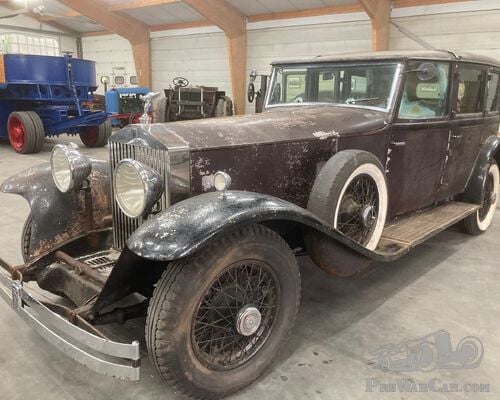
Rolls-Royce
Rolls-Royce Phantom ll chassisnummer 287 AJS. bouwjaar 1932, Links gestuurd, Brewster Keswick Sedance Towncar

1939 Wanderer W 23 Gläser(Dresden) Convertible
Wanderer W 23 Gläser(Dresden) Convertible in original condition Built in 1939 for sale. Ready to drive with TÜV and approval as a historic vehicle..