The global magazine and marketplace for classic car enthusiasts, by enthusiasts.


Filter
Classic O.M., M.M.C. for sale - O.M., M.M.C. cars for sale
-

1935 Ford Pickup
Offered for sale is 1935 Ford Pickup in very good preserved condition. Imported from Spain, bodywork is in lovely condition, only little corrosion. Car needs to be technically commissioned. With the car comes several documents, including an original Spanish title. -
Imperia 8/25 racing/sport car
Imperia 8/25 racing/sport car with Couchard patent slide-valve engine. Fully restored car, the radiator cooling design is very special and unique. Hallot cable braking system. (make an offer or proposal for an exchange) -
Imperia 8/25 1923
Imperia 8/25 1923,Couchard patent slide-valve engine,fully restored rolling chassis,interior still needs finishing.(make an offer or proposal for an exchange) -
MASE CC Sport 1921
Restoration to be finishedRadiator and tank overhauled, etc.Gives with the car: 1 engine, 1 gearbox, 2 radiators, parts, numerous documents.Restauration à finirRadiateur et réservoir révisés, etc,...Donne avec la voiture : 1 moteur, 1 boîte de vitesse, 2 radiateurs, pièces, nombreux documents. -
Benjamin Type B 1923
Car to be restartedGives with the car: 3 engines, parts, numerous documentsVoiture à remettre en route Donne avec la voiture : 3 moteurs, pièces, nombreux documents -
1929 Rolls-Royce 20/25 Estate Car
Extremely unusual well-proportioned estate coachwork from Burbage & SonsThoroughly well sorted benefitting from significant work from ourselvesCharming and practical vehicle accompanied by an interesting early history Coming off test on Christmas Eve 1929, GDP 43 was delivered to coachbuilder Th.. -
1938 BMW 328 Roadster 1938 for sale
1938 BMW 328 Roadster Chassis number 85316 Registration number: TBA €790,000.00 Part of a small collection of rare BMW cars: This 328 was found as a wreck in the late 1960's with the then Czechslovakian title documents going back to 4th November 1970 when it was registered in Bratislava. The registration lists a succe.. -
'Halford Special' 1923 Aston Martin
One of the most advanced race cars of the mid-1920s, the Halford Special was built by engine designer Major Frank Halford using Aston Martin chassis, number ‘1916’. In its original configuration, this chassis was the first Aston Martin built for sale and competed at Brooklands in 1923 but crashed in a Voiturette race in Boulogne the following ye.. -
Marmon Type 70 Sedan 1930 for sale
Marmon-Roosevelt straight eight sedan. Model 97, Type 70. The body was built by Hayes Corp. Roosevelt is the companion make to Marmon, nevertheless the Marmon label is featured on the car. The car makes a striking impression with it's six wire wheels and handsome headlights. It runs and drives but it requires work. The restoration is older and .. -
5 ROVERS in the BICYCLE COLLECTORS ONLINE AUCTION
5 ROVER BICYCLES in the BICYCLE COLLECTORS ONLINE AUCTIONhttps://auction.onlinebicyclemuseum.co.uk


O.M.
Italy, 1918 – 1934
(1) SA Officine Meccaniche, Brescia, 1918 – 1928
(2) O.M. Fabbrica Bresciana di Automobili, Brescia, 1928 – 1934
The Officine Meccaniche (OM cars) was a locomotive-building firm that absorbed Züst in 1918, and continued the production of that firm’s 4.7-litre sv 4-cylinder 25/35hp until 1923. Alongside this, however, they introduced their own design OM cars, with conventional sv monobloc engines, detachable heads, 12-volt coil ignition, thermos-syphon cooiling, and single-plate clutches. The OM cars were the work of an Austrian named Barratouché and changed little with the years, so much so that it is true that only one OM car theme reached the public – first as a four, and then as the famous 2-litre 6-cylinder OM Superba. The OM carcompany showed, but did not market, a 3-litre straight-8 OM car development in 1928. First of the OM car series was the OM 465, a 1.327cc four rated at 12/15hp in Italy. Output of this OM car was 18bhp and there were three forward speeds. In 1921 came the 1.410cc OM 467, and a year later this OM car gave way to the 1½-litre OM 469, available from the start with 4-wheel brakes and (until 1925) with straight bevel back axle. Initially developing a modest 40bhp, this OM car was giving 60bhp in single-carburettor touring form by 1926, and sports model OM cars were capable of 75mph. Competition successes of OM cars included the 1925 Tripoli GP, 4th at Le Mans in 1925 and 1926, and a victory at Minoia and Morandi in the first Mille Miglia of 1927.
In 1926 OM cars built a dohc straight-8 OM car for the 1.500cc Grand Prix Formula, but its 3-speed gearbox was against it, and the best showing of this OM car was a 2nd place in the 1927 European GP. The OM 665 was extensively modified for the British market by Rawlences, the concessionaires in London, and OM cars appeared with dual ignition, 12-plug heads of Ricardo type, 4-speed gearboxes of ENV make with right-hand change, and Dewandre servo brakes. In 1929 Rawlence produced an ohv conversion of the OM car with three carburetors and dual ignition that ran in the TT and the Double-Twelve. This OM car was catalogued in England, though never in Italy, where in the same year some works-built supercharged 80bhp sv OM cars appeared with raked radiators and underslung frames, followed by improved 1930 OM car versions on which capacity was increased to 2.350cc. This OM car was nog offered to the public, though standard 1930 OM cars had 2.2-litre engines; this size persisted until 1934 and supercharged sports editions of OM cars were also listed.
Though OM cars could still race to some purpose (there was a 2nd with an OM car in the 1931 Mille Miglia), the emphasis of OM cars was shifting towards commercial vehicles powered by Saurer diesel engines made under licence, and in 1930 the stock of private OM cars on hand was sold to the Esperia concern, run by two former OM car executives, Coletta and Mangano. It seems unlikely that they built any vehicles, and when Fiat acquired OM cars in 1933 the private cars were doomed.
Curiously, a new design for the OM car was announced in 1934; this one, the OMV or Alcyone, had synchromesh, hydraulic brakes, and overhead exhaust valves, but though the OM car did the round of the shows, this OM car was not made in series. A 1½-litre ohc four designed by Olivio Pellegatti did not even get off the drawing-board. O.M. still exist as makers of trucks, tractors and railway rolling-stock, but since 1968 they have been a sezione of Fiat.
Source: Georgano, encyclopedia of motorcar; MCS
The information is written with the greatest of care. However, if you have any suggested amendments please contact us at office@prewarcar.com
M.M.C.
GB, 1897 – 1908
(1) The Great Horseless Carriage Co Ltd, Coventry, Warwickshire, 1897 – 1898
(2) The Motor Manufacturing Co Ltd, Coventry, Warwickshire, 1898 – 1907
(3) The Motor Manufacturing Co (1907) Ltd, Clapham, London S.W., 1907 – 1908
The Great Horseless Carriage Company was formed by H.J. Lawson with grandiose plans to make cars and commercial vehicles in large numbers. Premises were secured in the Motor Mills at Coventry, adjoining the works of the Daimler Company. A very small number of cars was turned out in 1897, with engines, gearboxes and frames by Daimler, bodies and wheels by the Great Horseless Carriage Co. They had 4hp engines with tube ignition, chain drive and tiller steering. In 1898 the company was reoganized as the Motor Manufacturing Company(MMC), with George Iden, previously an engineer with the London, Brighton & South Coast Railway, as works manager. Two lines of development were followed: the Daimler-based MMC cars, and motorcycles and quads with MMC-built De Dion Bouton engines. In 1899 a new rang of MMC cars designed by Iden appeared; the MMC cars had rear-mounted horizontal 2-cylinder engines, and were made in various sizes such as the 4½hp MMC Princess two-seater, the 6hp MMC Sandringham Phaeton, or the 11hp MMC Balmoral charabanc.
During its lifetime the MMC car firm went through several reorganizations and changes of programme, and by 1901 the rear-engined MMC cars had been dropped, and replaced by a range of MMC cars with front-mounted vertical engines. These MMC cars were a 5hp with an MMC-De Dion engine, and 7, 10 and 12hp cars on Panhard lines. In 1902 the MMC car range was reduced to three, and an attempt was made to use interchangeable parts on MMC cars. The models were the 5½hp single MMC car, an 8hp twin, and a 12hp four. The MMC cars were lower in appearance, but still looked rather ungainly, with large gilled-tube radiators. For 1903 the same MMC car range was made, although the four was now a 20hp, sometimes called a 25hp MMC car. They now had lower bonnets, some with honeycomb radiators, and the MMC cars used the Iden constant-mesh gearbox. A very luxurious long wheelbase touring saloon MMC car on the 25hp chassis was shown at the 1903 Paris Salon.
In December 1903 Iden resigned, and later made cars under his own name, and there was little change in the 1904 MMC carmodels. On the 8hp single-cylinder MMC car, the buyer could have mechanical inlet valves as an alternative to automatic, but all MMC cars still used chain drive. In August 1905 the Motor Mills were sold to Daimler, and MMC cars moved to new premises at Parkside. An ambitious range of six MMC cars from a 9hp single to a 30/35hp four were listed, but few were made. Two years later the MMC car company was revived and moved to London, where they planned to make a new 6-cylinder 35/45hp MMC car, but only experimental models appeared. Alfred Burgess, the manager, then formed yet another company, still called MMC cars, with premises at Finchley, but this was only concerned with selling cars.
Source: Georgano, encyclopedia of motorcar; GNG
The information is written with the greatest of care. However, if you have any suggested amendments please contact us at office@prewarcar.com


Featured
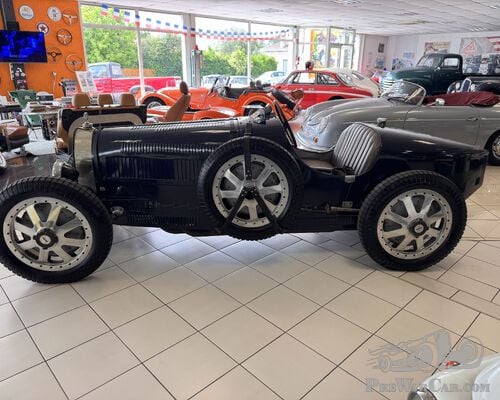
Bugatti 35 B Pur Sang
Bugatti 35 B Pur Sang,importée par un membre délégué de la FFVE il y’a une quinzaine d années.Participation à de nombreux Rallyes Bug..
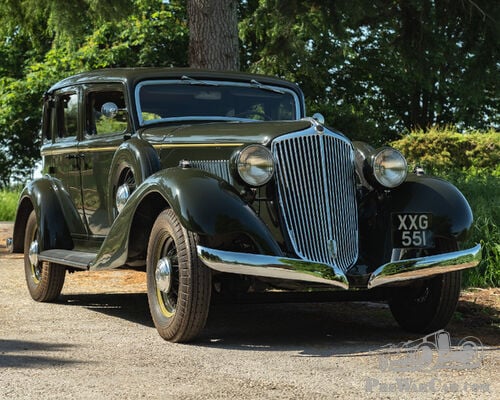
Graham Model 64 Standard Eight 'Blue Streak'
UK Registration No: XXG 551Chassis No: 1801069MOT: ExemptH&H ClassicsKelham Hall | Newark, Nottinghamshire