The global magazine and marketplace for classic car enthusiasts, by enthusiasts.


Filter
Classic Oakland, DeSoto for sale - Oakland, DeSoto cars for sale
-

1917 Oakland Model 34 Touring
Chassis/Engine No. D37548 An early product of General Motors' Oakland division — later renamed Pontiac — the Model 34 was introduced in 1917 as the marque's entry-level offering, riding a 112-inch wheelbase. Despite its modest price point, it featured genuine engineering interest for its class: among the first cars with aluminium pistons,..

Oakland
US, 1907 – 1931
Oakland Motor Car Co, Pontiac, Mich.
The original Oakland car was the work of A.P. Brush, designer both to the original single-cylinder Cadillac and of the Brush Runabout. The Oakland car was a 2½-litre vertical-twin with planetary transmission, selling for $1.300. The power unit on the Oakland car rotated anti-clockwise. In 1909, when General Motors took over, the Oakland car company was also marketing a conventional 4-cylinder Oakland car with sliding-type gearbox at $1.600. For the next few years Oakland car with fours were the stape product, 3.3- and 4.4-litre engines being used in 1912. 1913 Oakland cars had rounded V-radiators reminiscent of the Belgian Métallurgique, and these Oakland cars were made in 4- and 6-cylinder forms with electric lighting and starting. Left-hand drive was adopted on Oakland cars in 1915, when the bigger ‘Oakland 6-49’ model used a Northway engine. Four Oakland car models – a 5½-litre V8, two sixes, and a four – were offered in 1916, in which year the Oakland car firm’s own small ohv 6-cylinder unit appeared. This Oakland car was in a car modestly priced at $795, of which Oakland sold over 35.000 Oakland cars in 1917. From 1919 to 1923, this ohv car was the only Oakland car model listed, but in 1924 the Oakland car firm brought out a new and inexpensive sv six which offered both front wheel brakes and Duco cellulose finish for $995. 1926 saw the introduction of the companion make, Pontiac, but unlike other maker’s cheap lines this rapidly overshadowed the Oakland car, sales of which dropped from some 58.000 in 1926 to 30.826 Oakland cars in 1929.
An inexpensive sv V8 Oakland car on the lines of Oldsmobile’s Viking was introduced as a replacement for the six in 1930, but demand continued to fall and after 1931 only Pontiacs were made.
Source: Georgano, encyclopedia of motorcar; MCS
The information is written with the greatest of care. However, if you have any suggested amendments please contact us at office@prewarcar.com
DeSoto
US, 1913 – 1916
DeSoto Motro Car Co, Auburn, Ind.
The DeSoto appears to have succeeded the Zimmerman. This was a large car with a 55hp, 6-cylinder engine, which was furnished with a compressed-air starter. The DeSoto model Six-55 five-seater touring car sold for $2185.
US, 1928 – 1960
Chrysler Motors Corp, Detroit, Mich.
The DeSoto was launched in 1928 as a 3.2-litre side valve six to compete with Oldsmobile, Pontiac and the cheaper Nashes. Styling and general design of the DeSoto were in line with the 1929 Chryslers, and at $885 for a DeSoto sedan 90.000 were sold in the first twelve months. A 3.4-litre straight-8 DeSoto on a 9ft 6in wheelbase was announced for 1930 as the world’s cheapest 8-cylinder car. However, DeSoto suffered badly in the Depression, and in 1932, when flexible rubber engine mountings and free wheels were made available, sales dropped to 26.000 DeSoto cars.
The DeSoto disappeared from the British market about this time, though certain ‘Chrysler’ models listed in England (the Mortlake, Croydon, and some of the Richmonds) were in fact DeSoto cars in all but name. A 6-cylinder version of Chrysler’s advanced unitary-construction Airflow, the SE-type with a 4-litre engine, was brought out in 1934, but was an unsuccessful as its bigger sister. Later DeSotos followed regular Chrysler lines closely though in later years there was a tendency for DeSoto to move into a higher price class than Dodge; by 1952 DeSotos started $300 higher than the companion make.
By 1939 the DeSoto cars for sale were being made with independent front suspension, hypoid back axles and column change. There was a choice at DeSoto of two 6-cylinder engines and three wheelbase lengths, the longest of these being reserved for seven-seater bodywork – DeSoto continued to offer a really roomy family car right up to 1954. A 4-speed semi-automatic Vacumatic transmission became an option in 1941, but DeSoto’s big post-war change of models did not take place until 1952, when the division followed Chrysler’s lead in adopting the oversquare ohv V8; the DeSoto version was of 4½-litre capcity and developed 16-bhp. With the advent of Chrysler’s ‘flight sweep’ styling in 1955, the side-valve sixes were dropped and the standard engine in a DeSoto was now a 4.8-litre eight, giving 185bhp in Firedome guise, and 200bhp in Fireflite form. Though this redesigning saved Chrysler sales generally, the slump in the medium-price class had an adverse effect on DeSoto and in 1959 the DeSoto division was merged with Plymouth. Last of the DeSotos were the 1961 models, unitary-construction cars with a choice of three engines: Plymouth’s 145bhp ohv ‘slant six’ as used in the Valiant, and V8s of 230 and 265bhp, the two former only in Canadian DeSotos. Production of DeSoto cars ceased in November 1960 after only a few had been delivered.
Source: Georgano, encyclopedia of motorcar; MCS
The information is written with the greatest of care. However, if you have any suggested amendments please contact us at office@prewarcar.com


Featured
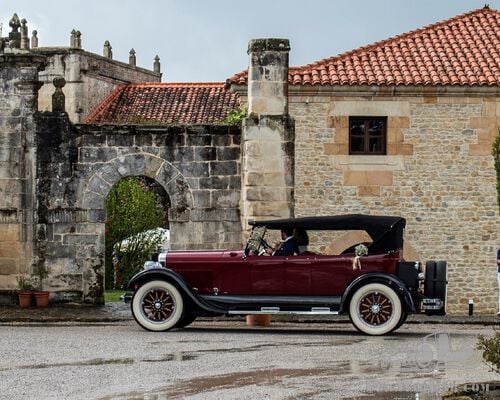
1925 Lincoln Model L Phaeton by Brunn - Excellent provenance
Retaining its original matching-numbers engine and chassis (both numbered 24576), the car benefits from an extensively documented history and..
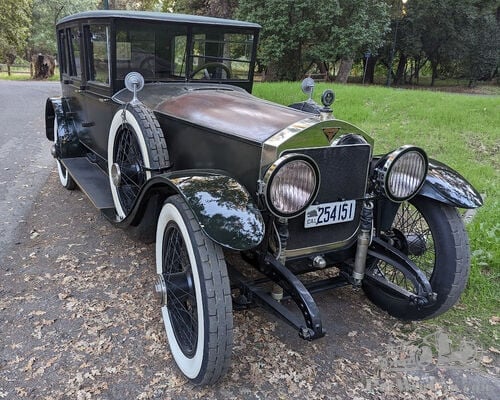
1916 Simplex, Crane model 5
1916 Simplex, Crane MODEL 5CUSTOM MADE HISTORIC PRESERVATION VEHICLE – READY TO TOUR!This Simplex recently completed th..
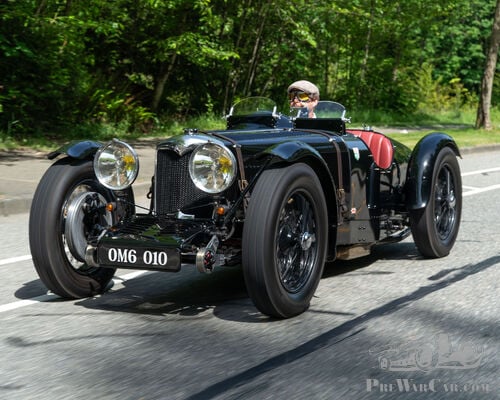
Riley 14/6 Special 1933
The ExperienceStep into the golden age of British motoring. This 1933 Riley 14/6 Special is a masterclass in pre-w..