The global magazine and marketplace for classic car enthusiasts, by enthusiasts.


Filter
Classic Morgan, Oldsmobile for sale - Morgan, Oldsmobile cars for sale
-

Te koop Morgan Aero 1927
De Morgan Aero is geproduceerd van 1920 tot rond 1933. Dit voertuig met chassisnummer B718 is van 1927. De driewieler is in goed rijdbare en in originele staat, video’s hierover zijn het bewijs. De aandrijving (koppeling & bak) en dynamo zijn op kwalitatief gezien technisch verantwoorde wijze enigszins aangepast, waarmee de technische betrou.. -
1910 OLDSMOBILE SPECIAL 40HP ROADSTER RHD
1910 OLDSMOBILE SPECIAL 40HP ROADSTER Chassis Number: 2037Registration Number: AA-00-41 Portugal Yellow with black pinstriping and black leather seats Engine: four cylinder, c336ci., 40bhp; Gearbox: four-speed manual; Suspension: front, semi-elliptic leaf springs, rear, three-quarter ellipt.. -
1904 Oldsmobile Model 6C "Curved-Dash" Runabout | RM Sotheby's | The Monterey Auction
To Be OFFERED AT AUCTION WITHOUT RESERVE at RM Sothebys' The Monterey Auction event, 13 - 15 August 2026. Offered Without Reserve | $75,000 - $100,000 USD Formerly owned for decades by well-known collector Sterling WalshHigh-quality older restoration, still in very good conditionFormer AACA Grand National First Prize wi.. -
1903 Oldsmobile Model R 5HP - VCC Dated
1903 Oldsmobile Model R 5HP - VCC DatedRegistration No. BS8268Engine No. 15506Chassis No. 15506VCC Dating Certificate No. 2220 In 1901, the Oldsmobile car company in Michigan launched the Model R runabout. Powered by a 5HP Gasoline engine, the car was widely r.. -
1904 Oldsmobile 6C 7HP Runabout - VCC Dated
1904 Oldsmobile 6C 7HP Runabout - VCC Dated Registration No. BS8670Chassis No. 21602Engine No. 21602VCC Dating Certificate No. 4169 Known as the 'Curved Dash' for obvious reasons, Ransom Eli Olds's gasoline-powered runabout was first offered for sale in 1901, following a fire at .. -
Oldsmobile Curved Dash Model 6C 7hp 1904
We have available for sale this exceptionally original 7hp Curved Dash Oldsmobile. Manufactured in 1904. Continuous ownership/history for many years. This is the larger engined motor car with rear brakes & larger hp. These are exceptionally good strong motor cars and can certainly cover some miles without any issues, well built & very go..


Morgan
GB, 1905 – 1906
Morgan and Co Ltd, Leighton Buzzard, Beds.
Made by a well-known firm of coachbuilders, the Morgan car was a conventional shaft-driven car with 5.8-litre T-head 4-cylinder Mutel engine, distinguished only by the Sparks-Boothby hydraulic clutch on the Morgan car, soon abandoned in favour of an ordinary leather cone. Only about five Morgan cars were made and their lack of success resulted in Morgan cars becoming Adler concessionaires in 1907, and abandoning motor manufacture.
GB, 1910 to date
Morgan Motor Co Ltd, Malvern Link, Worcs.
This Morgan car was the best-known, and best, of the British 3-wheelers that were popular while the horsepower tax gave the Morgan cars an advantage. H.F.S. Morgan’s tricycle was also the first of its type, this Morgan car going into production in 1910. At the front of a tubular chassis frame was an sv, air-cooled V-twin motor-cycle engine of 1.100cc by JAP, transversely mounted. Transmission of the Morgan car was by dog clutches and chains, providing two forward speeds. The steering was direct. The front wheels of the Morgan car, had independent front suspension, by sliding pillars and coil springs. There were two seats. A reasonable amount of power plus light weight meant an excellent performance of the Morgan cars. The Morgan car was safer than most 3-wheelers because its road-holding was above average. This recipe made the Morgan car popular with sportsmen, for whom the Morgan Grand Prix model was produced in 1914: the first catalogued competition Morgan car. Soon afterwards, an exiguous four-seater Morgan car, the forerunner of the Morgan Family model of the 1920s, was listed.
After World War 1, Morgan carscontinued to cater for all markets. Names changed, but the Morgan Sports or Morgan Standard model was the normal two-seater, also available in De Luxe form; the Morgan Family model was the more capacious type Morgan car, and the long-tailed Morgan Aero, later the Morgan Super Sports, was the Morgan car intended for serious speed work. Engines of Morgan cars were water- or air-cooled to choice, most being supplied by JAP, or by Blackburne in the case of the competition Morgan cars. From 1925 all the latter’s power units had overhead valves. By 1927 the Super Sports Morgan car could attain 80mph in standard trim, while the less sporting Morgan cars now had internal expanding front wheel brakes and electric starting. Geared-down steering and (if required) three forward speeds followed on Morgan cars in 1929. Even so, Morgan cars were losing customers to new, cheap sports cars such as the M-type MG. Three speeds and reverse in a normal gearbox (though still with chain final drive) were available from 1931 and standard on the Morgan car after 1932, and a modified 8hp Ford 4-cylinder engine could later be had in the Morgan car instead of the twin. Four years later the first 4-wheeled Morgan car was introduced, the excellent little Morgan 4/4. This Morgan car used an 1.122cc 4-cylinder Coventry-Climax engine with overhead inlet valves, developing 34bhp. The Morgan car was still light in weight, and retained the Morgan independent front suspension, so the performance and handling qualities of Morgan cars were well up to form. The Morgan car could attain 75mph. The twins were last catalogued in 1939.
Just before World War 2, a 1.267cc Standard 10hp engine with ohv head was substituted in the Morgan 4/4. When this was no longer available, from 1950, Morgan fitted a tuned Standard Vanguard unit in the Morgan car giving 70bhp. In this Morgan Plus Four, as the Morgan car was renamed, performance became still more lively, and when the 90bhp Triumph TR2 engine became available in 1954, maximum speed of the Morgan car rose to 100mph for the first time. With the advent of the Morgan Plus Four, there was no longer a small Morgan car, but this gap was made good in 1955, when the Morgan Series 2 4/4 arrived. This Morgan car used the very hard-wearing 1.172cc sv Ford Ten engine which had powered F4 Morgan. (The latter was the last 3-wheeler Morgan car, which had been made until 1950.) The result was a cheap, pleasant and reliable sports Morgan car of the old school. Later, the ohv Ford 105E engine was substituted. The latest version Morgan car had a 1.599cc 98bhp engine, a 4-speed all-synchromesh gearbox, front disc brakes, and the traditional Morgan suspension. The Morgan Plus Four kept pace with Triumph’s TR engine development, also acquiring disc brakes and, eventually, the 2.138cc 105bhp TR4 unit. A streamlined coupé, the Morgan Plus Four Plus of 1964, was a brief deviation from the classical Morgan car line which met with little approval and was discontinued after only 50 of these Morgan cars had been sold. When Triumph changed to a six during 1968, Morgan cars adopted a new engine for their bigger Morgan cars, and the Morgan Plus Four became the Morgan Plus Eight, powered by Rover’s 3 ½-litre 160bhp V8 and capable of 125mph. The 1973 versions of the Morgan car use the 4-speed all-synchromesh Rover gearbox in place of the Moss box previously fitted.
Source: Georgano, encyclopedia of motorcar; MCS, TRN
The information is written with the greatest of care. However, if you have any suggested amendments please contact us at office@prewarcar.com
Oldsmobile
US, 1896 to date
(1) Olds Motor Works, Lansing, Mich., 1896 – 1943
(2) Oldsmobile Division of General Motors Corp, Lansing, Mich., 1943 to date
Ransom Eli Olds built an experimental three-wheeled steam Oldsmobile car in 1891, following this six years later with a single-cylinder petrol-engined vehicle of dogcart type. He then made a small number of electric Oldsmobile cars, before producing his famous Oldsmobile Curved Dash Runabout, the world’s first mass-production automobile. This Oldsmobile car consisted of a very short and simple buggy-type chassis with two long springs serving as auxiliary side-members, on which was mounted a single-cylinder moiv engine of 1.6-litres’ capacity, with trembler coil ignition, a 2-speed epicyclic transmission, and central chain drive. The engine on the Oldsmobile car possessed an immense silencer and turned at 500rpm – ‘one chug per telegraph pole’. Despite a fire at the Oldsmobile carfactory in March 1901, which destroyed everything except a single prototype, the little Oldsmobile car was an instant success, 2.100 being sold in 1902 and 5.000 Oldsmobile cars in 1904. Though at its best as a town runabout, the Oldsmobile car made a number of epic runs, notably Whitman’s and Hammond’s drive from San Francisco to New-York in 1903. This type of Oldsmobile car was made under licence in Germany as the Polymobil, and Ultramobil.
By 1904 Ransom Olds had left the Oldsmobile car company to found the REO company and the Oldsmobile car started to grow up. Dummy-bonnetted versions of Oldsmobile cars were available in 1905. These were followed by a twin-cylinder 2-stroke Oldsmobile car with frontal engine and a conventional gearbox selling for $1.250, and by the Oldsmobile Palace touring car, a four of square cylinder dimensions which combined pressure lubcrication and automatic inlet valves. Oldsmobile cars grew bigger and bigger; by 1908 the smallest Oldsmobile car was a 3½-litre four and the largest a six of over 8 litres’ capacity, and this trend was not reversed when General Motors took over the Oldsmobile car company in 1909. Compressed-air starters were available on Oldsmobile cars in 1911 and the 1912 line of Oldsmobile cars was obviously designed for the carriage trade, being headed by the immense Oldsmobile Limited, with a 6-cylinder 11½-litre engine, a wheelbase of 11ft 6in, wooden wheels of 43in diameter and a top speed of over 70mph, all for $5.000. Even the baby of the Oldsmobile car-family, the 4-cylinder Oldsmobile Defender had a capacity of 5-litres and cost $3.000, while all the Oldsmobile car range boasted 4-speed gearboxes. Oldsmobile cars were a little smaller at 7-litres in 1914 and had acquired Delco electric lighting and starting, though right hand drive was retained on Oldsmobile cars.
The Oldsmobile car company did not return to prosperity until the following year, when a modestly-priced sv 4-cylinder Oldsmobile 42 with streamlined dash was marketed and over 7.500 Oldsmobile cars were sold. This was followed in 1916 by an sv V8 Oldsmobile car with a Fiat-like radiator selling at about $1.500, which Oldsmobile continued to offer until 1923. They also listed both a 2.8-litre six and an ohv Northway-engined four Oldsmobile car in the early 1920s. In 1924 only the six-cylinder Oldsmobile car was available, and a wide range of ‘sport equipment’ (such as trunk bars and step plates) was advertised. Over 44.000 Oldsmobile cars were sold, and tourers were listed at $785. Mechanical pump feed and front-wheel brakes followed in 1927 and bodies of the Oldsmobile cars were restyled in 1928.
Sales climbed to over 100.000 Oldsmobile cars in 1929, in which year Oldsmobile launched the abortive 8-cylinder Oldsmobile Viking. Synchromesh was available on these Oldsmobile cars in 1931, and a 3.9-litre straight-8 closely resembling the Bucik in outward appearance joined the Oldsmobile car range in 1932. 1934 Oldsmobile cars had independent front suspension, and turret top styling characterized the 1935 Oldsmobile car models. In 1938, when a 6-cylinder sedan could be bought for $967, Oldsmobile cars became the first of the GM group to offer the option of an automatic gearbox, evolved by 1914 into the famous Hydramatic. 273.000 Oldsmobile cars were sold in 1941.
Oldsmobile cars became GM’s technical leader after World War 2; Hydramatic was optional on all Oldsmobile carmodels in 1946 and in 1948 the Oldsmobile car company’s official half-centenary was made the occasion to give the Oldsmobile cars ‘Futuramic’ styling, a preview of what GM’s other cars were to look like in 1949. Oldsmobile’s 1949 4.9-litre ohv oversquare Rocket V8 was the first of its kind to appear, and by 1951 the old sixes Oldsmobile cars had been dropped altogether. The Oldsmobile Rocket was giving 202bhp in 1955 and air-suspension was optional, the Oldsmobile cars came in two wheelbase lengths and manual transmission was available only on the cheaper models.
Oldsmobile car companys compact, the Oldsmobile F85 of 1961, was an interesting car with unitary construction, coil springing all round, a 9ft 4in wheelbase and an aluminium V8 of only 3½-litres’ capacity, developing 155bhp. Fastest of the full-size V8 Oldsmobile cars was the Oldsmobile Starfire convertible with 330bhp, while a sporting version of the F85 came out the following year in the shape of the Oldsmobile Cutlass. In 1963 there was a companion Oldsmobile Jetfire model, capable of 110mph, and listed at $3.633 with turbo-supercharger. The aluminium V8 was replaced on 1964 Oldsmobile carmodel F85s by Buick’s V6, and a Jetstar line of economy Oldsmobile cars was evolved by fitting a modestly-rated 8-cylinder engine in the regular chassis. 1966 Oldsmobile cars covered a wide range from the small six up to V8s of 383bhp, but the Oldsmobile car Division achieved a real technical breakthrough once more with the big Oldsmobile Toronado coupé. This Oldsmobile car had front wheel drive and Hydramatic transmission, and was powered by the most potent version of Oldsmobile’s 7-litre engine. The 1968 Oldsmobile car models were made in various capacities up to 7½-litres. The largest Oldsmobile cars had automatic transmission and power steering as standard, and the Oldsmobile 442 with 360bhp 6.555cc V8 engine and 4-speed manual gearbox represented the fashionable sporting image. By 1971 the Oldsmobile Cutlass Supreme, 88, 98 and Cruiser station wagons had acquired front disc brakes, but a year later even the Oldsmobile Toronado boasted no more than 265bhp. The same basic range was still available on Oldsmobile cars in 1973, with single headlamps and front disc brakes standardized on the Oldsmobile Cutlass along with the new GM energy-absorbing front bumper. New to Oldsmobile car range was a compact, the Oldsmobile Omega with 3-speed manual box and drum brakes. Engine options for this Oldsmobile car were a 4.097cc six or a 5.735cc V8.
Source: Georgano, encyclopedia of motorcar; MCS
The information is written with the greatest of care. However, if you have any suggested amendments please contact us at office@prewarcar.com


Featured

1915 Rolls-Royce Silver Ghost Barker Tourer
⁃ An exceptionally rare original bodied pre-war Silver Ghost⁃ Desirable Barker tourer in exciting barn find condition⁃ ..

Lagonda LC Tourer 1934
The Lagonda story began in 1901 in Staines, a small town in the UK. The company enjoyed its greatest successes around 1935. During this period, the..
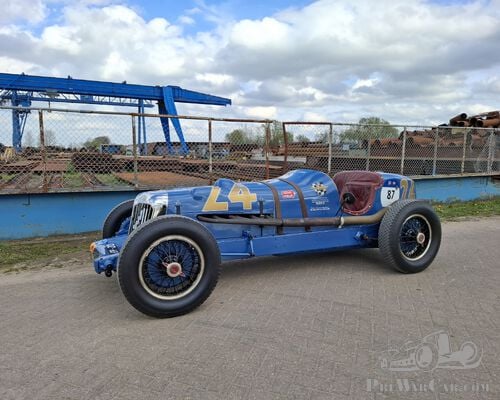
1932 - Graham " Lucenti " Indianapolis
Original participant of the 1932, 1934 and 1935 Indy 500. Best result: finishing 10th overall in the 1934 Indy 500 with driver “Herb” Ardinger...