The global magazine and marketplace for classic car enthusiasts, by enthusiasts.


Filter
Classic Rolland-Pilain, Oldsmobile for sale - Rolland-Pilain, Oldsmobile cars for sale
-

Oldsmobile Curved Dash Model 6C 7hp 1904
We have available for sale this exceptionally original 7hp Curved Dash Oldsmobile. Manufactured in 1904. Continuous ownership/history for many years. This is the larger engined motor car with rear brakes & larger hp. These are exceptionally good strong motor cars and can certainly cover some miles without any issues, well built & very go.. -
Rolland Pilain
I am selling a 1913 Rolland Pilain RP 10HP in very good condition. It has a standard registration document in my name, and the MOT will be carried out prior to the sale. -
1910 OLDSMOBILE SPECIAL 40HP ROADSTER RHD
1910 OLDSMOBILE SPECIAL 40HP ROADSTER Chassis Number: 2037Registration Number: AA-00-41 Portugal Yellow with black pinstriping and black leather seats Engine: four cylinder, c336ci., 40bhp; Gearbox: four-speed manual; Suspension: front, semi-elliptic leaf springs, rear, three-quarter ellipt.. -
1903 Oldsmobile Model R 5HP - VCC Dated
1903 Oldsmobile Model R 5HP - VCC DatedRegistration No. BS8268Engine No. 15506Chassis No. 15506VCC Dating Certificate No. 2220 In 1901, the Oldsmobile car company in Michigan launched the Model R runabout. Powered by a 5HP Gasoline engine, the car was widely r..


Rolland-Pilain
France, 1906 – 1931
SA des Etablissements Rolland-Pilain, Tours
Unusual among French marques of its period, Rolland Pilain cars made their greatest impact after World War 1. Their first product was a 20hp 4-cylinder model Rolland Pilain cars with a monobloc engine, though smaller 2.2-litre shaft-driven Rolland Pilain cars were available in 1909 and a 3-speed 1½-litre Rolland Pilain 8/10CV in 1910, in which year the Rolland Pilain car company was also experimenting with ‘valveless’ engines and 4-wheel brakes. Though racing was in the doldrums, the Rolland Pilain car company went to the trouble of building a big chain-driven Rolland Pilain car for the 1911 Grand Prix de France, and a complex 1912 range started with a Rolland Pilain 9CV of 1.7-litres and went up to a chain-driven 4-cylinder 60 Rolland Pilain car of 130x270mm. The 6-cylinder Rolland Pilain 18CV had a ‘valveless’ engine, and even in 1913 chain drive was still optional on the biggest fours of 20CV and 24CV Rolland Pilain cars. Only 1.9-litre and 4-litre 4-cylinder Rolland Pilain cars with sv monobloc engines and unit gearboxes were listed in 1914.
These basic types of Rolland Pilain cars, still with pedal-operated transmission brakes, were available again after World War 1, but far more advanced was the 2.2-litre Rolland Pilain 14/16 of 1921, which boasted not only overhead valves and a detachable head, but also front-wheel brakes (hydraulic at the front and mechanical at the rear). This Rolland Pilain car was still catalogued in 1926. Even more ambitious was the 2-litre twin ohc straight-8 GP Rolland Pilain car of 1922, with desmodromic valves, ball-bearing crankshafts and 4-wheel hydraulic brakes. A victory of a Rolland Pilain car at San Sebastian in 1923 was the limit of the success of Rolland Pilain cars on the circuits, but the type found its way into the catalogue as the Type A22 Rolland Pilain car at 90.000fr, and one of the racers also ran with a 2-litre, 6-cylinder cuff-valve Schmid engine. In 1925 came a 2-litre ohv 4-cylinder Rolland Pilain car with 4-wheel mechanical brakes, selling for £725 in England, while a 1½-litre development, the Rolland Pilain D26, was introduced for 1927. In 1929 Rolland-Pilain car, along with several other French firms, tried a Franco-American theme by introducing a range of big luxury chassis with sv Continental engines. Both the 6-cylinder, 3-litre, and the 4-litre straight-8 Rolland Pilain cars had centralized chassis lubrication, though the elegant bodywork of the Rolland Pilain car was marred by the use of artillery wheels. At the 1930 Paris Salon the Rolland Pilain car company shared a stand with the BNC (also going through a Franco-American phase), but this was the end, though the Rolland Pilain car firm’s Paris depot was still advertising spare parts for Bignan as well as Rolland Pilain cars in 1934.
Source: Georgano, encyclopedia of motorcar; MCS
The information is written with the greatest of care. However, if you have any suggested amendments please contact us at office@prewarcar.com
Oldsmobile
US, 1896 to date
(1) Olds Motor Works, Lansing, Mich., 1896 – 1943
(2) Oldsmobile Division of General Motors Corp, Lansing, Mich., 1943 to date
Ransom Eli Olds built an experimental three-wheeled steam Oldsmobile car in 1891, following this six years later with a single-cylinder petrol-engined vehicle of dogcart type. He then made a small number of electric Oldsmobile cars, before producing his famous Oldsmobile Curved Dash Runabout, the world’s first mass-production automobile. This Oldsmobile car consisted of a very short and simple buggy-type chassis with two long springs serving as auxiliary side-members, on which was mounted a single-cylinder moiv engine of 1.6-litres’ capacity, with trembler coil ignition, a 2-speed epicyclic transmission, and central chain drive. The engine on the Oldsmobile car possessed an immense silencer and turned at 500rpm – ‘one chug per telegraph pole’. Despite a fire at the Oldsmobile carfactory in March 1901, which destroyed everything except a single prototype, the little Oldsmobile car was an instant success, 2.100 being sold in 1902 and 5.000 Oldsmobile cars in 1904. Though at its best as a town runabout, the Oldsmobile car made a number of epic runs, notably Whitman’s and Hammond’s drive from San Francisco to New-York in 1903. This type of Oldsmobile car was made under licence in Germany as the Polymobil, and Ultramobil.
By 1904 Ransom Olds had left the Oldsmobile car company to found the REO company and the Oldsmobile car started to grow up. Dummy-bonnetted versions of Oldsmobile cars were available in 1905. These were followed by a twin-cylinder 2-stroke Oldsmobile car with frontal engine and a conventional gearbox selling for $1.250, and by the Oldsmobile Palace touring car, a four of square cylinder dimensions which combined pressure lubcrication and automatic inlet valves. Oldsmobile cars grew bigger and bigger; by 1908 the smallest Oldsmobile car was a 3½-litre four and the largest a six of over 8 litres’ capacity, and this trend was not reversed when General Motors took over the Oldsmobile car company in 1909. Compressed-air starters were available on Oldsmobile cars in 1911 and the 1912 line of Oldsmobile cars was obviously designed for the carriage trade, being headed by the immense Oldsmobile Limited, with a 6-cylinder 11½-litre engine, a wheelbase of 11ft 6in, wooden wheels of 43in diameter and a top speed of over 70mph, all for $5.000. Even the baby of the Oldsmobile car-family, the 4-cylinder Oldsmobile Defender had a capacity of 5-litres and cost $3.000, while all the Oldsmobile car range boasted 4-speed gearboxes. Oldsmobile cars were a little smaller at 7-litres in 1914 and had acquired Delco electric lighting and starting, though right hand drive was retained on Oldsmobile cars.
The Oldsmobile car company did not return to prosperity until the following year, when a modestly-priced sv 4-cylinder Oldsmobile 42 with streamlined dash was marketed and over 7.500 Oldsmobile cars were sold. This was followed in 1916 by an sv V8 Oldsmobile car with a Fiat-like radiator selling at about $1.500, which Oldsmobile continued to offer until 1923. They also listed both a 2.8-litre six and an ohv Northway-engined four Oldsmobile car in the early 1920s. In 1924 only the six-cylinder Oldsmobile car was available, and a wide range of ‘sport equipment’ (such as trunk bars and step plates) was advertised. Over 44.000 Oldsmobile cars were sold, and tourers were listed at $785. Mechanical pump feed and front-wheel brakes followed in 1927 and bodies of the Oldsmobile cars were restyled in 1928.
Sales climbed to over 100.000 Oldsmobile cars in 1929, in which year Oldsmobile launched the abortive 8-cylinder Oldsmobile Viking. Synchromesh was available on these Oldsmobile cars in 1931, and a 3.9-litre straight-8 closely resembling the Bucik in outward appearance joined the Oldsmobile car range in 1932. 1934 Oldsmobile cars had independent front suspension, and turret top styling characterized the 1935 Oldsmobile car models. In 1938, when a 6-cylinder sedan could be bought for $967, Oldsmobile cars became the first of the GM group to offer the option of an automatic gearbox, evolved by 1914 into the famous Hydramatic. 273.000 Oldsmobile cars were sold in 1941.
Oldsmobile cars became GM’s technical leader after World War 2; Hydramatic was optional on all Oldsmobile carmodels in 1946 and in 1948 the Oldsmobile car company’s official half-centenary was made the occasion to give the Oldsmobile cars ‘Futuramic’ styling, a preview of what GM’s other cars were to look like in 1949. Oldsmobile’s 1949 4.9-litre ohv oversquare Rocket V8 was the first of its kind to appear, and by 1951 the old sixes Oldsmobile cars had been dropped altogether. The Oldsmobile Rocket was giving 202bhp in 1955 and air-suspension was optional, the Oldsmobile cars came in two wheelbase lengths and manual transmission was available only on the cheaper models.
Oldsmobile car companys compact, the Oldsmobile F85 of 1961, was an interesting car with unitary construction, coil springing all round, a 9ft 4in wheelbase and an aluminium V8 of only 3½-litres’ capacity, developing 155bhp. Fastest of the full-size V8 Oldsmobile cars was the Oldsmobile Starfire convertible with 330bhp, while a sporting version of the F85 came out the following year in the shape of the Oldsmobile Cutlass. In 1963 there was a companion Oldsmobile Jetfire model, capable of 110mph, and listed at $3.633 with turbo-supercharger. The aluminium V8 was replaced on 1964 Oldsmobile carmodel F85s by Buick’s V6, and a Jetstar line of economy Oldsmobile cars was evolved by fitting a modestly-rated 8-cylinder engine in the regular chassis. 1966 Oldsmobile cars covered a wide range from the small six up to V8s of 383bhp, but the Oldsmobile car Division achieved a real technical breakthrough once more with the big Oldsmobile Toronado coupé. This Oldsmobile car had front wheel drive and Hydramatic transmission, and was powered by the most potent version of Oldsmobile’s 7-litre engine. The 1968 Oldsmobile car models were made in various capacities up to 7½-litres. The largest Oldsmobile cars had automatic transmission and power steering as standard, and the Oldsmobile 442 with 360bhp 6.555cc V8 engine and 4-speed manual gearbox represented the fashionable sporting image. By 1971 the Oldsmobile Cutlass Supreme, 88, 98 and Cruiser station wagons had acquired front disc brakes, but a year later even the Oldsmobile Toronado boasted no more than 265bhp. The same basic range was still available on Oldsmobile cars in 1973, with single headlamps and front disc brakes standardized on the Oldsmobile Cutlass along with the new GM energy-absorbing front bumper. New to Oldsmobile car range was a compact, the Oldsmobile Omega with 3-speed manual box and drum brakes. Engine options for this Oldsmobile car were a 4.097cc six or a 5.735cc V8.
Source: Georgano, encyclopedia of motorcar; MCS
The information is written with the greatest of care. However, if you have any suggested amendments please contact us at office@prewarcar.com


Featured
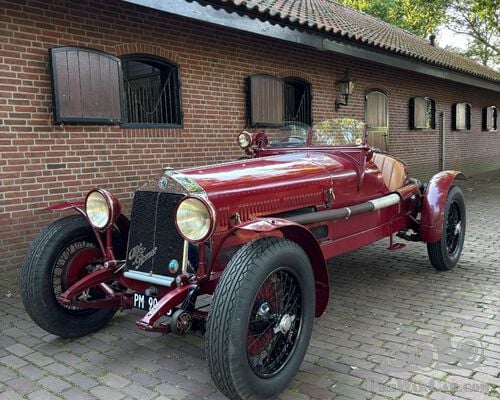
1930 Alfa Romeo 6C 1750 Spider
1930 Alfa Romeo 6C 1750 Spider with complete history from delivery to first owner in 1930 in Firenze till today with copy Libretto/license plate.
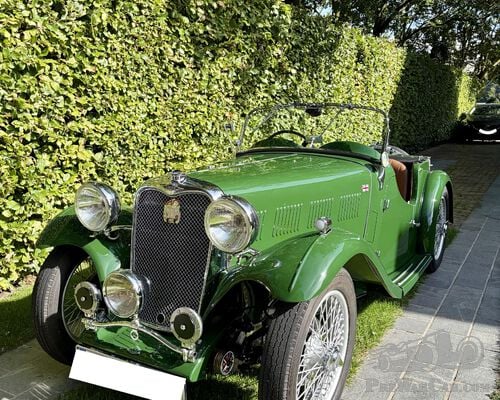
Singer 9 Le Mans Special Speed in British Racing Green, bouwjaar 1935
Prachtige Singer 9 Le Mans Special Speed. (De Singer 9 Le Mans werd uitgebracht na het succes van Singer in de gelijknamige 24u race.) 4 cil..
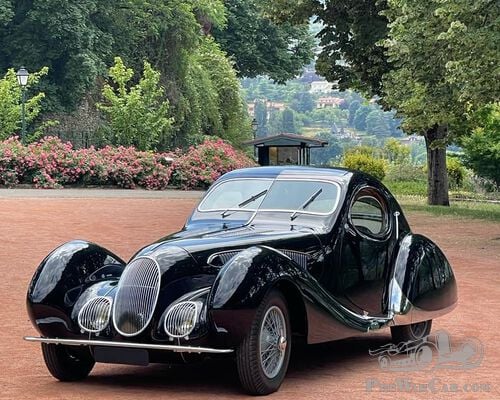
1939 Talbot-Lago T150C “Goutte d’Eau” — Iconic French Coachbuilt Masterpiece
Talbot-Lago T150C ‘Teardrop’ — An Icon of French Automotive Art There are motor cars that define an era. And then there are those tha..