The global magazine and marketplace for classic car enthusiasts, by enthusiasts.


Filter
Classic Imperia, Orient for sale - Imperia, Orient cars for sale
-

1905/6 Orient Buckboard
Build by Waltham , mass. Usa . very original and unrestored , except the engine which is restored and running .Known history back to before ww2 . Last ovner found it in 1950.Eur 25.800

Imperia
B, 1906 – 1949
(1) Automobiles Imperia, Liège, Nessonvaux, 1906 – 1929
(2) SA des Automobiles Imperia-Excelsior, Nessonvaux, 1929 – 1949
The first Imperia cars were the work of the German Paul Henze, who himself handled an 8-litre car in the 1907 Kaiserpreis. At first only a Imperia 24/30hp four of 4.9-litres was marketed with low tension magneto and coil-ignition, 4-speed gearbox, and shaft or side-chain drive. The smaller 3-litre Imperia car that followed was shaft-driven, and a 1.767cc monobloc four arrived during 1909. As late as 1911 an immense, Kaiserpreis-inspired chain-driven 9.9-litre 50/60 Imperia car was still offered. In 1912 Imperia cars merged with Springuel, but though the latter name soon vanished, Jules Springuel took over the management, and some Springuel designs were sold under the Imperia car companies name. In 1914 Imperia cars in a range of conventional, well-made small volume fours, of 1.8-litres, 2.6-litres, 3.6-litres and 5-litres was offered.
In 1919 the Imperia car company took over the manufacture of the Spanish Abadal (this had always had a substantial Belgium content), offering both a 3-litre Imperia Type E, and the Hispano-Suiza-like 80x180mm 3.6-litre Imperia Type T, complete with handsome V-radiator as found on subsequent Imperias. These Imperia cars were made in small numbers until 1922, though a 6-litre twin-carburettor sohc Imperia-Abadal straight-9 with Perrot fwb on a 12ft wheelbase never progressed beyond the prototype stage. Equally short-lived Imperia car, was a promosing sports car, the long-stroke 16-valve ohc 4-cylinder 3-litre with which de Tornaco won the 1922 Belgium GP. In 1923 M.A. van Roggen, now in charge at Nessonvaux, came up with his side-valve 1.100cc 6CV Imperia car, a small tourer of Panhard-like appearance, but with an unusual servo-assisted foot transmission brake – brakes on the front wheels were standardized in 1925 on Imperia cars. This Imperia car was quite successful, winning the small-car class of the 1926 Monte Carlo Rally and selling 504 Imperia cars in 1927, but Van Roggen’s ‘empire-building’ did not prosper: plans to produce 6CVs in France (at the Voisin works) and at the British GWL factory proved abortive. The 1928 Imperia car season brought a companion 1.642cc six, later enlarged to 1.8-litres and available in 3-carburettor sporting form, and in this period Imperia cars acquired Excelsior, Nagant (who were converted to making 6-cylinder engines), and the Matthys et Osy coachbuilding works. The slide-valve Imperia car models survived until 1934, acquiring hydraulic brakes at the end, but in 1934 Imperia took out a licence to build fwd Adlers, and until 1940 these were their staple; the 995cc Trumpf-Junior, the 1.645cc Trumpf, and the later Zweiliter were all made. In 1935 the Imperia car company fused with the only other surviving Belgian private-car maker, Minerva, and the big sleeve-valve models from Antwerp disappeared for good.
In 1947 there was a brief revival by Imperia cars with the Imperia TA8, a synthesis of pre-World War 2 fwd models by Adler and Amilcar, powered by the 1.340cc ohv 4-cylinder engine used in 1940 Amilcars. Features of this Imperia car were fravity feed, hydraulic brakes, a 3-speed gearbox with dashboard change, and composite wood and metal coachwork.
D, 1935
Imperia-Werk AG, Bad Godesberg
The German Imperia factory, well-known for its motorcycles, had already experimented with Imperia cars in 1924/ 1925, but production on a limited scale of Imperia cars was not started until 1935. A 3-cylinder 2-stroke 750cc radial engine mounted in the rear of the Imperia car was used for a streamlined two-seater coupé and for a small monoposto racing Imperia car, both with independent wheel suspension. Financial difficulties stopped production of Imperia cars at an early stage.
Source: Georgano, encyclopedia of motorcar; MCS, HON
The information is written with the greatest of care. However, if you have any suggested amendments please contact us at office@prewarcar.com
Orient
US, 1898 – 1908
Waltham Mfg Co, Waltham, Mass.
The Orient car company made an experimental electric runabout in 1898, but did not put this Orient car into production. Their first petrol-engined Orient cars were motor cycles, tricycles and light runabouts powered by De Dion engines. In 1902 they introduced the Orient Buckboard, a very simple Orient car consisting of two seats on a wooden platform, with a 4hp air-cooled engine geared to the rear axle, and, originally, only one speed. There were no springs on this Orient car, as the wooden platform was said to have enough resilience. The weight was 350lb and the price $375.
Although the simple Buckboard was continued, more sophisticated Orient cars were gradually introduced, including a four-seater version Orient car which in turn became a side-entrance tonneau. Wheel steering and small bonnets to cover the driver’s feet appeared in 1904, although the engine of the Orient car was still at the back, and the Buckboard ancestry remained obvious.
In 1905 a completely new Orient car appeared, known as the Waltham Orient. This Orient car had a 4-cylinder air-cooled 18/20hp engine mounted in front in the conventional manner, friction transmission and shaft drive. A slightly smaller 16hp Orient car model was also made. In 1908 Waltham merged with the C.H. Metz Company, and for the following year the cars were known as Metz.
Source: Georgano, encyclopedia of motorcar; GNG
The information is written with the greatest of care. However, if you have any suggested amendments please contact us at office@prewarcar.com


Featured
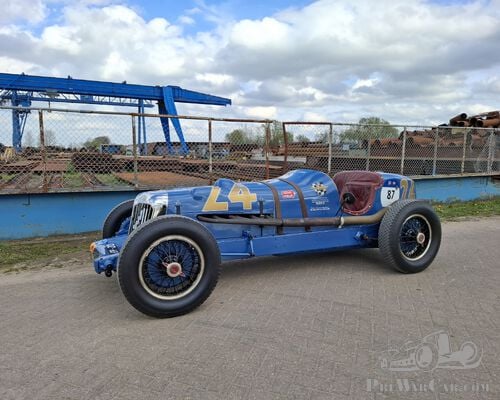
1932 - Graham " Lucenti " Indianapolis
Original participant of the 1932, 1934 and 1935 Indy 500. Best result: finishing 10th overall in the 1934 Indy 500 with driver “Herb” Ardinger...
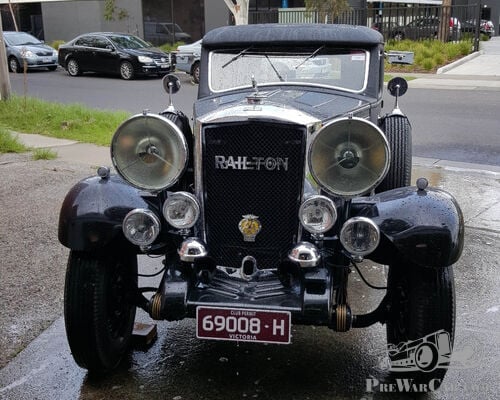
Railton straight 8 sports coupe for rallying REDUCED PRICE run with the bentleys at a fraction of the price
1934 Railton Sports CoupeBuilt for long distance rallyingRebuilt 2017built up at a cost of $160,000AUD, OFFERED FOR SALE AT A ..
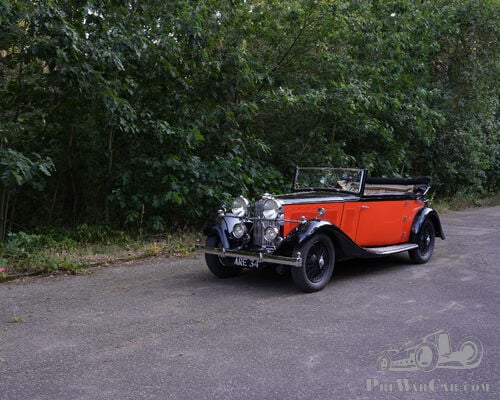
1934 Talbot AV105 Three Position Drophead Coupé
Registration no. ARE 34Chassis no. 35488 Much supporting paperworkRestored exampleVery usa..