The global magazine and marketplace for classic car enthusiasts, by enthusiasts.


Filter
Classic Orient, Pilain for sale - Orient, Pilain cars for sale
-

Société des Automobiles Pilain
The 1911 Pilain is the Type 4.0, equipped with a four-cylinder engine and a single Zenith carburetor. This car has undergone a comprehensive restoration over the past few years. Since the original body was too deteriorated to restore, it was decided to install an alternative body. The current elegant body is sourced from a Bianchi, which perfect.. -
1905/6 Orient Buckboard
Build by Waltham , mass. Usa . very original and unrestored , except the engine which is restored and running .Known history back to before ww2 . Last ovner found it in 1950.Eur 25.800


Orient
US, 1898 – 1908
Waltham Mfg Co, Waltham, Mass.
The Orient car company made an experimental electric runabout in 1898, but did not put this Orient car into production. Their first petrol-engined Orient cars were motor cycles, tricycles and light runabouts powered by De Dion engines. In 1902 they introduced the Orient Buckboard, a very simple Orient car consisting of two seats on a wooden platform, with a 4hp air-cooled engine geared to the rear axle, and, originally, only one speed. There were no springs on this Orient car, as the wooden platform was said to have enough resilience. The weight was 350lb and the price $375.
Although the simple Buckboard was continued, more sophisticated Orient cars were gradually introduced, including a four-seater version Orient car which in turn became a side-entrance tonneau. Wheel steering and small bonnets to cover the driver’s feet appeared in 1904, although the engine of the Orient car was still at the back, and the Buckboard ancestry remained obvious.
In 1905 a completely new Orient car appeared, known as the Waltham Orient. This Orient car had a 4-cylinder air-cooled 18/20hp engine mounted in front in the conventional manner, friction transmission and shaft drive. A slightly smaller 16hp Orient car model was also made. In 1908 Waltham merged with the C.H. Metz Company, and for the following year the cars were known as Metz.
Source: Georgano, encyclopedia of motorcar; GNG
The information is written with the greatest of care. However, if you have any suggested amendments please contact us at office@prewarcar.com
Pilain
France, 1902 – 1920
SA des Automobiles Pilain, Lyons
François Pilain made his first Pilain cars, with 2- and 4-cylinder engines, in 1902, but had dropped the twin in his Pilain car by 1904. The drive of the Pilain car was independent of the rear axle, but two shafts to internally-toothed rings, with a dead axle beneath. The principle on the Pilain car was the same as that used by De Dion, the aim being to allow the axle to move in relation to the frame without recourse to chain drive. The engines of the Pilain car had side valves in a T-head, and there were 4 forward speeds. Round radiators and low-tension magneto ignition were featured, and 1906 Pilain cars came in 4.1-litre and 8.6-litre sizes, both with 4-cylinder engines. High-tension ignition and pressure lubrication followed on Pilain cars in 1908. There was a 1.9-litre Pilain car with monobloc engine in 1909, and a small 2.4-litre six in 1912. A wide 1913 range Pilain cars covered everything from a 1-litre lightweight up to 6.3-litres, including an ultra-long-stroke 4.2-litre (85x185mm) four. The Pilain car was an expensive if excellent machine that did not long outlive World War 1 in its original form. The Pilain car was then developed into the extraordinary S.L.I.M.
France, 1930 – 1935
E. Pilain, Levallois-Perret, Seine
Emile Pilain, who had been responsible for the original Rolland-Pillain, produced a light Pilain car on his own account in 1930 for the mass market. This Pilain car was a 919cc, watercooled sv four, with a 3-speed gearbox and Perrot brakes. It was rated at 5CV, and in 1932 there was also a 1.2-litre version Pilain car with free wheel.
Source: Georgano, encyclopedia of motorcar; TRN
The information is written with the greatest of care. However, if you have any suggested amendments please contact us at office@prewarcar.com


Featured
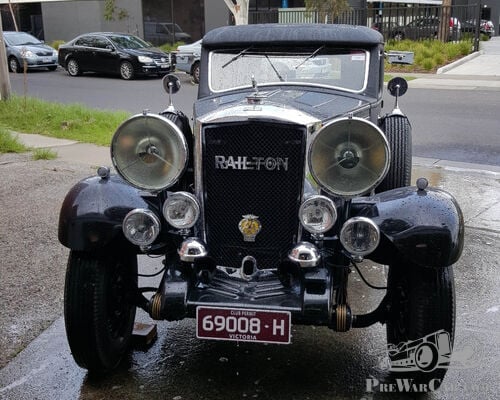
Railton straight 8 sports coupe for rallying REDUCED PRICE run with the bentleys at a fraction of the price
1934 Railton Sports CoupeBuilt for long distance rallyingRebuilt 2017built up at a cost of $160,000AUD, OFFERED FOR SALE AT A ..
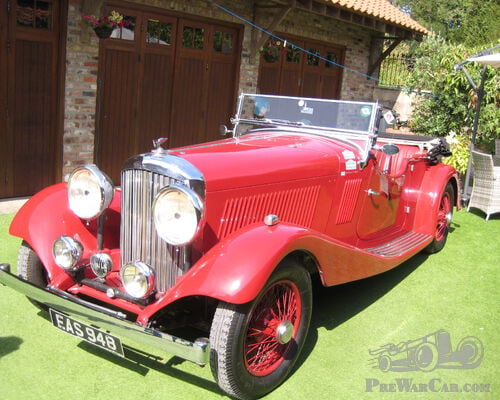
1935 Bentley 3.5 ltr. VDP 4str. Tourer
Chassis B 123 CW was first registered 14th March 1935, and in the late eighties underwent a " body-off" restoration and fitted with VANDEN PLAS
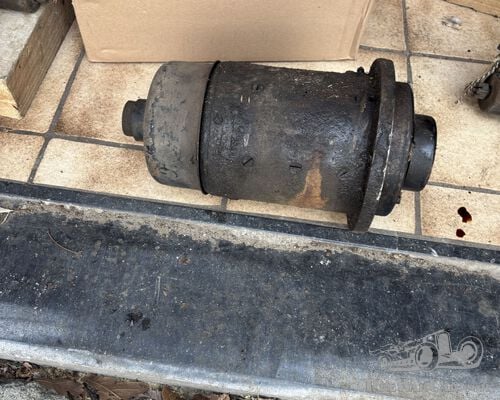
1929 Talbot K74 Limousine – Very comprehensive restoration project
For sale – 1929 Talbot K74 Limousine – Very comprehensive restoration projectAsking price: €19,950 A very rare 1929 Talbot K74..