The global magazine and marketplace for classic car enthusiasts, by enthusiasts.


Filter
Classic Hillman, Overland for sale - Hillman, Overland cars for sale
-

1932 Hillman Minx with a rare Tickford body | The Ernie Warren Collection Auction | 13th June 2026
A 1932 Hillman Minx with a rare Tickford body.Reg No. YY 9613.Car No. 7533.Engine No. 7590.Cream and black with grey interior.In 1929, Hillman was taken over by the Rootes Group and some of its offerings included the Sunshine Coachwork by Salmons & Sons. Christened the Tickford Foursome Coupe.. -
1929 Hillman 14 Tourer | The Ernie Warren Collection Auction | 13th June 2026
A 1929 Hillman 14 Tourer.Reg No. WL 6731.Car No. E10973.Engine No.Tba.Blue and black with black interior.Hillman, like many motor manufacturers started in the bicycle trade and became one of the largest motor car manufacturers by the commencement of the First World War.The Hillman 14hp bec.. -
1910 Overland Model 46 Roadster
1910 Overland Model 46 RoadsterChassis number: 46366Registration Number: BF7057 This Model 46 two-seat roadster has right-hand drive, as did all Overlands before 1915. The car was imported into Norway from the USA in 1969 and then to Sweden by the family the previous owner purchased it from. The Overland ..


Hillman
GB, 1907 to date
(1) Hillman – Coatalen Motor Car Co Ltd, Coventry, 1907 – 1909
(2) Hillman Motor Car Co Ltd, Coventry (1910 – 1946); Ruton-on-Dunsmore, Warwickshire (1946 – 1970); Linwood, Glasgow (1963 – 1970
(3) Chrysler United Kingdom Ltd, Ruton-on-Dunsmore, Warwickshire; Linwood Glasgow, 1970 to date
The Hillman car was originally known as the Hillman-Coatalen, the first cars being the work of Louis Coatalen, who designed a 25hp 4-cylinder for the 1907 Tourist Trophy. Pre-1914 production of Hillman cars was on a small scale, and consisted initially of big sv machines with separately cast cylinders (a 6.4-litre four and a 9.7-litre six) and shaft drive. The traditional shape of Hillman car radiator emerged in 1908, and continued on all Hillman car models up to 1930. Neither a little-known 1.8-litre 2-cylinder of 1913 nor a very small six of 2 litres’ capacity in 1914 made much impression, but much more successful was the 9hp Hillman car, a monobloc 1.357cc sv four, selling at £200. This Hillman car was brought up to date with electrics after World War 1, and progressively developed until 1925, by which time it had grown to 1.6-litres. A sports version with a V-radiator, outside exhaust, and polished aluminium bodywork was raced quite extensively in the early 1920s and Raymond Mays served his apprenticeship on one of these. All 1923 – 1925 Hillman cars came with drophead bodywork and winding windows. A conventional sv Hillman Fourteen with a 4-speed gearbox and magneto ignition was the only Hillman car model offered from 1926 to 1928, and production of this was stepped up after Rootes took over in the latter year. In 1929 prices started at £295, and ‘Safety’ versions were fitted with safety glass and servo brakes. Less happy was a companion to the Hillman Fourteen, a 2.6-litre ohv straight-8 with coil ignition. However, Hillman moved into the mass-production class in 1932 with their excellent 1.185cc sv Hillman Minx car at £159. This Hillman car was progressively developed up to the outbreak of World War 2, with 4-speed gearbox and the options of free-wheel and radio in 1934, all-synchromesh boxes in 1935 (these were dropped again in 1939), integral luggage boot in 1936, and unitary construction in 1940. The underslung Hillman Aero-Minx sports model of 1933 formed the basis for the Talbot and Sunbeam-Talbot Tens which resulted from Rootes’ acquisition of the S.T.D group, and there was even a luxury Hillman car Minx-based Humber Ten, though this was marketed only in New Zealand. Alongside these there were also some sv 6-cylinder Hillman cars, 1936 and later versions having transverse independent front suspension, but they gave way to another sv 1.9-litre Hillman Fourteen, sold with hydraulic brakes by 1940; these were not added to the Hillman Minx until the Phase II Hillman car models of late 1947, which also featured steering-column change.
Post-war Hillman Minxes continued the model’s reputation as a style leader of conventional mechanical specification. 1949 Hillman cars had full-width five/six-seater bodywork, there was a more powerful 1¼-litre engine in 1950, and a hardtop coupé version, the Hillman Californian, in 1953. In 1955 the Hillman car range was extended to include the Hillman Husky short-wheelbase station wagon, while de luxe Hillman Minxes acquired 1.395cc short-stroke ohv power units, and licence-production was taken up in Japan by Isuzu. The Hillman car model continued to keep abreast of the times with its cylinder capacity increased to 1½-litres in 1959, to 1.6-litres in 1962, and to 1.7-litres with a 5-bearing crankshaft in 1966. Automatic transmission became optional in 1960 with Hillman cars, hypoid final drive replaced the spiral bevel type in 1961, and later cars had front disc brakes. From 1957 onwards the Rootes-owned Singer company’s Gazelle had a Minx-type hull, and the Minx engine was used after 1959. A bigger Hillman Super Minx car joined the Hillman car range in 1962, and 1963 produced a challenger in the baby-car class, the Hillman Imp car. Made in the Rootes’ Group’s Scottish factory at Linwood, this Hillman car had an inclined, rear-mounted ohc 875cc 4-cylinder engine, 4-speed all-synchromesh gearbox, and all-round independent suspension. In 1966 Hillman Imps did well in the saloon-car racing, and Singer and Sunbeam versions followed, as well as a new Hillman Husky station wagon: the engine was used by a number of specialist manufacturers, notably Bond, Ginetta, TVR and Clan. It was also fitted to one version of the Greek Farmobil cross-country vehicle.
Chrysler acquired a majority interest in Rootes in 1964, the first consequences of the new management being the 1967 Hillman Minx car and Hillman Hunter car that replaced the existing Minx, and Super Minx types. Design was entirely new on these Hillman cars, though the 1.496cc and 1.725cc engines (now inclined in the ‘chassis’) were retained. These were assembled in Iran under the name of Peykan. Vehicles assembled in South-Africa used Peugeot engines. A Hillman Hunter won the 1968 London-Sydney Marathon. An entirely new shape from Hillman cars, the Avenger, appeared in 1970. Its suspension, by McPherson struts at the front and by rigid axle and coils at the rear, was similar to that of French Chryslers, there was a choice of 1.248cc or 1.496cc ohv 4-cylinder engines, disc brakes were fitted at the front, and automatic transmission was optional. Prices of these Hillman cars started at £765.
At the end of the 1970 season the Hillman Minx was dropped after an unbroken run of 38 years. Its replacement was a 54bhp Hillman Hunter De Luxe with the 1½-litre engine. Hillman Avengers went on sale in the USA as Plymouth Crickets. Two new Hillman Avenger cars were added during 1972: a station wagon and the twin-carburettor high-performance Hillman Tiger, a limited-production saloon with magnesium alloy wheels, capable of 105mph and retailing at £1.328. A 78bhp GLS Hillman car version with power brakes, radial-ply tyres and wide-rim wheels appeared in 1973, when the Hillman Imp was continued, and the Hunter line-up ranged from the basic Hillman De Luxe up to the 93bhp 1.7-litre GLS with twin Weber carburetors and close-ratio gearbox.
Source: Georgano, encyclopedia of motorcar; MCS
The information is written with the greatest of care. However, if you have any suggested amendments please contact us at office@prewarcar.com
Overland
US, 1903 – 1963
(1) Standard Wheel Co, Terre Haute, Indiana, 1903 – 1905
(2) Overland Co, Indianapolis, Indiana, 1905 – 1907
(3) Willys-Overland Co, Toledo, Ohio, 1908 – 1963
The makes Willys, Overland and Willys-Knight are inseparable, if only ecause of their confusing nomenclature. The original product of the Standard Wheel Co, as Overland cars were originally called, was a tiller-steered single-cylinder runabout with solid tyres which differed from most of its contemporaries in having its engine mounted in front under a real bonnet. This Overland car sold for $595. This Overland car had grown up by 1905 into a wheel-steered 1.3-litre twin, still with planetary transmission, and the company changed its style and moved to Indianapolis. Financial difficulties In 1907 brought John North Willys, and Elmira, N.Y. automobile dealer into the picture, and under his ownership a $1.250 4-cylinder Overland cars was produced, this having a pedal-controlled planetary transmission in the Ford manner, separately-cast cylinders, and a transaxle. There were two sixe-cylinder Overland cars in 1909, an Overland car at $2.000, and the 45hp Willys costing $250 more. Both the Willys name and multi-cylinder engines disappeared in 1910, and production of 4-cylinder Overland cars was concentrated in the old Pope factory at Toledo. During these years Willys continued to distribute the Marion, for which he had held an agency in the Elmira days. High-tension magneto ignition was used on the 1912 Overland cars, which included a 3.2-litre 2-speed Overland Model 58 at $850, a 3-speed version (Model 59 Overland car) with conventional gearbox at $900, and two bigger 4 Overland cars at $1.200 and $1.500 respectively. By 1914 Overland cars had moved into the ranks of the best-sellers with the 79 series Overland car at $950, a 4-litre car which helped to sell 80.000 Overland cars that year. 1915 saw a sv Overland 6 at $1.145, with the group moving up into second place behind Ford in the sales race. Willys-Knight, still a young make, was placed eighteenth: and in 1916 a second Willys 6, with 5-litre engine, joined the range, to remain there for three seasons. Willys-Knight had a V8 on a 10ft 5in wheelbase for $1.950 in 1917, but in 1919 4s Overland cars only were being made, the chassis L-head Overland car having made its appearance at the low price of $495. The 4-cylinder Willys-Knight had 3.3-litre engines and sold around the $1.400 mark.
In 1920 Willys Overland Crossley Ltd was formed in England with works at Stockport: this was a subsidiary of Crossley Motors Ltd, and assembled Overland cars for the British market. It originated nothing save in 1924 version of the Overland car powered by a 1.802cc Morris-Oxford engine. Overland cars continued to sell well in America, the Overland Model-92 ‘Redbird’ appearing in 1923 and helping to push the year’s sales up to 196.000 Overland cars. Sixes were back in the Overland carprogramme for 1925, the Overland car being a straightforward 3.3-litre sv machine selling for $895, while Willys-Knight’s Model-66 had a 60bhp 3.9-litre unit and front wheel brakes, and cost $1.845. It supplanted the sleeve-valve 4s the following year, and 1926 also saw the first of Overland cars 2.2-litre 4-cylinder ‘Whippet’ series, priced at $625: these Overland cars repeated the success of the 1919 type. ‘Whippets’ had front wheel brakes in 1927, in which year a companion 2.4-litre 6 Overland car was listed, as well as a smaller and cheaper Model-70 Willys-Knight. This could be bought for only $1.145 in 1928 – a record year both for the group and for the Knight-engined machines, which found 55.000 customers. Other Willys-Overland car products during this period were the Stearns-Knight and Falcon-Knight. The Whippet Overland car was restyled for 1929. The Whippet was now a Willys rather than an Overland car, and in 1931 the 4-cylinder cars were dropped. Sales also slumped, and the sleeve-valve Willys-Knights were allowed to die out with the 87bhp Model-66E of 1932. From 1933 to 1936 the Overland car company struggled through a receivership, making only a 2.2-litre sv 4, the Overland Model 77, with some pretensions to aerodynamic shape and a low price of $445, but this Overland car was brought up to date in 1937 with new styling and synchromesh. The Overland car acquired hydraulic brakes in 1939, reverting briefly to the name of Overland cars: both name and styling of the Overland car were different again by 1941, when the Overland car went under the designation ‘Willys-Americar’, with roomier bodywork, hypoid final drive, and a list price of $705.
During World War 2, Willys-Overland cars, along with Ford, were responsible for series production of the famous 4x4 Bantam inspired ‘Jeep’, and Willy-Overland cars continued its manufacture to civilian account after the War, licences being sold to Hotchkiss in France and Mitsubishi in Japan among others.
Source: Georgano, encyclopedia of motorcar; MCS
The information is written with the greatest of care. However, if you have any suggested amendments please contact us at office@prewarcar.com


Featured
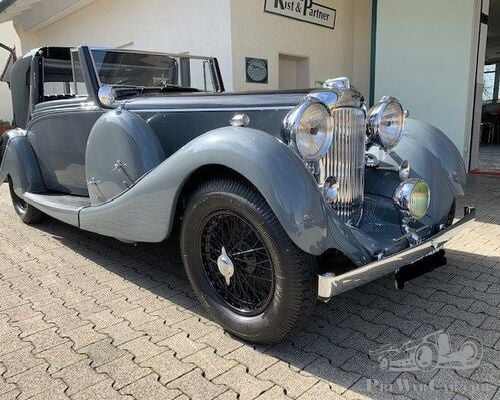
Lagonda LG 45 Coupe de Ville Sedanca by Mayfair
The successor to the M45, the LG45 was built around the same highly capable, competition-proven 4.5-litre Meadows inline-six engine, but featured r..

Daimler Flat six 15 Saloon - Fluid Flywheel / pre-selector
The E20 was manufactured between 1935 and 1939. It offered the choice of a coachbuilt saloon, Sports Saloon, Fixedhead Coupé and Drophead Coupé bod..
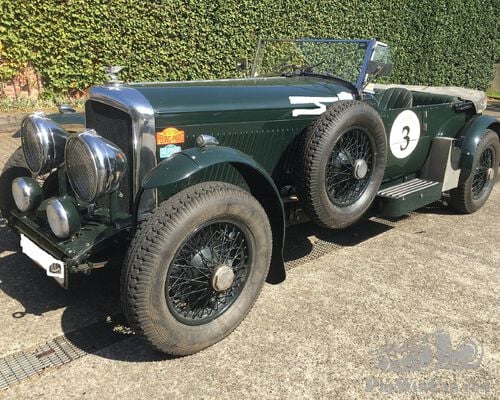
Bentley Derby Special Open Rally Car
This Bentley Derby, manufactured in 1935, has been rebuilt into a short and long-distance rally car. Full rebuilt engine in 2021, Since 2021 low mi..