The global magazine and marketplace for classic car enthusiasts, by enthusiasts.


Filter
Classic Packard, DeSoto for sale - Packard, DeSoto cars for sale
-

1928 Packard 533 Golfers Coupe
1928 Packard 533 Golfers Coupe Chassis number 144148RRegistration number: UC1064 Vintage and Prestige Fine Motor Cars are proud to be offering this 1928 Packard 533 Golfers Coupe for sale. A spectacular Packard in mint order throughout. This right hand drive example was sold new to the UK in 1928 and has remained here since... -
1936 Packard 1404 Super 8 956 Club Sedan
1936 Packard 1404 Super 8 956 Club Sedan Chassis Number: 757703 Registration Number: YXS196 Imported to the Uk a decade or so ago as a freshly restored mint car; since then the car has been sparingly but regularly used & is in really really fine condition. -
1931 Packard 845 Deluxe Eight Convertible Victoria by Rollston | RM Sotheby's | The Hershey Auction
To Be OFFERED AT AUCTION WITHOUT RESERVE at RM Sothebys' The Hershey Auction event, 7 - 8 October 2026. Offered Without Reserve | $140,000 - $180,000 USD One of eight Rollston Convertible Victorias built to this design on the 845 Deluxe Eight chassisDocumented by historical research, including a copy of its Rollston build sheet -
1942 Packard Super Eight One-Sixty Convertible Coupe | RM Sotheby's | The Hershey Auction
To Be OFFERED AT AUCTION WITHOUT RESERVE at RM Sothebys' The Hershey Auction event, 7 - 8 October 2026. Offered Without Reserve | $40,000 - $50,000 USD One of the final Packard automobiles produced before wartime suspension of civilian productionDelivered on 20 December 1941, less than six weeks before Packard ceased passenger c.. -
1938 Packard 1607 Twelve Five-Passenger Coupe Project | RM Sotheby's | The Hershey Auction
To Be OFFERED AT AUCTION WITHOUT RESERVE at RM Sothebys' The Hershey Auction event, 7 - 8 October 2026. Offered Without Reserve | $30,000 - $60,000 USD Packard’s celebrated Twelve in refined Sixteenth Series form A very appealing and seldom-seen body styleOlder, partially completed restoration in attractive colors -
1938 Packard 1607 Twelve Convertible Victoria | RM Sotheby's | The Hershey Auction
To Be OFFERED AT AUCTION WITHOUT RESERVE at RM Sothebys' The Hershey Auction event, 7 - 8 October 2026. Offered Without Reserve | $130,000 - $170,000 USD One of Packard's most coveted factory body stylesFormerly owned by noted Packard enthusiasts Chuck Mitchell, Jim Adams, and Henry PetronisAttractive older CCCA Senior .. -
1938 Packard 1607 Twelve Convertible Victoria | RM Sotheby's | The Hershey Auction
To Be OFFERED AT AUCTION WITHOUT RESERVE at RM Sothebys' The Hershey Auction event, 7 - 8 October 2026. Offered Without Reserve | $150,000 - $225,000 USD One of 566 Twelves produced for 1938Formerly owned by Russ Jackson and Henry PetronisAttractively preserved older restoration in wonderful colorsElegant Conve.. -
1937 Packard 1501 Super Eight Convertible Victoria | RM Sotheby's | The Hershey Auction
To Be OFFERED AT AUCTION WITHOUT RESERVE at RM Sothebys' The Hershey Auction event, 7 - 8 October 2026. Offered Without Reserve | $50,000 - $80,000 USD Desirable Convertible Victoria coachwork on the 134-inch-wheelbase 1501 Super Eight chassisBelieved to be the ninth Fifteenth Series Convertible Victoria producedWell-ac.. -
1935 Packard 1201 Eight Convertible Victoria | RM Sotheby's | The Hershey Auction
To Be OFFERED AT AUCTION WITHOUT RESERVE at RM Sothebys' The Hershey Auction event, 7 - 8 October 2026. Offered Without Reserve | $90,000 - $125,000 USD A beautifully presented Standard Eight Convertible Victoria from Packard's acclaimed Twelfth SeriesFinished in timeless black over a richly trimmed cognac leather interior -
Packard 120 Sedan 1935
This Packard Sedan is in very good driving condition.Always well maintained, the brakes were overhauled and a new radiator fitted a few years ago.It is an older restoration with some imperfections in the paintwork.The car has enough room for 5 people, and there is room behind the wheel for a tall driver.An impressive ..


Packard
US, 1899 – 1958
(1) New York & Ohio Automobile Co, Warren, Ohio, 1899 – 1901
(2) Ohio Automobile Co, Warren, Ohio, 1901 – 1902
(3) Packard Motor Car Co, Warren, Ohio, 1902 – 1903
(4) Packard Motor Car Co, Detroit, Mich., 1903 – 1955
(5) Studebaker – Packard Corp, Detroit, Mich., 1955 – 1958
The brothers J.W. and W.D. Packard bought a Winton in 1898 and determined to improve upon it. The result was the first 12hp Packard car of 1899. This Packard car followed traditional early-American lines with a single horizontal cylinder, central chain drive, buggy styling and wire wheels, but the Packard car was more advanced than its competitors in having a 3-speed and reverse gearbox and automatic spark advance. This gave way to the wheel-steered Model C Packard car, which proved capable of 40mph. An even more powerful Packard car, a single old for $3.000 in 1903 and on one of these Fetch and Krarup Packard cars successfully drove from San Francisco to New York in 61 days. In the same year a very big Packard car four of over 12 litres’ capacity was designed on European lines by Charles Schmidt, late of Mors. This Packard car sold for $7.500 and led to the famous Packard Model L, the first Packard car to bear the classic Packard radiator. This Packard car had side valves in an L-head and the gearbox was mounted in unit with the back axle; a similar engine was used in the racing car Gray Wolf, a streamlined lightweight Packard car capable of 75mph. 1906 Packard cars had T-head engines and magneto ignition in place of coil; engine capacity was 5¾-litres, increasing to 7-litres Packard cars in 1907 with the introduction of the famous ‘Packard 30’, from which 60bhp was claimed. For the next few years these high-quality four-cylinder Packard cars engaged all Packard’s attentions, the ‘Packard 30’ at $4.200 being joined by a short-wheelbase Packard 18 intended for use as a town carriage. Dry-plate clutches were adopted on Packard cars in 1910 and in 1911 a third model joined the range: Packard cars first six, the 7¼-litre ‘Packard48’.
Six-cylinder Packard cars only were offered in 1913, when electric lighting and starting were standardized. Spiral bevel final drive followed in 1914. Revolutionary was the world’s first series-production 12-cylinder, the Packard Twin-Six, which Packard car was announced in 1915 for 1916: this Packard car was also the first American touring car to use aluminium pistons and was quite modestly priced at $2.600. First series Packard cars had the unusual combination of left-hand drive and left-hand gear-change, abandoned on later series Packard car which also had detachable cylinder heads. A special racing car version of the Packard car, the 905 with a much bigger engine, recorded 149.9mph in the hands of Ralph de Palma at Daytona in 1919. From 1916 to 1920 only the Packard Twin Six was made, but this Packard car was then joined by a straightforward sv Single-Six selling from $2.350 up. This Packard car was given front-wheel brakes as standard replaced the Packard Twin-six during 1923; the Packard car came in two wheelbase lengths. A tourer Packard car cost $3.750 and it was the ancestor of the whole line of ‘Senior’ Packard cars up to 1939. 1925 Packard cars had centralized chassis lubrication and over 40.000 sixes were sold, as against less than 5.700 eights. Innovations on Packard cars for 1927 were a hypoid back axle, and a bigger 8-cylinder engine of 6.3-litres’ capacity, developing 106bhp. Only eight-cylinder Packard car were made in 1929, in which year a 5.3-litre Standard model was catalogued at $2.435, while in 1930 a limited series of ‘Packard 734’ sports models with high axle ratio, 145 bhp engines and 4-speed gearboxes was introduced. 1932 Packard cars had V-radiators. An inexpensive Packard Light 8 at $1.750, using the 5.3-litre engine, proved uneconomic to make, but there was also an excellent 7-litre V12 and all Packard cars had synchromesh gearboxes and vacuum-servo brakes. The Packard car company’s styling with its traditional radiator shape continued up to 1939.
In 1935 the Packard car company made a bid for the low-priced market with the 3.7-litre straight-8 ‘Packard 120’ with hydraulic brakes and independent front suspension, priced from $980, as against $2.475 for the Packard Standard-eight, $2.990 for the Packard Super-eight and $3.820 for the Twelve. The new Packard car model accounted for 24.995 of the 31.889 cars sold by Packard cars that year and was joined two seasons later by a very similar 3.6-litre six, the ‘115’ at $860; this and the ‘120’, now enlarged to 4.6-litres, were made in a separate factory. In 1938, 50 percent of the Packard car company’s labour force was engaged in making the senior Packard cars which accounted for no more than 8 percent of total production.
In 1937 hydraulic brakes and independent front suspension were standardized on Packard cars throughout the range. 1939 was the last year of the true senior Packard cars; column change was introduced and overdrive was available on all Packard cars except the Twelve. Air conditioning was a 1940 option and 1941 brought the first of the handsome Packard Clipper line, made in 4-litre 6-cylinder and 4.6-litre straight-8 versions. Expensive Packard cars were still made, with custom bodywork by Rollson, Le Baron and Darrin available on the 5.8-litre chassis. During World War 2, body dies for the bigger, conventionally-bodied Packard cars were sold to the Soviet Government, the result being the 1945 Z.I.S.
Production of Packard cars was resumed with the Clipper 6 and 8 in 1946, but Packard never regained their former pre-eminence. Styling was unfortunate and the Packard car company retained the old straight-8 until 1954, though they evolved their own ‘Ultramatic’ automatic transmission in 1949 and had power brakes, steering and window lifts in 1954. Super-luxury Packard cars included the eight-seater Executive limousine at $6.900 in 1953 and the big Caribbean convertible.
The 1954 merger of Packard cars with Studebaker brought about a new 260bhp, ohv V8 with an ingenious inter-linked torsion-level suspension, while engines were sold to American Motors for their Nash and Hudson lines. Sales fell to a depressing 13.000 in 1956 and though the Packard lingered on until 1958, the last two seasons’ cars were nothing more than disguised Studebakers.
Source: Georgano, encyclopedia of motorcar; MCS
The information is written with the greatest of care. However, if you have any suggested amendments please contact us at office@prewarcar.com
DeSoto
US, 1913 – 1916
DeSoto Motro Car Co, Auburn, Ind.
The DeSoto appears to have succeeded the Zimmerman. This was a large car with a 55hp, 6-cylinder engine, which was furnished with a compressed-air starter. The DeSoto model Six-55 five-seater touring car sold for $2185.
US, 1928 – 1960
Chrysler Motors Corp, Detroit, Mich.
The DeSoto was launched in 1928 as a 3.2-litre side valve six to compete with Oldsmobile, Pontiac and the cheaper Nashes. Styling and general design of the DeSoto were in line with the 1929 Chryslers, and at $885 for a DeSoto sedan 90.000 were sold in the first twelve months. A 3.4-litre straight-8 DeSoto on a 9ft 6in wheelbase was announced for 1930 as the world’s cheapest 8-cylinder car. However, DeSoto suffered badly in the Depression, and in 1932, when flexible rubber engine mountings and free wheels were made available, sales dropped to 26.000 DeSoto cars.
The DeSoto disappeared from the British market about this time, though certain ‘Chrysler’ models listed in England (the Mortlake, Croydon, and some of the Richmonds) were in fact DeSoto cars in all but name. A 6-cylinder version of Chrysler’s advanced unitary-construction Airflow, the SE-type with a 4-litre engine, was brought out in 1934, but was an unsuccessful as its bigger sister. Later DeSotos followed regular Chrysler lines closely though in later years there was a tendency for DeSoto to move into a higher price class than Dodge; by 1952 DeSotos started $300 higher than the companion make.
By 1939 the DeSoto cars for sale were being made with independent front suspension, hypoid back axles and column change. There was a choice at DeSoto of two 6-cylinder engines and three wheelbase lengths, the longest of these being reserved for seven-seater bodywork – DeSoto continued to offer a really roomy family car right up to 1954. A 4-speed semi-automatic Vacumatic transmission became an option in 1941, but DeSoto’s big post-war change of models did not take place until 1952, when the division followed Chrysler’s lead in adopting the oversquare ohv V8; the DeSoto version was of 4½-litre capcity and developed 16-bhp. With the advent of Chrysler’s ‘flight sweep’ styling in 1955, the side-valve sixes were dropped and the standard engine in a DeSoto was now a 4.8-litre eight, giving 185bhp in Firedome guise, and 200bhp in Fireflite form. Though this redesigning saved Chrysler sales generally, the slump in the medium-price class had an adverse effect on DeSoto and in 1959 the DeSoto division was merged with Plymouth. Last of the DeSotos were the 1961 models, unitary-construction cars with a choice of three engines: Plymouth’s 145bhp ohv ‘slant six’ as used in the Valiant, and V8s of 230 and 265bhp, the two former only in Canadian DeSotos. Production of DeSoto cars ceased in November 1960 after only a few had been delivered.
Source: Georgano, encyclopedia of motorcar; MCS
The information is written with the greatest of care. However, if you have any suggested amendments please contact us at office@prewarcar.com


Featured
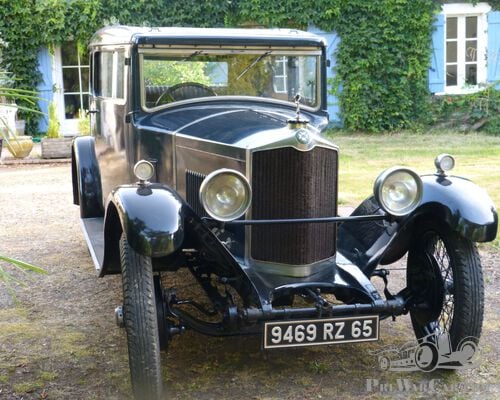
2-door 15.7hp six cylinder saloon
The car is a 6-cylinder 2-door saloon described as the "Sportsman's coach built coupé". Only three of this model are known to have survived. I have..
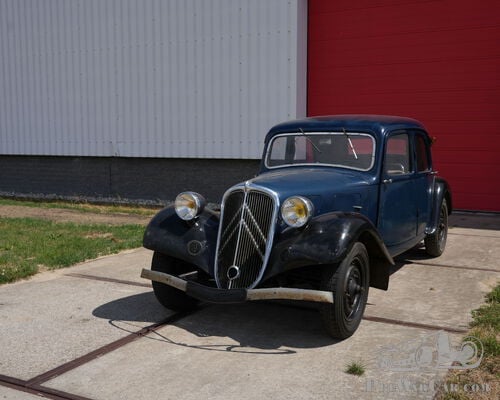
1935 Citroën Traction Avant
Early-production Traction AvantExceptionally original, unrestored conditionRecently part of a major museum collection
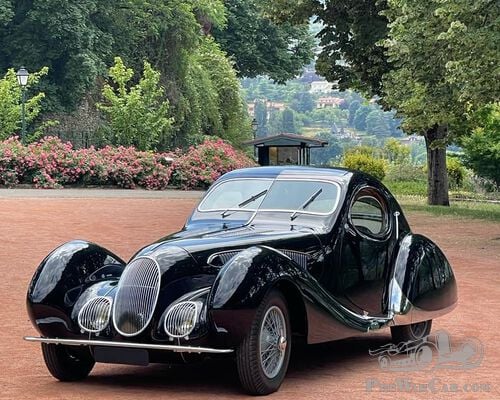
1939 Talbot-Lago T150C “Goutte d’Eau” — Iconic French Coachbuilt Masterpiece
Talbot-Lago T150C ‘Teardrop’ — An Icon of French Automotive Art There are motor cars that define an era. And then there are those tha..