The global magazine and marketplace for classic car enthusiasts, by enthusiasts.


Filter
Classic Packard, Léon Bollee for sale - Packard, Léon Bollee cars for sale
-

1934 Packard 1108 Twelve Individual Custom Sport Phaeton by LeBaron | RM Sotheby's | The Monterey Auction
To Be OFFERED AT AUCTION at RM Sothebys' The Monterey Auction event, 13 - 15 August 2026. $4,000,000 - $5,000,000 USD Among the ultimate American automobiles of the Classic EraOne of four surviving original, authentic examplesBreathtakingly beautiful and advanced design by Alexis de SakhnoffskyFormerly owned by.. -
Packard single six convertible
Rare 1925 Packard Six Sedan – Unique 7-Seater Project with Belgian PapersA solid, rust-free base for the true vintage enthusiast.We are proud to offer this rare and stately 1925 Packard Six. In the 1920s, Packard was the ultimate symbol of American luxury and engineering. This specific model is a grand 7-seater, complete with the.. -
1939 Packard 1707 Twelve 2/4-Passenger Coupe | RM Sotheby's | The Hershey Auction
To Be OFFERED AT AUCTION WITHOUT RESERVE at RM Sothebys' The Hershey Auction event, 7 - 8 October 2026. Offered Without Reserve | $100,000 - $125,000 USD One of about 12 examples builtWell-preserved and maintained older restoration with rare accessoriesFormerly owned by noted actor and Packard enthusiast Ken Kercheval -
1928 Packard 533 Golfers Coupe
1928 Packard 533 Golfers Coupe Chassis number 144148RRegistration number: UC1064 Vintage and Prestige Fine Motor Cars are proud to be offering this 1928 Packard 533 Golfers Coupe for sale. A spectacular Packard in mint order throughout. This right hand drive example was sold new to the UK in 1928 and has remained here since... -
1 OF 1 BARKER COACHWORK, EXTRAORDINARY HISTORY!
INTRODUCTION:*CCCA Senior First Prize*Packard Automobile Classics National 1st Place*Pebble Beach Concours D'Elegance Best in Class*Shown in multiple concours events*Featured in 2 books In 1938 Harry Hatch, the man behind one of the largest and most successful distilleries in the world: Hiram Walk.. -
1929 Packard 640 Sport Phaeton
Elite definition: A select group that is superior to the rest of a group. Our Elite Collection is comprised of automobiles we consider to be superior in terms of significance, desirability, rarity, quality and beauty. These are cars that only a select group of privileged people will ever have the good fortune of owning. As care tak.. -
1930 Packard 740 Custom Eight Roadster
A new arrival at Oldtimer Australia is this very impressive, opulent 1930 Packard 740 Custom Eight Roadster (7th Series).Ask the Man Who Owns One was Packards famous advertising slogan. It was a simple but powerful line, suggesting that the best endorsement of a Packard car came from its owners themselves - reinforcing the brands reputati.. -
1940 Packard Custom Super Eight 180 Darrin Convertible Victoria
This vehicle is the very desirable and rare Darrin designed convertible victoria, which is mounted on the model 1806, 127-inch chassis and was part of the company’s Super 8 Custom Line. The new Super Eight Custom line was more lavish in trim than the regular Super Eight series and was powered by the largest, eight-cylinder engine Packard produce.. -
1926 Packard 236 Straight Eight Roadster for sale
1926 Packard 236 Straight Eight Roadster Chassis number: 211436 USA Papers. We can UK register the car for you. As the recipient of a complete restoration in the 1980s, this rare and stylish Model 236 Runabout Roadster still presents in excellent condition throughout. In a previ.. -
packard eight 443 sedan limousine
packard eight sedan limousine serie 443, eight cylinders in line, 6306 cm3


Packard
US, 1899 – 1958
(1) New York & Ohio Automobile Co, Warren, Ohio, 1899 – 1901
(2) Ohio Automobile Co, Warren, Ohio, 1901 – 1902
(3) Packard Motor Car Co, Warren, Ohio, 1902 – 1903
(4) Packard Motor Car Co, Detroit, Mich., 1903 – 1955
(5) Studebaker – Packard Corp, Detroit, Mich., 1955 – 1958
The brothers J.W. and W.D. Packard bought a Winton in 1898 and determined to improve upon it. The result was the first 12hp Packard car of 1899. This Packard car followed traditional early-American lines with a single horizontal cylinder, central chain drive, buggy styling and wire wheels, but the Packard car was more advanced than its competitors in having a 3-speed and reverse gearbox and automatic spark advance. This gave way to the wheel-steered Model C Packard car, which proved capable of 40mph. An even more powerful Packard car, a single old for $3.000 in 1903 and on one of these Fetch and Krarup Packard cars successfully drove from San Francisco to New York in 61 days. In the same year a very big Packard car four of over 12 litres’ capacity was designed on European lines by Charles Schmidt, late of Mors. This Packard car sold for $7.500 and led to the famous Packard Model L, the first Packard car to bear the classic Packard radiator. This Packard car had side valves in an L-head and the gearbox was mounted in unit with the back axle; a similar engine was used in the racing car Gray Wolf, a streamlined lightweight Packard car capable of 75mph. 1906 Packard cars had T-head engines and magneto ignition in place of coil; engine capacity was 5¾-litres, increasing to 7-litres Packard cars in 1907 with the introduction of the famous ‘Packard 30’, from which 60bhp was claimed. For the next few years these high-quality four-cylinder Packard cars engaged all Packard’s attentions, the ‘Packard 30’ at $4.200 being joined by a short-wheelbase Packard 18 intended for use as a town carriage. Dry-plate clutches were adopted on Packard cars in 1910 and in 1911 a third model joined the range: Packard cars first six, the 7¼-litre ‘Packard48’.
Six-cylinder Packard cars only were offered in 1913, when electric lighting and starting were standardized. Spiral bevel final drive followed in 1914. Revolutionary was the world’s first series-production 12-cylinder, the Packard Twin-Six, which Packard car was announced in 1915 for 1916: this Packard car was also the first American touring car to use aluminium pistons and was quite modestly priced at $2.600. First series Packard cars had the unusual combination of left-hand drive and left-hand gear-change, abandoned on later series Packard car which also had detachable cylinder heads. A special racing car version of the Packard car, the 905 with a much bigger engine, recorded 149.9mph in the hands of Ralph de Palma at Daytona in 1919. From 1916 to 1920 only the Packard Twin Six was made, but this Packard car was then joined by a straightforward sv Single-Six selling from $2.350 up. This Packard car was given front-wheel brakes as standard replaced the Packard Twin-six during 1923; the Packard car came in two wheelbase lengths. A tourer Packard car cost $3.750 and it was the ancestor of the whole line of ‘Senior’ Packard cars up to 1939. 1925 Packard cars had centralized chassis lubrication and over 40.000 sixes were sold, as against less than 5.700 eights. Innovations on Packard cars for 1927 were a hypoid back axle, and a bigger 8-cylinder engine of 6.3-litres’ capacity, developing 106bhp. Only eight-cylinder Packard car were made in 1929, in which year a 5.3-litre Standard model was catalogued at $2.435, while in 1930 a limited series of ‘Packard 734’ sports models with high axle ratio, 145 bhp engines and 4-speed gearboxes was introduced. 1932 Packard cars had V-radiators. An inexpensive Packard Light 8 at $1.750, using the 5.3-litre engine, proved uneconomic to make, but there was also an excellent 7-litre V12 and all Packard cars had synchromesh gearboxes and vacuum-servo brakes. The Packard car company’s styling with its traditional radiator shape continued up to 1939.
In 1935 the Packard car company made a bid for the low-priced market with the 3.7-litre straight-8 ‘Packard 120’ with hydraulic brakes and independent front suspension, priced from $980, as against $2.475 for the Packard Standard-eight, $2.990 for the Packard Super-eight and $3.820 for the Twelve. The new Packard car model accounted for 24.995 of the 31.889 cars sold by Packard cars that year and was joined two seasons later by a very similar 3.6-litre six, the ‘115’ at $860; this and the ‘120’, now enlarged to 4.6-litres, were made in a separate factory. In 1938, 50 percent of the Packard car company’s labour force was engaged in making the senior Packard cars which accounted for no more than 8 percent of total production.
In 1937 hydraulic brakes and independent front suspension were standardized on Packard cars throughout the range. 1939 was the last year of the true senior Packard cars; column change was introduced and overdrive was available on all Packard cars except the Twelve. Air conditioning was a 1940 option and 1941 brought the first of the handsome Packard Clipper line, made in 4-litre 6-cylinder and 4.6-litre straight-8 versions. Expensive Packard cars were still made, with custom bodywork by Rollson, Le Baron and Darrin available on the 5.8-litre chassis. During World War 2, body dies for the bigger, conventionally-bodied Packard cars were sold to the Soviet Government, the result being the 1945 Z.I.S.
Production of Packard cars was resumed with the Clipper 6 and 8 in 1946, but Packard never regained their former pre-eminence. Styling was unfortunate and the Packard car company retained the old straight-8 until 1954, though they evolved their own ‘Ultramatic’ automatic transmission in 1949 and had power brakes, steering and window lifts in 1954. Super-luxury Packard cars included the eight-seater Executive limousine at $6.900 in 1953 and the big Caribbean convertible.
The 1954 merger of Packard cars with Studebaker brought about a new 260bhp, ohv V8 with an ingenious inter-linked torsion-level suspension, while engines were sold to American Motors for their Nash and Hudson lines. Sales fell to a depressing 13.000 in 1956 and though the Packard lingered on until 1958, the last two seasons’ cars were nothing more than disguised Studebakers.
Source: Georgano, encyclopedia of motorcar; MCS
The information is written with the greatest of care. However, if you have any suggested amendments please contact us at office@prewarcar.com
Léon Bollee
France, 1895 – 1933
(1) Automobiles Léon Bollée, Le Mans, 1895 – 1924
(2) Morris Motors Ltd, Usines Léon Bollée, Le Mans, 1925 – 1931
(3) Sté Nouvelle Léon Bollée, Le Mans, 1931 – 1933
Leon Bollee was a son of Amédée Bolllée père, the most important pioneer of steam road vehicles in France. Leon Bollee, however, turned to really small petrol Leon Bollee cars. He was the first to do so, and therefore had to invent a new name for his Leon Bollee car of 1895 – he called it a Leon Bollee voiturette. This Leon Bollee car was a tandem two-seater 3-wheeler that was faster than any other petrol-engined vehicle on the road when the Leon Bollee car was working, thanks to a powerful 3hp engine and light weight, but the power unit was unreliable on the Leon Bollee car. The Leon Bollee car had a single air-cooled cylinder of 650cc and used hot-tube ignition. There were 3 forward speeds on the Leon Bollee car, with belt final drive. The frame was tubular. Four years after the Leon Bollee voiturette appeared, Leon Bollee superseded it with a 4-wheeler with independent front suspension by double transverse leaf springs. This Leon Bollee car had a single-cylinder, water-cooled engine. Unlike the Leon Bollee voiturette, this Leon Bollee car made no mark. The design rights were sold to Darracq, and around 1901 the name of Leon Bollee cars vanished. Meanwhile, the term voiturette had been taken up by the trade and public in general as the name for a small light car.
The Leon Bollee car reappeared in 1903 as an entirely normal, full-sized car in the more expensive class, backed by Vanderbilt money and designed for the American market. This Leon Bollee car was made in 28hp (4.6-litres) and 45hp (8-litres) versions, with four cylinders and chain drive, and led on to a 11.9-litre six Leon Bollee car in 1907, in which year the first shaft driven Leon Bollee car appeared. From 1909 there was also a small modern four, the Leon Bollee 10/14hp. The 1910 range embraced 9 Leon Bollee cars, including 2 of over 10-litres capacity. Electric lighting became available on Leon Bollee cars in 1913, but the Leon Bollee grew increasingly old-fashioned after World War 1 despite the introduction of ohv in 1922 on Leon Bollee cars and front wheel brakes in 1923. Late in 1924 Sir William Morris bought the Le Mans Leon Bollee car factory. From making a wide range of conservative French Leon Bollee fours, it turned to thinly-disguised products of Cowley, Oxford, the idea being to breach the French tariff walls from the inside. The first Morris- Leon Bollee had a 12CV 2½-litre 4-cylinder unit-construction engine made by Hotchkiss, the engine manufacturers controlled by Morris, but it had push-rod overhead valves and bore little evidence of its parentage. Not so the 18CV Morris- Leon Bollee car of 1928. This was a 3-litre straight-8 with single overhead camshaft that reflected Morris’ takeover of Wolseley two years earlier. Morris’ own new six of 1928 was mirrored in the 15CV 2.6-litre Le Mans product of 1929. The bodies for the Morris- Leon Bollee car were all made in France and were usually considerably more dashing and attractive than their British counterparts. Chassis of this Morris- Leon Bollee car were made in France, and all cars had a 4-speed gearbox. At one time, 50 12CV Morris- Leon Bollee cars were being turned out each week. However, Morris’ enterprise was not a success, and he discontinued it in the hard times of the Depression. A new syndicate was formed in September 1931 to sell the same range of cars under the name of Leon Bollee cars. This lasted for less than two years and few Leon Bollee cars were made.
Source: Georgano, encyclopedia of motorcar; TRN
The information is written with the greatest of care. However, if you have any suggested amendments please contact us at office@prewarcar.com


Featured
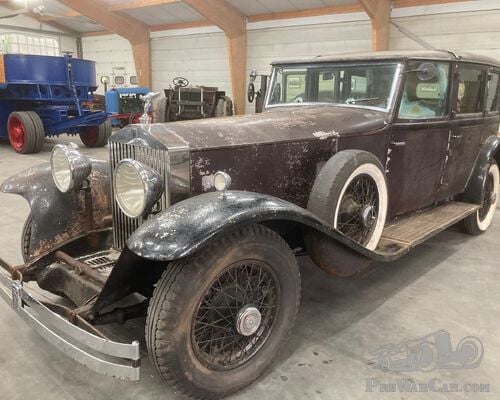
Rolls-Royce
Rolls-Royce Phantom ll chassisnummer 287 AJS. bouwjaar 1932, Links gestuurd, Brewster Keswick Sedance Towncar

1915 Rolls-Royce Silver Ghost Barker Tourer
⁃ An exceptionally rare original bodied pre-war Silver Ghost⁃ Desirable Barker tourer in exciting barn find condition⁃ ..
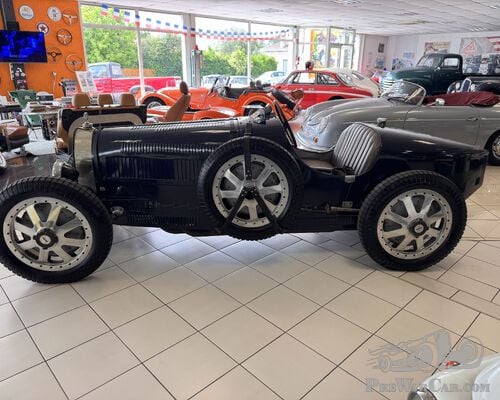
Bugatti 35 B Pur Sang
Bugatti 35 B Pur Sang,importée par un membre délégué de la FFVE il y’a une quinzaine d années.Participation à de nombreux Rallyes Bug..