The global magazine and marketplace for classic car enthusiasts, by enthusiasts.


Filter
Classic C.G.V./ Charron, Peerless for sale - C.G.V./ Charron, Peerless cars for sale
-

1939 Rolls Royce Wraith James Young Razor Edge Saloon
1939 Rolls Royce Wraith James Young Razor Edge Saloon Chassis Number: WEC72 Registration Number: 39D25 (Ireland) £200k spent upon the restoration of this car to make it in effect a brand new Rolls Royce Wraith being delivered 86 years late!!! Simply.. -
1936 Bentley Derby 4.25 Sedanca by Thrupp & Maberly
1936 Bentley Derby 4.25 Sedanca by Thrupp & Maberly Chassis number: B-36-GA Registration Number: CXE213 A stunningly beautiful car which wows onlookers wherever it is seen, this 4.25 Litre Derby Bentley Sedanca Coupe has fabulous and possibly unique aluminium Sedanca coachwork by Thrupp and Maberly... -
Cadillac V16 - Series 452 - 1930 - Imperial Sedan 4330
Offers invited a round € 200.000 - This ONE of 4 Survivors of Serie 4330 body style - book C.W. Cummings - 2014) ***excellent driving car, the V16 gives you a special experience, no other car has***https://www.prewarcar.com/a-stately-cadillac-v16-in-the-netherlandsBuilt; no 9 of 50 - Engine no. 700163Lengt.. -
Bugatti Type 30 short chassis roadster. Fully restored on a replica chassis
This car has had a full restoration and is build from a lot of original parts on a replice chassis built in Germany, It has chassis number BC 189 from the UK Bugatti Owners Club. Car has done only about 500km since restoration but health problems dictate that it must go. Please email for fullest details of the source of all the parts and a vide.. -
1930 Bentley Speed Six
1930 Bentley Speed Six Chassis Number: SB2774 Engine Number: SB2772 Reistration Number: GH8974 New to market & freshly restored to perfection. This car has over the past two years been fully rebuilt & built up as a LeMans style tourer by noted Rolls Royce &.. -
1936 Cadillac Series 60 Convertible Coupe | RM Sotheby's | The Hershey Auction
To Be OFFERED AT AUCTION WITHOUT RESERVE at RM Sothebys' The Hershey Auction event, 7 - 8 October 2026. Offered Without Reserve | $50,000 - $70,000 USD Please check back soon as our dedicated cataloguing team is preparing the description for this lot. To view this car and others currently consigned to this auction, please visit the RM website a.. -
Renault NN Torpedo Commerciale (1926)
Highlights Complete, coherent, unmodified exampleExcellent base for a full restorationAttractive 1920s torpedo body styleVery accessible entry priceIdeal for workshops or enthusiasts looking for a rewarding project Restoration project – Complete car – Solid base but major work r.. -
Renault 12 HP Coupé de Ville Carrosserie Kellner Type CB – 1911
HighlightsExceptional original conditionRare Kellner coachworkComplete, authentic, coherent exampleOriginal paint and interiorMuseum‑grade preservationIdeal for concours preservation class Kellner Coupé de Ville – Exceptional original condition This.. -
De Dion‑Bouton Type D (1899)
HighlightsRare early De Dion‑Bouton, highly collectibleBeautiful presentation and coherent historyEligible for major international veteran eventsA centrepiece for any prestigious collection Vis‑à‑vis “La Petite Voiture” – High‑quality restoration – Veteran car eligible .. -
1940 Buick Super Convertible Coupe | RM Sotheby's | The Hershey Auction
To Be OFFERED AT AUCTION WITHOUT RESERVE at RM Sothebys' The Hershey Auction event, 7 - 8 October 2026. Offered Without Reserve | $50,000 - $60,000 USD Please check back soon as our dedicated cataloguing team is preparing the description for this lot. To view this car and others currently consigned to this auction, please visit the RM website a..


C.G.V. / Charron
(1) Charron, Girardot et Voigt, 1901 – 1906
(2) Automobiles Charron Ltd, Puteax, Seine, 1906 – 1930
All three original partners in the CGV (C.G.V.) concern had raced Panhards; Charron won the first Gordon Bennett Cup race in 1900, while Girardot, who had been associated with him in a Parisian Panhard agency since 1897, enjoyed the reputation of being ‘the Eternal Second’. Thus it is not suprising that C.G.V.’s first cars reflected Panhard influence with their flitch-plate frames, 4-cylinder automatic inlet valve engines, 4-speed gearboxes and side-chain drive. The capacity of the CGV car was 3.3-litres. Girardot drove a 9.9-litre CGV racing machine in the 1902 Gordon Bennett Cup, but retired, though the CGV touring models rapidly established a sound reputation and were made under licence in the USA by Smith and Mabley, later to be responsible for Simpley. In 1903 CGV built one of the world’s first straight-8s, a racing 7.2-litre machine with no gearbox. In the same year they also made an auto-mitrailleuse based on their private-car CGV chassis, a line of development they were still exploring in 1906. Mechanically-operated inlet valves featured on their bigger models,though there was also an 8hp automatic inlet valve twin in addition to the original ‘CGV 15’. By 1905 automatic inlet valves had been dropped altogether and the CGV firm were turning out big 4-cylinder cars of 4.9-litre, 6.2-litre and 9.8-litre capacity, all T-headed and still with flitch-plate frames, but now with high-tension magneto ignition and swiveling acetylene headlights. CGV’s had Renault-type bonnets, but adhered to pump cooling and underslung frontal radiators. The biggest CGV car model cost £1.200 for a bare chassis in England. Girardot’s entry of a twin-radiatored car for the French Gordon Bennett Eliminating Trials was written off in a crash. The CGV company never raced again. Shaft drive was found on a 14/18hp CGV model in 1906, while at the other end of the range there was an immense 12.9-litre chain-driven 75/90hp with geared-down starting handle; one huge berline de voyage with built-in lavatory was shipped to an American client! In this year the CGV firm became a British limited liability company and Girardot left to sponsor the GEM petrol-electric. By 1912, Fernard Charron was also engaged on a venture of his own, the Alda.
From 1907 the CGV cars were knowns as Charrons, and the 14/18hp had acquired a monobloc engine, while shaft drive was available a year later on the 4.9-litre ‘Charron 20/28’. The smaller models appeared on the home market with left-hand drive. 1909 saw the advent of a new line of Charron cars which was to continue with little change up to 1914. These Charron cars had L-head engines, thermos-syphon cooling and dashboard radiators living uncomfortably near their petrol tanks. They were made in 1.2-litre 2-cylinder, 2.4-litre and 3.7-litre 4-cylinder, and 3.9-litre 6-cylinder versions, the two bigger Charron types having 4-speed gearboxes. The twins were dropped at the end of 1912, and the sixes a season later. At the same time the bigger Charron models continued unchanged, with fitch-plate frames, and chain drive, the latter being still listed as an option as late as 1912. The Charron make was used widely as a taxicab in London and some Charron cars were tried with Lentz hydraulic transmissions in 1913. Just before World War 1 came a baby 4-cylinder, the 845ccc Charron Charronette with 3-speed gearbox and detachable wood wheels, which offered a 40mph performance for £214. Other Charron models listed in 1914 were monobloc fours of 2.4-litres (the well-known ‘Charron 15’) and 3.4-litres.
The larger post-war Charrons were uninteresting cars, differing from their 1914 forebears in having pump cooling, conventional frontal radiators, and full electrical equipment. The 3.4-litre ‘Charron 18/24’ with sv and fixed head cost £1525 in England in 1920, but alongside this was developed a new Charonette with 1057cc sv engine, 2-bearing crankshaft, thermo-syphon cooling, frontal radiator, trough-and-dipper lubrication and a central vertical gate change for the 3-speed separate gearbox. It had little affinity with the British-made Charron-Laycock made in Sheffield from 1920, but the latter’s presence kept it off the English market until 1922, when it was listed at £325. Charron cars were not made with front-wheel brakes until 1925, when a 1½-litre ohv Charron 10CV on conventional lines was announced. Like many a Frenchmaker, Automobiles Charron departed from the scene with an undistinguished small six. Its capacity was 2.8-litres, the valves were overhead and cooling was by pump. A smaller 1.8-litre version was listed in 1929, but this marked the end of the make Charron.
Source: Georgano, encyclopedia of motorcar; MCS
The information is written with the greatest of care. However, if you have any suggested amendments please contact us at office@prewarcar.com
Peerless
US, 1901 – 1931
(1) Peerless Mfg Co, Cleveland, Ohio, 1900 – 1905
(2) Peerless Motor Car Co, Cleveland, Ohio, 1905 – 1931
The Peerless car was known in its heyday as ‘One of the three P’s’ (Packard, Peerless and Pierce-Arrow), the great trio of American motoring. The Peerless car first appeared in 1900, the product of a concern which had built clothes wringers and bicycles since 1869. Its début was not auspicious, the 1900 prototype Peerless car being a typical horseless carriage with bicycle wheels and a single-cylinder De Dion Bouton engine. This Peerless car was followed in 1901 by the Peerless Type C Motorette, with a 3½hp single-cylinder water-cooled engine, this Peerless car was priced at $1.300. This was augmented later in the year by the Peerless Type B, similar but smaller and cheaper.
Louis P. Mooers came to Peerless cars as chief engineer in 1901 and it was he who shaped the policy of the Peerless car company during its first formative years. He designed the 1902 range of Peerless cars. These Peerless cars were shaft-driven and the engine was mounted vertically at the front of the car in what was to be the conventional arrangement in most cars, but was an innovation at the time. Selective sliding-gear transmission was used on Peerless cars and side-entrance tonneaus were included in the range, possibly the first cars of this type. The prototypes of the 1902 Peerless car line were equipped with a single-cylinder Mooers-designed engine, although the production Peerless cars had 2-cylinder power plants. The 1903 Peerless car series were based on 1902 Peerless racing cars (also designed by Mooers). Two Peerless cars were available, a 24 and a 35hp, both with 4-cylinder T-head engines of Mooers design. The year 1903 was notable for the appearance of the Peerless limousine, probably America’s first closed car that was not custom-built.
In 1904, Mooers designed the famous Peerless Green Dragon racing car, a behemoth with a 6x6in bore and stroke. Driven from track to track by Barney Oldfield, ‘The Boy in Green’ test driver for the Peerless car company’s racing cars, the Green Dragon brought Peerless cars an enviable reputation as Oldfield continued to break records – frequently his own. He crashed the Green Dragon Peerless car in 1905, but a new Peerless Green Dragon car was built and continued the record set by its earlier namesake.
By this time, the Peerless car company was rapidly expanding and production of Peerless cars was increased. The Peerless cars was regarded as one of the prestige cars of America and was priced accordingly. In 1907, the first 6-cylinder Peerless car was introduced although the fours continued for many years. Changes on Peerless cars were largely limited to perfection of details. In 1912, prices ranged from $4.200 to $7.200. By 1913, Peerless cars were equipped with self-starters of the Peerless car firm’s own design.
An important development in Peerless design was the introduction of a V8 Peerless car, a year after the rival Cadillac concern. This Peerless V8 appeared late in 1915 and was reasonably priced in comparison with the expensive six-cylinder Peerless cars which were discontinued at this time. With 80bhp at 2.700rpm, low speeds as well as high were possible in top gear. In appearance the V8 closely, resembled the Cadillac. The 1915 model Peerless car continued without basic change until 1922, by which time its appearance had become outmoded. For 1923, bodies of the Peerless car were lowered and rounded and the rear platform spring given up. Strangely enough, the newer design of the Peerless car also closely resembled the contemporary Cadillac.
By 1923, business was good with some 5.000 Peerless cars being sold. A year later, a six was introduced as a companion car to the larger eight, now termed the ‘Peerless Equipoised Eight’. In 1925, for the first time, an outside engine was utilized in a six by Peerless cars. This was a Continental and was used on the Peerless 6-80 chassis. Prices of Peerless cars ranged from $1.400 for the cheapest six to more than $4.100 for the most expensive eight. Between 1926 and 1929, Peerless cars continued to market two lines of sixes and one of eights at prices from $1.895 to $3.795. But despite a wide price range, sales of Peerless cars were falling steadily, possibly because of generally uninspired and rather unattractive bodies. In 1929, the Peerless car range was redesigned, the new Peerless car models resembling the Marmon or Stutz to a considerable degree. A Continental straight-8 replaced the old V8 engine. The two sizes Peerless cars were continued and towards the end of 1929, with sales increasing, the outlook seemed brighter. Count Alexis de Sakhnoffsky was hired to design the 1930 Peerless car line. Thsese Peerless cars were the sleekest and best-looking the Peerless car company had ever produced. Three sixes and one eight were offered by Peerless cars with prices ranging from $995 to $2.195. The eight was dropped shortly after its introduction.
Then came the Depression and this finished the Peerless car. The Peerless car make had slipped from 25th to 28th place among American car manufacturers from 1928 to 1929 and to 30th place in 1930.
It was early in 1931 that the Peerless car company decided to attempt to recapture its former position by introducing a new prestige Peerless car which would compare with the Cadillac-V16 and the Marmon Sixteen. This Peerless car was the Peerless V16; only one prototype Peerless car was built and this still survives today. Built in 1931, the Peerless car was to have been produced as a 1933 or possibly even a 1932 model. This Peerless car was almost entirely built of aluminium. With a 42lb frame, an aluminium engine of 7.6-litres and 173bhp at 3.300rpm the Peerless car was one of the handsomest cars ever made in the United States then or at any other time. Its custom sedan body was built by Murphy.
Actual production of Peerless cars ended on 30th June 1931. The Peerless car plant remained idle for more than two years then, prohibition having been repealed, the Peerless Motor Car Company became the Peerless Corporation, brewers of Carling’s Ale and as such, it survives to this day.
Source: Georgano, encyclopedia of motorcar; KM
The information is written with the greatest of care. However, if you have any suggested amendments please contact us at office@prewarcar.com


Featured
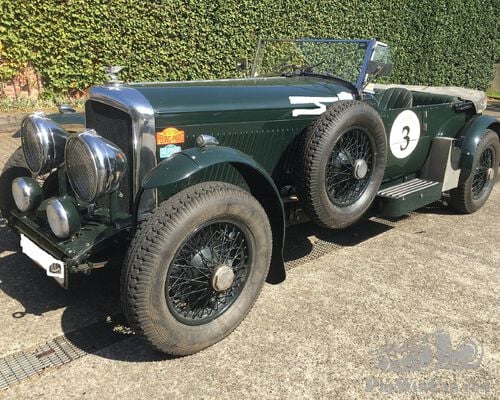
Bentley Derby Special Open Rally Car
This Bentley Derby, manufactured in 1935, has been rebuilt into a short and long-distance rally car. Full rebuilt engine in 2021, Since 2021 low mi..
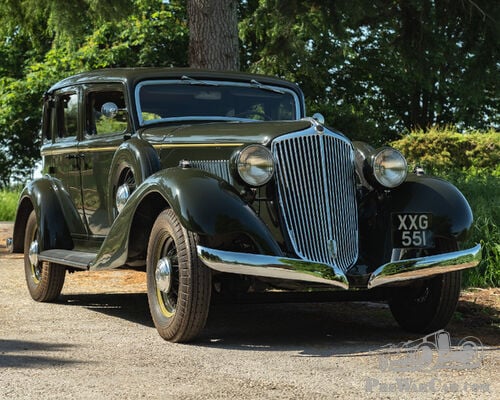
Graham Model 64 Standard Eight 'Blue Streak'
UK Registration No: XXG 551Chassis No: 1801069MOT: ExemptH&H ClassicsKelham Hall | Newark, Nottinghamshire