The global magazine and marketplace for classic car enthusiasts, by enthusiasts.


Filter
Classic Pilain for sale - Pilain cars for sale
-

1936 Lagonda LG45 Drop head Coupe
1936 Lagonda LG45 Drop head Coupe Chassis number: 12104 Registration number: HXV183 (Previous) Fully Nut & bolt restored some years ago; this car has seen very sparing dry weather only use ever since & has also been the winner of some Lagonda club awards. Unusually the c.. -
1903 Panhard Et Levassor 7HP Twin Cylinder Rear Entrance Tonneau - VCC Dated
FULL DETAILS COMING SOON -
Derby Bentley Special 4-1/4
Sadly i am having to sell on my Bentley special ( Icarus). It is currently a work in progress and still needs finalising/ refining. A great opportunity to be able to buy a cheaper Derby special to finish with your own touch. Details on the car:The car was originally built by well known Bentley special builder and profe.. -
1910 OLDSMOBILE SPECIAL 40HP ROADSTER RHD
1910 OLDSMOBILE SPECIAL 40HP ROADSTER Chassis Number: 2037Registration Number: AA-00-41 Portugal Yellow with black pinstriping and black leather seats Engine: four cylinder, c336ci., 40bhp; Gearbox: four-speed manual; Suspension: front, semi-elliptic leaf springs, rear, three-quarter ellipt.. -
1920 HUDSON SUPER SIX
FOR SALE :1920 HUDSON SUPER SIX SEVEN SEAT TOURER. 4.7 litre six cylinder sidevalve engine producing 76bhp at 2445rpm. . The car stands on four excellent wooden wheels fitted with new Goodrich 35x5 tyres. The car also has 4 addition rims with tyres as supplied with the car when new. I've reluctantly to part with the car which has a lot of.. -
Ford model T racer 1925
This is an original “ Poor mans race car “ build in New Jersey by Ralph Cox , in 1935 - 39 .It has 2 speed rearend , Lovered chassis , another steering ect. Engine is standard .He was Aircraft pilot and made the body in the weymann / aircraft style with leather- clothe over padded frame. Price : please ask ! -
1938 Bugatti Type 57 Atalante by Gangloff | RM Sotheby's | The Monterey Auction
To Be OFFERED AT AUCTION at RM Sothebys' The Monterey Auction event, 13 - 15 August 2026. $1,500,000 - $1,800,000 USD A bespoke example for original owner Fernand CrouzetNumerous unique and special details throughout, as specified by Mr. CrouzetContinuously known ownership history since newWell-preserved concou.. -
1937 Delahaye 145 Cabriolet by Franay | RM Sotheby's | The Monterey Auction
To Be OFFERED AT AUCTION at RM Sothebys' The Monterey Auction event, 13 - 15 August 2026. $4,500,000 - $6,000,000 USD One of five competition 12-cylinder 145 chassis producedBelieved to be the car that famously beat Germany’s finest for the Prix du MillionFitted with astonishing custom roadgoing coachwork by Fran.. -
1937 Delahaye 135 Grand Prix | RM Sotheby's | The Monterey Auction
To Be OFFERED AT AUCTION at RM Sothebys' The Monterey Auction event, 13 - 15 August 2026. $250,000 - $400,000 USD Mr. Mann’s proven and very successful longtime vintage racing entrantBuilt by Pascal Morel to period Le Mans specificationRecipient of much sorting over the years by Competition Motors and Marcovicci-Wenz -
1937 Delage D8-120 S Aerodynamic Coupe by Pourtout | RM Sotheby's | The Monterey Auction
To Be OFFERED AT AUCTION at RM Sothebys' The Monterey Auction event, 13 - 15 August 2026. $5,000,000 - $6,000,000 USD Best of Show at the 2005 Pebble Beach Concours d’EleganceThe original prototype for the D8-120 S chassisThe personal automobile of Louis Delage Extraordinarily beautiful, unique coachwork of sup..


Pilain
France, 1902 – 1920
SA des Automobiles Pilain, Lyons
François Pilain made his first Pilain cars, with 2- and 4-cylinder engines, in 1902, but had dropped the twin in his Pilain car by 1904. The drive of the Pilain car was independent of the rear axle, but two shafts to internally-toothed rings, with a dead axle beneath. The principle on the Pilain car was the same as that used by De Dion, the aim being to allow the axle to move in relation to the frame without recourse to chain drive. The engines of the Pilain car had side valves in a T-head, and there were 4 forward speeds. Round radiators and low-tension magneto ignition were featured, and 1906 Pilain cars came in 4.1-litre and 8.6-litre sizes, both with 4-cylinder engines. High-tension ignition and pressure lubrication followed on Pilain cars in 1908. There was a 1.9-litre Pilain car with monobloc engine in 1909, and a small 2.4-litre six in 1912. A wide 1913 range Pilain cars covered everything from a 1-litre lightweight up to 6.3-litres, including an ultra-long-stroke 4.2-litre (85x185mm) four. The Pilain car was an expensive if excellent machine that did not long outlive World War 1 in its original form. The Pilain car was then developed into the extraordinary S.L.I.M.
France, 1930 – 1935
E. Pilain, Levallois-Perret, Seine
Emile Pilain, who had been responsible for the original Rolland-Pillain, produced a light Pilain car on his own account in 1930 for the mass market. This Pilain car was a 919cc, watercooled sv four, with a 3-speed gearbox and Perrot brakes. It was rated at 5CV, and in 1932 there was also a 1.2-litre version Pilain car with free wheel.
Source: Georgano, encyclopedia of motorcar; TRN
The information is written with the greatest of care. However, if you have any suggested amendments please contact us at office@prewarcar.com


Featured
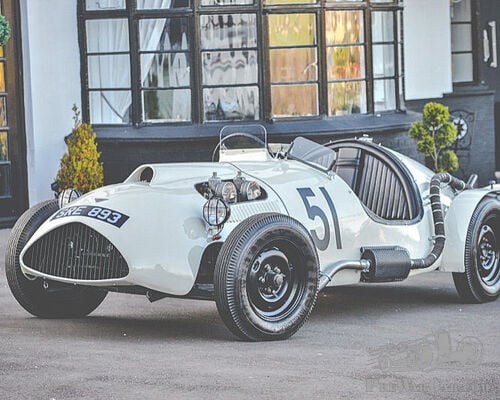
1933 Alvis 3.0 Special - One-Off Alloy Body | Period Competition Car | Featured in “Alvis – A Century of Drivers”
1933 Alvis 3. 0 Special - One-Off Alloy-Body | Period Competition Car | Featured in “Alvis – A Century of Drivers”

1939 Wanderer W 23 Gläser(Dresden) Convertible
Wanderer W 23 Gläser(Dresden) Convertible in original condition Built in 1939 for sale. Ready to drive with TÜV and approval as a historic vehicle..