The global magazine and marketplace for classic car enthusiasts, by enthusiasts.


Filter
Classic Adler, Plymouth for sale - Adler, Plymouth cars for sale
-

Adler Trumpf Junior Sport Roadster 1935 – Ex Willi Kornmayer – 40 Jahre zugelassen & gefahren
Zum Verkauf steht eine absolute Rarität der deutschen Vorkriegsgeschichte: ein originaler Adler Trumpf Junior Sport Roadster mit Erstzulassung vom 20. April 1935. Der sportliche, zweisitzige Sport Roadster ist heute eine absolute Rarität auf dem MarktZustand & Historie:Nach der Restaurierung durch den bekannten Adler-Spezialist.. -
1940 Plymouth P10 Deluxe Convertible Coupe | RM Sotheby's | The Hershey Auction
Sold | $43,680 USD One of 6,986 Deluxe Convertible Coupes produced for 1940Benefits from an excellent rotisserie restoration under previous ownershipL-head inline six-cylinder engine; three-speed manual with overdriveWonderfully presented in Boatswain Blue over red leather Richly appointed with a remark.. -
Adler 1913 Touring
Very unrestored . Is a real eye-catcher in the present condition. Previous owner has run it recently.Danish registration document .Price : please ask. -
1932 Plymouth Model PB Sport Roadster | RM Sotheby's | The Hershey Auction
Sold | $22,400 USD One of just 2,163 Sport Roadsters produced for 1932Final year for Plymouth's original Silver Dome four-cylinder engineEquipped with dual side-mounted spares, rumble seat, and folding rear luggage rackOne of Plymouth's most attractive and desirable pre-war open body styles By 1932, ..


Adler
D, 1900 – 1939
(1) Adler Fahrradwerke vorm. Heinrich Kleyer AG 1900 – 1906
(2) Adlerwerke vorm. Heinrich Kleyer AG, Frankfurt/Main 1906 – 1939
This well-known bicycle and typewriter firm had already built components for Benz as well as a few De Dion tricycles when their first car appeared in 1900. This closely resembled the contemporary Renault, with tubular frame, shaft drive, and front-mounted 400cc single-cylinder De Dion engine; suspension was full-elliptic all round and steering was by tiller, but both these archaisms had gone by 1901 when a bigger 510cc power unit was standardized. By 1902 the company were making their own engines, an 850cc single and a 1.7-litre twin, there were four forward speeds, and the lateral radiators continued the Renault idiom.
With the arrival of Edmund Rumpler in 1903 the Adler idiom crystallized, even if this experimental swing-axle suspension did not pass beyond the prototype stage. Characteristics of the new models were side valves in an L-head, dual ignition, pressed-steel frames, and rectangular radiators. Four cylinders were preferred, though singles were still offered in 1905, and twins as late as 1909. By 1905 there were 4-cylinder cars of 2.8-litres, 4-litres and 7.4-litres, this last figuring in Adler’s Herkomer Trophy entry, and attracting an order from Kaiser Wilhelm II in 1907. If the 1906 Kleinwagen, a 1.032cc aiv V-twin with water cooling and steel artillery wheels, marked a retrograde step, by 1907 the company had adopted the unit gearbox, and were experimenting with ioe engines, achieving a 3rd place in the Prince Henry trials. There were also some modest short-stroke fours. A 2-litre 8/15ps was followed a year later by the successful 1.555cc 7/15. This developed into the 1.8-litre 7/15, popular in England as the 12hp. These small Adlers had dual ignition, but foot accelerators were found only on the bigger cars as late as 1913. There was a fast 5.2-litre 76bhp ioe model for the 1910 Prince Henry Trials, and a smaller 3.2-litre version was offered to the public. It evolved into the 15/40 of 1913, with 3.8-litre and 69bhp, used as the basis for Adler’s unsuccessful 1914 T.T. racers. Their Knight-engined 1911 cars did not progress beyond the prototype stage, but very attractive was that year’s new model, the 1.3-litre K voiturette, initially with pair-cast cylinders, but offered in 1913 with Monobloc engine and a choice of side-by-side or tandem seats. Rear suspension was full-elliptic. It did 50mhp and 38mpg, and was well received by Britons, who bought it under the name of Morgan-Adler Carette. There were also some large sv fours, the 4.8-litre 19/45 appearing in 1911, followed in 1912 by a 7.8-litre 30/70, and in 1914 by a V-radiatored 9.1-litre monster, top of a nine-model range. Also new was an enlarged K, the 1.552cc KL with four-seater bodywork and semi-elliptic rear springs.
A selection of the more popular 1914 types reappeared in 1919, and even in 1922 a replacement for the KL, the 6/22PS, retained a fixed head and reverted to a separate gearbox. Adler’s first sixes came in 1925, these boasting alloy pistons, detachable heads, and front wheel brakes. The 10/50 had a 2.6-litre Monobloc engine, but the 4.7-litre 18/80 was of biblock type. Also new was an essay in the American idiom, Becker’s 1.550cc 4-cylinder Favorit. Three years later it had been joined by a 2.9-litre six and a 3.9-litre straight-8, both with hydraulic brakes, these being offered on an enlarged and modernized Favorit in 1929.
At the Geneva Show in 1932 Adler presented their new 1.5-litre Trumpf with front-wheel drive and independent wheel suspension, a design of H.G. Röhr. This first front-driven car was followed by the 1-litre Trumpf Junior, the 1.7-litre Trumpf and the 2-litre model. The competition versions of these models – very often fitted with aerodynamic bodies – were very successful in the years from their appearance to the outbreak of World War 2. Streamlined Trumpf and Trumpf Junior cars gained 22 international records in 1935 and 1936 on the Avus and the Darmstadt Autobahn. A win in the Leinster Trophy Race of 1934, a Team Prize at Spa in 1936 in the 2-litre class, a 2-litre class win and 6th place overall at Le Mans in 1937 were only a few of the victories. In 1937 Adler introduced a rear-wheel driven model again, the 2.5-litre with 6-cylinder 50bhp engine, aerodynamic body and swing axles. The sports version of this type developed 80bhp.
Production of private ceased in 1939. Some prototypes of the Trumpf Junior were produced after the war and were on show at the Hanover Fair 1948, but production was not taken up. Instead of this, production of motorcycles was resumed, lasting until 1957.
Source: Georgano, encyclopedia of motorcar; HON
The information is written with the greatest of care. However, if you have any suggested amendments please contact us at office@prewarcar.com
Plymouth
US, 1928 to date
Chrysler Corporation, Detroit, Mich.
The 4-cylinder 21hp Plymouth car appeared in 1928 at a list price of $725 for a sedan. This Plymouth car replaced the earlier 4-cylinder Chryslers and represented a serious challenge for Ford and Chevrolet in their lowest price class. The Plymouth car had side valves, internal-expanding hydraulic brakes and ribbon-type radiator and gave the Plymouth car a close resemblance to the 1928 Chryslers and De Sotos, and Plymouth cars sold over 100.000 in its first year, even improving its sales position in the bleak economic climate of 1932. Plymouth cars adhered to four cylinders until 1933, when the Plymouth PD-series 6-cylinder was listed at less than $600. 1934 de luxe models of Plymouth cars had independent front suspension, but this was dropped after a year and did not reappear for some time on Plymouth cars. The standard engine in the later 1930 Plymouth cars had a capacity of 3.3-litres, rather smaller than that used in comparable Chevrolets and Fords: a small-bore 2.8-litre version Plymouth car was made for export up to 1939, but the name Plymouth was not usually found on Plymouth cars sold in England, which were nominally Chrysler Kew and Wimbledon sixes. After World War 2 evolution followed that of other Chrysler Corporation cars closely, the old-fashioned styling losing the Plymouth car division its long-held third place in American sales to Buick. Further, Plymouth cars retained the L-head six as its staple power unit right up to 1955, when Flight Sweep versions were introduced with over-square ohv V8 engines on accepted American lines in a variety of powers from 157 to 177bhp. The capacity of these Plymouth cars had 4.3-litres, while the six, now of 3.8-litres, remained available. These 1955 Plymouth cars were lower and longer than their predecessors and could be obtained with synchromesh, overdrive or automatic gearboxes.
The Plymouth Fury models of the ensuing decade represented a breakaway from the traditional Plymouth stolid family car, while the Plymouth Car Division was also responsible for Chrysler’s contribution to the compacts, the Plymouth Valiant launched for 1960. This Plymouth car had rather more European styling than its competitors, with a dummy spare-wheel moulding on the tail; interesting items of specification were the unitary construction of the Plymouth car, alternator ignition, and inclined in-line 2.8-litre ohv 6-cylinder engine. The influence of the Plymouth GT car on America resulted in the Plymouth Barracuda of 1965, a fastback coupé using the Valiant’s 8ft 10in wheelbase and a 4½-litre V8 power unit. Plymouth cars, like Ford and Chevrolet, was aiming at comprehensive coverage of the low and medium price market in 1966, with the compact Plymouth Valiant, the sports-compact Plymouth Barracuda, the medium-sized Plymouth Belvedere, the full-size Plymouth Fury, and the luxurious ‘VIP’ 4-door hardtop Plymouth car, offered only with a 5.2-litre V8 engine and selling for $2.930. An increasing emphasis on sporting Plymouth cars was detectable by 1968, when in addition to the established Barracuda there were two other sports coupés Plymouth car, the Plymouth GTX and the Plymouth Road Runner. All three Plymouth cars were available with 4-speed manual gearboxes and the 6.981cc 425bhp hemi-head V8 also used by Dodge. In 1970, when Valiant prices started at a low $2.172, there was also a Valiant sports coupé, the Plymouth Duster.
In 1971 Plymouth car company added a sub-compact to their Plymouth car range when they offered the 1½-litre Hillman Avenger as the Plymouth Cricket. The 1972 range of Plymouth cars embraced the Valiant on a 9ft wheelbase, the Barracudas and Satellites, and the full-size Furys with V8 engines and automatic transmission as standard. Engines in the Plymouth cars ranged from the Valiant’s 3.2-litre and 3.7-litre sixes up to the largest Chrysler unit, a V8 of 7.210cc. Electronic ignition was offered on the costliest Barracuda model. Casualties of new Federal regulations were the hemi-head engine and convertibles, and the same range Plymouth cars with minor improvements, among them manually-operated sun roofs, was offerd in 1973.
Source: Georgano, encyclopedia of motorcar; MCS
The information is written with the greatest of care. However, if you have any suggested amendments please contact us at office@prewarcar.com



Featured
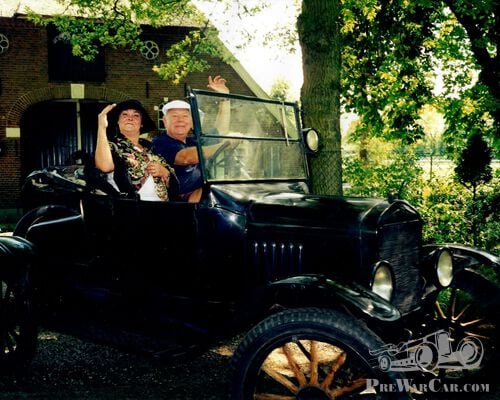
Zeer originele Ford Model T runabout
2 zits cabrio, motor is los, niet gerestaureerd, volledig orgineel, ingevoerd uit california in 1998, van de 2e eigenaar (m'n Oom) die hem van zn b..
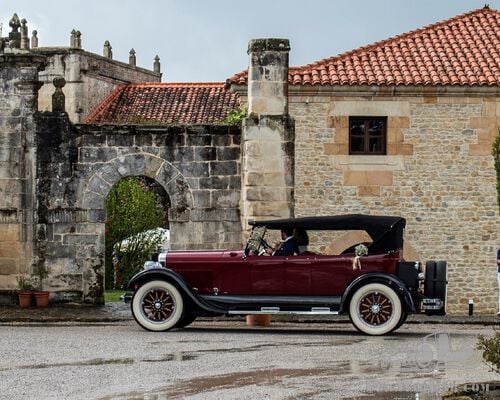
1925 Lincoln Model L Phaeton by Brunn - Excellent provenance
Retaining its original matching-numbers engine and chassis (both numbered 24576), the car benefits from an extensively documented history and..
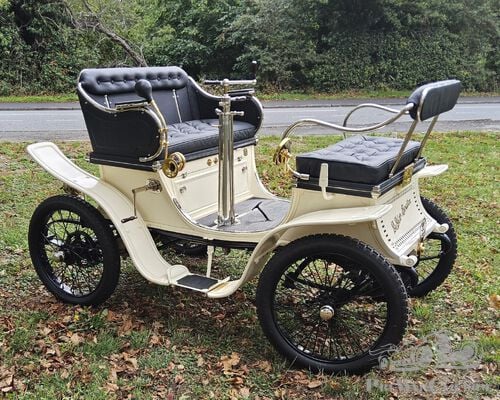
1902 De Dion Bouton Vis-a Vis 4.5 H.P. Reg No. Y123 V.C.C. Cert No. 1649
1902 De Dion Bouton Vis-à-vis 4.5 H.P.Reg. No. Y132 V.C.C. Cert No. 1649Beautifully presented and completely restored following an ex..