The global magazine and marketplace for classic car enthusiasts, by enthusiasts.


Filter
Classic Chalmers, Plymouth for sale - Chalmers, Plymouth cars for sale
-

1940 Plymouth P10 Deluxe Convertible Coupe | RM Sotheby's | The Hershey Auction
To Be OFFERED AT AUCTION WITHOUT RESERVE at RM Sothebys' The Hershey Auction event, 7 - 8 October 2026. Offered Without Reserve | $60,000 - $80,000 USD Please check back soon as our dedicated cataloguing team is preparing the description for this lot. To view this car and others currently consigned to this auction, please visit the RM website a..

Chalmers / Chalmers-Detroit
US, 1908 – 1924
Chalmers Motor Car Co, Detroit, Mich.
The Chalmers was one of the most popular automobiles made in the United States for more than a decade. The Chalmers was the successor to the Thomas-Detroit which was built by a company which had been founded in 1906 by E.R. Thomas (builder of the Thomas car in Buffalo, N.Y.), Roy D. Chapin and Howard Earle Coffin; the two latter had previously served at Oldsmobile. The Thomas-Detroit of which some 500 were sold during the first year of production, was marketed through the parent firm in Buffalo which manufactured a larger line of cars under the Thomas emblem. The Thomas-Detroit was a medium priced four-cylinder car which had been designed by Coffin. In 1907, Hugh Chalmers, vice president of the National Cash Register Co and a noted salesman, entered the firm. Shortly after, he bought a half of E.R. Thomas’ stock and became president of the company which became the Chalmers-Detroit Motor Company. The Thomas-Detroit became the Chalmers-Detroit in 1908 and in 1910, the Chalmers. Open and closed Chalmers models in two lines comprised the Chalmers four-cylinder cars, with self-starters appearing in 1912. Chalmers (as Chalmers-Detroit) had distinguished itself in road races as early as 1908 when W.R. Burns won the Motor Parkway Sweekstakes at Jericho, N.Y., averaging 48.7mph in the six-lap 140.76 mile run.
In 1913, the Chalmers brought out its first 6-cylinder model, as well as the four and apart from small mechanical and design changes, continued both until 1914. The Chalmers four was dropped from the 1915 line, however, and sixes were to be used exclusively in Chalmers until the ending of manufacture. By 1915, some 20.000 Chalmers cars per year were coming off the Chalmers production line and would even exceed that figure before the advent of World War 1. In 1917, an L-head motor replaced the earlier overhead-valve type and on August 4th, Chalmers again headed racing news when Joe Dawson won the 24-hour stock Car Endurance Run at Sheepshead Bay, N.Y. Sales flagged following the end of the war and Hugh Chalmers, always the salesman, and with the realization that a competitor, Maxwell, wasn’t faring well either, arranged to lease his Chalmers plants to Maxwell, using his salesmanship to promote the two concerns and getting the benefit of Maxwell tooling and manufacturing equipment. By the early 1920s, however, many makes of cars were in financial difficulties due to over-expansion and recession, and Walter P. Chrysler was called in to try and reorganize Maxwell. Chrysler was at this time planning his own corporation and in 1922 Chalmers was taken over by Maxwell which had become a Chrysler subsidiary. The last Chalmer cars for sale were equipped with Lockheed hydraulic brakes but 1923 was the last year of Chalmers production with some 9000 units leaving the factories. The Maxwell survived until 1925 when it became the Chrysler Four.
Source: Georgano, encyclopedia of motorcar; KM
The information is written with the greatest of care. However, if you have any suggested amendments please contact us at office@prewarcar.com
Plymouth
US, 1928 to date
Chrysler Corporation, Detroit, Mich.
The 4-cylinder 21hp Plymouth car appeared in 1928 at a list price of $725 for a sedan. This Plymouth car replaced the earlier 4-cylinder Chryslers and represented a serious challenge for Ford and Chevrolet in their lowest price class. The Plymouth car had side valves, internal-expanding hydraulic brakes and ribbon-type radiator and gave the Plymouth car a close resemblance to the 1928 Chryslers and De Sotos, and Plymouth cars sold over 100.000 in its first year, even improving its sales position in the bleak economic climate of 1932. Plymouth cars adhered to four cylinders until 1933, when the Plymouth PD-series 6-cylinder was listed at less than $600. 1934 de luxe models of Plymouth cars had independent front suspension, but this was dropped after a year and did not reappear for some time on Plymouth cars. The standard engine in the later 1930 Plymouth cars had a capacity of 3.3-litres, rather smaller than that used in comparable Chevrolets and Fords: a small-bore 2.8-litre version Plymouth car was made for export up to 1939, but the name Plymouth was not usually found on Plymouth cars sold in England, which were nominally Chrysler Kew and Wimbledon sixes. After World War 2 evolution followed that of other Chrysler Corporation cars closely, the old-fashioned styling losing the Plymouth car division its long-held third place in American sales to Buick. Further, Plymouth cars retained the L-head six as its staple power unit right up to 1955, when Flight Sweep versions were introduced with over-square ohv V8 engines on accepted American lines in a variety of powers from 157 to 177bhp. The capacity of these Plymouth cars had 4.3-litres, while the six, now of 3.8-litres, remained available. These 1955 Plymouth cars were lower and longer than their predecessors and could be obtained with synchromesh, overdrive or automatic gearboxes.
The Plymouth Fury models of the ensuing decade represented a breakaway from the traditional Plymouth stolid family car, while the Plymouth Car Division was also responsible for Chrysler’s contribution to the compacts, the Plymouth Valiant launched for 1960. This Plymouth car had rather more European styling than its competitors, with a dummy spare-wheel moulding on the tail; interesting items of specification were the unitary construction of the Plymouth car, alternator ignition, and inclined in-line 2.8-litre ohv 6-cylinder engine. The influence of the Plymouth GT car on America resulted in the Plymouth Barracuda of 1965, a fastback coupé using the Valiant’s 8ft 10in wheelbase and a 4½-litre V8 power unit. Plymouth cars, like Ford and Chevrolet, was aiming at comprehensive coverage of the low and medium price market in 1966, with the compact Plymouth Valiant, the sports-compact Plymouth Barracuda, the medium-sized Plymouth Belvedere, the full-size Plymouth Fury, and the luxurious ‘VIP’ 4-door hardtop Plymouth car, offered only with a 5.2-litre V8 engine and selling for $2.930. An increasing emphasis on sporting Plymouth cars was detectable by 1968, when in addition to the established Barracuda there were two other sports coupés Plymouth car, the Plymouth GTX and the Plymouth Road Runner. All three Plymouth cars were available with 4-speed manual gearboxes and the 6.981cc 425bhp hemi-head V8 also used by Dodge. In 1970, when Valiant prices started at a low $2.172, there was also a Valiant sports coupé, the Plymouth Duster.
In 1971 Plymouth car company added a sub-compact to their Plymouth car range when they offered the 1½-litre Hillman Avenger as the Plymouth Cricket. The 1972 range of Plymouth cars embraced the Valiant on a 9ft wheelbase, the Barracudas and Satellites, and the full-size Furys with V8 engines and automatic transmission as standard. Engines in the Plymouth cars ranged from the Valiant’s 3.2-litre and 3.7-litre sixes up to the largest Chrysler unit, a V8 of 7.210cc. Electronic ignition was offered on the costliest Barracuda model. Casualties of new Federal regulations were the hemi-head engine and convertibles, and the same range Plymouth cars with minor improvements, among them manually-operated sun roofs, was offerd in 1973.
Source: Georgano, encyclopedia of motorcar; MCS
The information is written with the greatest of care. However, if you have any suggested amendments please contact us at office@prewarcar.com


Featured

HORCH 930 V
For SaleHorch 930 VManufacturer: HorchModel and Variant: 930 VBody Type: 4-door sedanChassis Number: ..

Alfa 6C1750 Spider
Alfa 6C1750 Spider with complete history from delivery in 1930 to first owner in Firenze till today with copy Libretto/license plate all the years
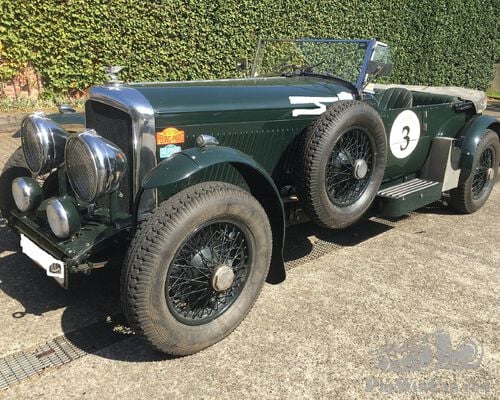
Bentley Derby Special Open Rally Car
This Bentley Derby, manufactured in 1935, has been rebuilt into a short and long-distance rally car. Full rebuilt engine in 2021, Since 2021 low mi..