The global magazine and marketplace for classic car enthusiasts, by enthusiasts.


Filter
Classic Crossley, Pontiac for sale - Crossley, Pontiac cars for sale
-

Pontiac Racing Baquet
Pontiac Racing Baquet ,1933, 8 cylinders 4100 cc 249 cu with 115 hp, incredible nice car with full aluminium patina and cracked body Incredible car! The engine has been kept mostly original. Only a twin carburetor setup has been fitted on the engine to gain a bit more power. The 3-speed gearbox has been maintained. The electrics h..

Crossley
GB, 1904 – 1937
(1) Crossley Brothers Ltd, Gorton, Manchester, 1904 – 1910
(2) Crossley Motors Ltd, Gorton, Manchester, 1910 – 1937
The name of Crossley was famous on engines before it was famous on cars; in fact the Crossley company was the first in Britain to make 4-stroke internal combustion engines on the Otto principle. Later, Daimler engines were made under licence. The first Crossley car for sale, a chain-driven 22hp 4-cylinder, appeared for the 1904 season. A Crossley 28hp and Crossley 40hp followed, all three cars being of normal design and foreign inspiration. Their designer was J.S. Critchley, formerly of Daimler. Shaft drive appeared in 1906, and late in 1909, some were fitted with Allen-Liveredge front-wheel brakes, but Crossley cars, though excellent machines, made little impression until after 1910. The 4-litre 20hp Crossley which then made its bow was a well-constructed, durable and very popular car. Designed by A.W. Reeves, it lived on in modified form until 1925. Crossley’s finest hour came in World War 1, when, as the Crossley 20/25hp it achieved fame as a staff car in the Royal Flying Corps, and as an ambulance and light truck. The Crossley model was extremely popular with the British Royal Family after the war in its 25/30hp version. In its early years, however, it was rivalled by the 15hp. The efficiency of the latter’s otherwise conventional engine, a side-valve four like the rest, gave this Crossley a better performance than most cars in its class and encouraged the makers to offer a special sporting variant, the Crossley Shelsley.
The Crossley Fifteen was discontinued after 1914, but a new Crossley arrived for 1921. This Crossley 19.6hp was a rather more modern design, having a detachable cylinder head, and it was cheaper and lighter on fuel than its 25/30hp companion. The performance was about the same. It was also made in sporting form as the Crossley 20/70hp, but this model was heavy, like the ’Crossley 19.6’ itself, and the brakes were not good enough for the 75mph that was available. Crossley did not make a serious attempt to invade the middle-class market until 1923, when the Crossley 12/14hp, later called the Crossley Fourteen, was introduced. Like its brothers, this was a simple side-valve four, in this case of 2.4 litres, but was more modern, with its unit construction of engine and gearbox and central gear-change. The Crossley Fourteen was a very successful model, being flexile and, thanks to its light weight, both roomy and economical. It survived until 1927. By this time the two bigger Crossley cars were giving way to a much more up-to-date car; the Crossley company’s first six and its first overhead-valve machine. This Crossley 18/50hp model was a spacious, heavy 2.6-litre car with good brakes but somewhat lacking in power. Its engine was enlarged to 3.2-litres and 20.9hp for 1928. At the same time a new small Crossley of similar design, the 2-litre Crossley 15.7hp was introduced, to which a sporting alternative reviving the Shelsley name was added in 1929. Lagonda’s 16/80 model used this engine later. The 6-cylinder Crossley 15.7hp continued until 1934 and the Crossley 20.9hp until 1937. Wilson pre-selector gearboxes were fitted from 1934.
In 1932, the Crossley company had introduced a light car, the Crossley Ten. This was an assembled vehicle powered by an 1100cc Coventry-Climax engine with overhead inlet valves. It was too heavy (a drawback compounded by the pre-selector gearbox), it was very low-geared and its brakes were mediocre. Another mistake was Crossley’s attempt to market the Burney rear-engined car with all-independent suspension. It was given a 15.7hp Crossley engine and a Wilson box, but it was too unconventional in appearance and handling. Very few were made. In 1935, Crossley introduced its new Regis range of small cars with handsome bodies styled by C.F. Beauvais. They consisted of the Crossley Ten and a new Crossley 1½-litre six of the same design also powered by Coventry-Climax, both with a new lowered frame. Both cars, together with the last Crossley 20.9s, disappeared after 1937.
Crossley assembled other people’s cars as well as making their own, beginning with the Willys-Overland Model 4 in 1920. The Gorton-produced Willys came to include more and more British-made parts, such as a Morris Oxford engine. A less likely diversion was an attempt of Crossley in 1921 to make the Type 22 Bugatti in England, but only a handful of these Crossley-Bugattis appeared. In 1922-1933 the Crossley factory made the AJS as well.
Source: Georgano, encyclopedia of motorcar; TRN
The information is written with the greatest of care. However, if you have any suggested amendments please contact us at office@prewarcar.com
Pontiac
US, 1907 – 1908
Pontiac Spring and Wagon Works, Pontiac, Mich.
The Pontiac car was a two-seater high-wheeler with right-hand steering by wheel. The Pontiac car was powered by a 2-cylinder, water-cooled engine mounted under the body. The drive of the Pontiac car was through a friction transmission and double chains to the rear wheels. The cost of the Pontiac car was $600.
US, 1915
Pontiac Chassis Co, Pontiac, Mich.
A chassis without body was all that this Pontiac car company marketed. This Pontiac car chassis was furnished with a 4-cylinder engine, by Perkins, rated at 25hp, driving through a 3-speed transmission.
US, 1926 to date
(1) Oakland Motor Car Co, Pontiac, Mich., 1926 – 1932
(2) Pontiac Motor Co, Pontiac, Mich., 1933 to date
Oakland’s Pontiac Six was intended as a lower-priced running mate, and prices of this conventional 3-litre sv six Pontiac cars started at $825. Only closed bodies were offered initially, but a sales of over 140.000 Pontiac cars was an indication of acceptance, especially when followed by an increase to 210.890 Pontiac cars in 1928. The 1930 Pontiac cars closely resembled Buick’s Marquette, and had 3.3-litre engines, the six being joined in 1932 by a V8 which Pontiac car was really a revamped 1931 Oakland.
In 1933 Pontiac car company scored an important success with a 3.7-litre, 77bhp straight-8 Pontiac car selling for less than $600 with General Motors’ new no-draught ventilation, the 6-cylinder Pontiac cars being dropped for the time being. The 1934 Pontiac cars had Dubonnet-type independent front suspension, and ‘turret-top’ all-steel bodies. Fencer’s mask radiator grilles were found on the 1935 Silver Streak line of Pontiac cars. Capacities of the six and the eight were 3.6-litres and 4.1-litres respectively in 1937. In 1939 Pontiac car company’s cheaper cars had body shells very similar to those of the Chevrolet, as befitted a make which ranked next in the GM hierarchy – though in fact only $20 separated the cheapest Pontiac car, the 4-door sedan from the corresponding Oldsmobile model.
Pontiac cars Torpedo Streamliners brought back the fastback style in 1941, and the immediate pre-war Pontiac cars were continued with little alteration until 1949, when the whole group’s products were restyled, and Pontiacs emerged with lower bodies, redesigned X-frames, and the option of Hydramatic transmission. Though maintaining high sales – they beat Plymouth cars into 4th place overall in 1954 – Pontiac cars remained conservative in engine design, and the well-tried 127bhp sv straight-8 Pontiac car was not supplanted until 1955, when all US-produced Pontiac cars received a 4.7-litre ohv V8. The L-head six was retained for some Pontiac cars made for the Canadian market.
Along with some of the other staider American makes, such as Plymouth and Mercury, the Pontiac car company stove to build their reputation on performance in the later 1950s; the 1958 Pontiac Super Tempest attained 330bhp, and in 1959 Pontiac car came out with a wide-track chassis and concentrated on a 6.4-litre V8 available in a variety of powers from 245 to 345hp.
The Pontiac Car Division’s compact, the Pontiac Tempest arrived in 1961, and was an unusual ohv oversquare four of 3.2-litres’ capacity, mounted in a unitary-construction hull, with its 3-speed synchromesh gearbox in the rear axle. Floor change was standardon the Pontiac car: it was listed at $2.240. A small V8 Pontiac car was available as an option in 1963. The big Pontiac cars went over to GM’s perimeter-type frame in 1963, when the V8 engine was available in a variety of guises on the Pontiac car, from a ‘cooking’ 215bhp version burning regular-grade petrol at $2.725 up to the sporting Pontiac Grand Prix coupé with 303bhp and a revolution counter as standard equipment, at $3.489. The Tempest’s 4-cylinder engine was dropped on the Pontiac car in 1965 in favour of a 140bhp six or 5.4-litre eight. Sporting qualities were emphasized in 1966, by which time the Pontiac Tempest had grown from a 9ft 4in wheelbase to 9ft 8in, and the range of Pontiac cars included the Pontiac GTO Grand Prix and 2 plus 2 models, all Pontiac cars disposing of more than 330bhp from engines of 6.4 and 6.9 litres’ capacity. In 1967, 3.8-litre ohc 6-cylinder engines were introduced: in the sporting Pontiac Firebird Sprint this unit developed 215bhp.
By 1970 the more sporting Pontiac cars (GTO, Firebird and Grand Prix) had front disc brakes, and all full-sized Pontiac cars came with automatic transmission as regular equipment. New for 1971 was a compact Pontiac car, the Pontiac Ventura II on a 9ft 3in wheelbase. The 1972 Pontiac car range covered most sectors of the market, from the Pontiac Ventura at $2.394 up to the luxury Pontiac Grand Ville with 220bhp 7.456cc V8 engine at $4.368. For the sporting motorist there were the Pontiac Le Mans Sport, the Pontiac GTO, and a wide selection of Pontiac Firebirds up to the Pontiac Trans Am with 300bhp V8 unit, giving the Pontiac car a top speed of about 120mph. Peculiar to Canada was the Laurentian, a hybrid Chevrolet-Pontiac on a 10ft 3½in wheelbase, available with 110bhp 6-cylinder or 165bhp V8 unit. In the main 1973’s improvements concerned styling, the Pontiac cars being longer and wider, but new Pontiac cars were the Grand Am 2- and 4-door hardtops, with 6½- or 7½-litre V8 engines, power steering, power disc front brakes and 3-speed automatic gearbox.
Source: Georgano, encyclopedia of motorcar; MCS
The information is written with the greatest of care. However, if you have any suggested amendments please contact us at office@prewarcar.com


Featured
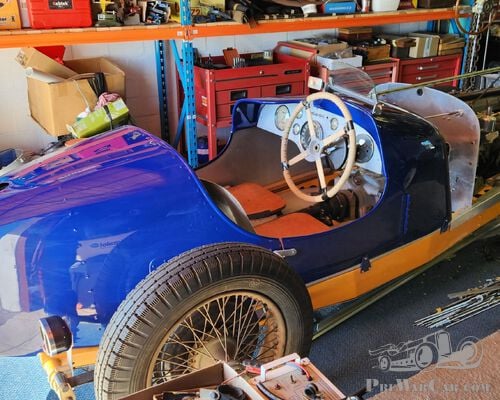
Riley TT Sprite
1935 6-cylinder TT Sprite replica. Chassis # 46A2722. Engine # 6A2722. Original Ulster Imp body. Restoration nearing completion. Engine, G..
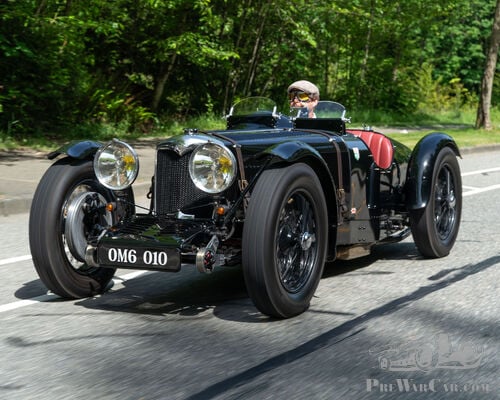
Riley 14/6 Special 1933
The ExperienceStep into the golden age of British motoring. This 1933 Riley 14/6 Special is a masterclass in pre-w..

1915 Rolls-Royce Silver Ghost Barker Tourer
⁃ An exceptionally rare original bodied pre-war Silver Ghost⁃ Desirable Barker tourer in exciting barn find condition⁃ ..