The global magazine and marketplace for classic car enthusiasts, by enthusiasts.


Filter
Classic Premier, Stoewer for sale - Premier, Stoewer cars for sale
-

1924 Stoewer type D3 roadster
Rare opportunity to buy a vintage 1924 Stoewer type D3 roadster in fully restored condition. More than € 50K were spent in 2018 and 2019 on its restoration . Detailed work invoices come with the car. A video can be sent on request . Price € 64000 ex Eibergen Netherlands imported EEC. -
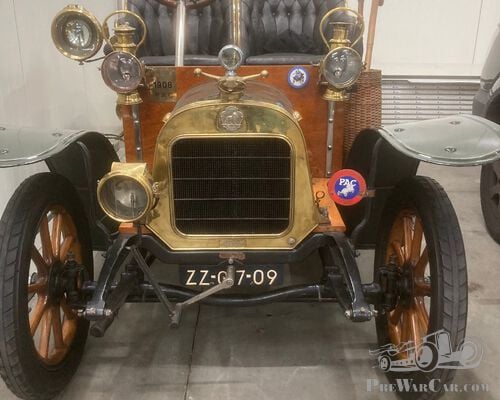
1907 Premier Model 24
Right out of our Titanic Museum display, representing the cars from that era. We chose this car because of it's quality and beauty, it is the type of car that is a pleasure to look at. This 1907 Premier Model 24 Runabout is a prime example from this rarely seen marque that continues to benefit from an older, high-quality concours-level restorati..


Premier
US, 1903 – 1925
(1) Premier Motor Mfg Co, Indianapolis, Ind.
(2) Premier Motor Corp, Indianapolis, Ind.
The Premier car started life as a conventional machine made on modern lines, with a pressed-steel frame, mechanically-operated inlet valves, and shaft drive. A four-cylinder air-cooled Premier car was made in 1905. The designer of the Premier car was G.A. Weidely, who made his name with proprietary engines. A line of conventional water-cooled big fours and six-cylinder Premier cars followed, starting with a 24/28hp Premier car in 1907. From 1913, sixes alone were built, the ‘Premier 48’ at $3.250 having a capacity of over 8 litres. The special racing Premier cars of 1916 had a twin ohc, 4-cylinder, 16-valve engine reminiscent of the Peugeot. The touring Premier car of 1919 – 1920 was notable mainly for its use of the Cutler-Hammer Magnetic Gear Shift, an electric transmission system controlled by a lever mounted on the steering wheel. The ohv 4.8-litre engine of the Premier car was an unusually advanced six, with aluminium block, crankcase and pistons, and iron liners.
GB, 1906 – 1907; 1912 – 1913
Premier Motor Co Ltd, Birmingham
The Premier car company were concessionaires for the Italian Marchand car, and the 1906 4-cylinder Premier car was, in fact, a Marchand. Towards the end of 1906 Premier cars launced a short-lived two-seater of their own design powered by a 10/12hp Aster engine, but no further Premier cars appeared until the cyclecar boom of 1912. This brought two distinct designs of Premier cars: the PMC Motorette 3-wheeler with a rear-mounted 6hp single-cylinder engine driving the rear wheel by chains; and the more conventional Premier car, a 4-wheeler using an 8hp 2-cylinder engine, and chain drive.
D, 1913 – 1914
Justus Christian Braun Premier – Werke AG, Nuremberg
After producing the Kaiser cars this firm offered a new model in 1913 under the name of Premier. This Premier car was a two-seater sports car with a 1.030cc 4/12PS engine. This Premier car was also built in the company’s Austrian factory at Eger and was marketed as the Omega.
Source: Georgano, encyclopedia of motorcar; TRN, GNG, HON
The information is written with the greatest of care. However, if you have any suggested amendments please contact us at office@prewarcar.com
Stoewer
D, 1899 – 1939
(1) Gebrüder Stoewer, Fabrik für Motorfahrzeuge, Stettin, 1899 – 1916
(2) Stoewer-Werke AG vorm. Gebr. Stoewer, Stettin, 1916 – 1939
The Stoewer car factory developed out of the Stoewer ironworks and was among the pioneers of the German car industry. After manufacturing motor cycles, tricycles and quadricycles for two years, Stoewer turned to cars in 1899. The first Stoewer car had a rear-mounted 2-cylinder engine. 4-cylinder Stoewer cars followed in 1901, and electric Stoewer cars were also produced. Best known were the 2-cylinder Type T Stoewer car (2.280cc and 3/12PS), the 4-cylinder Stoewer P4 (3.052cc and 11/22PS), the Stoewer G4 (1.500cc and 6/12PS) and the 6-cylinder Stoewer P6 (8.820cc and 34/60PS), evolved in the 1905-1907 period all Stoewer cars with shaft-drive. The Stoewer B1 of 6/16PS and the Stoewer B6 of 9/22PS which appeared in 1910 were also built by Mathis under licence. The G4 Stoewer car was the basis for the Stoewer B5, which Stoewer car in 1912 became famous by setting up a record at Brooklands with 67.7mph. The new range of Stoewer cars which appeared in 1913 was also based on successful earlier cars. They were the Stoewer C1 (6/18PS), Stoewer C2 (10/28PS) and C3 Stoewer car (6-cylinder and 19/45PS). Shortly before the outbreak of World War 1 the Stoewer car range was headed by the F4 Stoewer car with a 4-cylinder, 8.8-litre 33/100PS ohc engine. After the war an enormous Stoewer car appeared, the Stoewer D7, using a 6-cylinder 11.2-litre 42/120PS aero engine, as well as some conservative sv 4- and 6-cylinder Stoewer cars with rear wheel and transmission brakes. Front wheel brakes appeared on Stoewer cars in 1925. Stoewer introduced 8-cylinder Stoewer cars in 1928. These were the Stoewer Superior, Stoewer Marschall, Stoewer Gigant and Stoewer Repräsentant with engines ranging from 2-litres and 45bhp to 4.9-litres and 100bhp. The Stoewer car firm re-entered the economy class in 1931 with the V5, a front-driven Stoewer car with a V4 1.188cc engine, followed by the front-drive models R140 (1.369cc), R150 (1.488cc) and R180 (1.769cc). Another 8-cylinder was the front wheel drive Greif V8 with a 2.488cc engine, which was replaced by the conventional 6-cylinder 3.609cc Arcona Stoewer car in 1938. In 1934 the 1½-litre 4-cylinder Stoewer car and 2½-litre V8 Stoewer car were shown at the Brussels Salon by Monsieur Dewaet under the name D.S. (Dewaet-Stoewer). The Greif Junior was built under Tatra licence with an opposed 4-cylinder 1.474cc engine. It succeeded the Röhr Junior. In the middle of the range was the Stoewer Sedina with a 4-cylinder engine of 2.4-litres.
Production of private Stoewer cars was given up at the outbreak of World War 2 in 1939. The Stoewer car factory was destroyed during the war and production of Stoewer cars was not resumed.
Source: Georgano, encyclopedia of motorcar; HON
The information is written with the greatest of care. However, if you have any suggested amendments please contact us at office@prewarcar.com


Featured
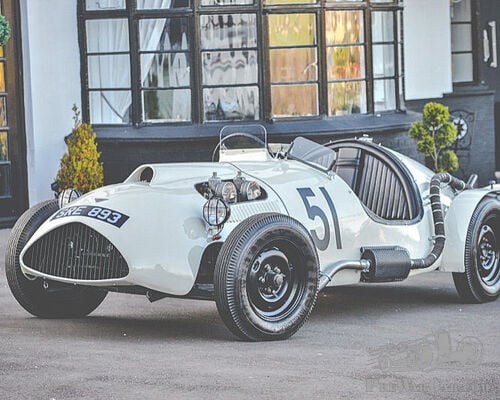
1933 Alvis 3.0 Special - One-Off Alloy Body | Period Competition Car | Featured in “Alvis – A Century of Drivers”
1933 Alvis 3. 0 Special - One-Off Alloy-Body | Period Competition Car | Featured in “Alvis – A Century of Drivers”