The global magazine and marketplace for classic car enthusiasts, by enthusiasts.


Filter
Classic Rauch & Lang, Columbia for sale - Rauch & Lang, Columbia cars for sale
-

1918 Rauch & Lang Model B26 Brougham | RM Sotheby's | The Hershey Auction
To Be OFFERED AT AUCTION at RM Sothebys' The Hershey Auction event, 7 - 8 October 2026. $150,000 - $175,000 USD One of the finest surviving examples of the Rauch & Lang electric carBeautiful show-quality, AACA First Junior-winning restorationKnown history, with only three long-term caretakers since the 1950s -
1912 Columbia 45hp Touring
Multi-award-winning restoration on a high quality/low production brass era. Powerful 410 cubic inch T-head engine, dual ignition, pressurized fuel system & discreetly electrified lamps. Built in Connecticut by The Pope Manufacturing Company. Known history, ex. James A. Conant. A fast, tight example and a joy to drive!Worldwide Ship..


Rauch & Lang
US, 1905 – 1928
(1) Rauch & Lang Carriage Co, Cleveland, Ohio, 1905 – 1916
(2) Baker, Rauch & Lang Co, Cleveland, Ohio, 1916 – 1922
(3) Rauch & Lang Electric Car Manufacturing Co, Chicopee Falls, Mass., 1922 – 1928
Rauch & Lang were an old-established carriage building firm (founded 1853) when they began to make electric Rauch & Lang cars in 1905. These Rauch & Lang cars followed the usual pattern for such electric vehicles, being mainly closed town cars, although a few open phaeton Rauch & Lang cars were also made. The biggest Rauch & Lang cars were heavier vehicles and included a six-seater limousine with separate outside seat for the chauffeur. Some Rauch & Lang cars had 4-doors, a very unusual feature in electric cars. In 1916 the Rauch & Lang cars became part of the Baker, Rauch & Lane group and production declined. From 1919 onwards the Rauch & Lang cars were sometimes listed as Raulangs, and from 1922 this became the official name of the Rauch & Lang cars.
By this time production of Rauch & Lang cars had been transferred to the Stevens-Duryea factory at Chicopee Falls where the number of private cars made was very small. The factory, which was still turning out a few Stevens-Duryeas, also made petrol and electric taxi-cabs under the name Rauch & Lang cars, and bodies for Stanley Steamers.
Source: Georgano, encyclopedia of motorcar; GNG
The information is written with the greatest of care. However, if you have any suggested amendments please contact us at office@prewarcar.com
Columbia
US, 1897 – 1913
(1) Pope Manufacturing Co, Hartford, Conn., 1897 – 1899
(2) Columbia Automobile Co, Hartford, Conn., 1899
(3) Columbia & Electric Vehicle Co, Hartford, Conn., 1900
(4) Electric Vehicle Co, Hartford, Conn., 1901 – 1909
(5) Columbia Motor Car Co, Hartford, Conn., 1909 – 1913
The detailed organizational history of the Columbia car make is complex, and its ancestry includes such pioneers as Riker and Morris & Salom. The initial Columbia models were electrically powered and this source was used until at least 1907. They were sold in England under the name City and Suburban, and in France as l’Electromotion. Petrol models were introduced in 1899, known then as the Pope-Columbia, and were designed by Hiram Maxim. These petrol cars were advanced for their time, with left-hand steering wheel, full elliptical springs, a coil radiator in front, and a 2-cylinder engine. The 1903 Columbia Type XLI showed definite European influence, with a sloping bonnet, double chain drive, and its 14hp engine drove it at 45mph.
In 1907, an electric transmission was introduced to the Columbia car, giving 7 forward speeds, with a 4-cylinder engine of 48hp. In 1911 a Knight sleeve-valve engine was used in one model known as the Columbia-Knight. This had a 6.3-litre engine, and was continued to 1913.
The Columbia Motor Car Co was absorbed by United States Motor Co in 1910, and the Columbia make ended when this company collapsed in 1913.
US, 1914
Seattle, Washington
This Columbia was a side-by-side two-seater cyclecar. It used a 2-cylinder engine with overhead valves, combined with a friction transmission and belt drive. Its wheelbase was 8ft, with a track of 3ft 4in.
US, 1914 – 1918
Columbia Electric Vehicle Co, Detroit, Mich.
This electric Columbia car was made in open two-seater, three-seater ‘coupelette’, and four-seater brougham form and was furnished with wire wheels. The price-range of this model, with various options, was $785 to $985. Soon after its introduction, the name was changed from Columbia to Columbian.
US, 1916 – 1924
Columbia Motors Co, Detroit, Mich.
The Columbia was a well thought of assembled car of its era and its low price attracted a considerable number of buyers. Two basic Columbia models were offered, both sixes and both powered by Continental engines. As many as 6.000 units were sold in 1923, principally the roadster at $995 (disc wheels were extra). Planning to expand its manufacturing activities, Columbia purchased the Liberty in 1923, but both makes failed a year later. Noteworthy was Columbia’s use of thermostatically-controlled radiator shutters as early as 1920 which opened as radiator temperature increased. The Columbia car was one of the first automobiles to use this device and doubtless it aided Columbia sales.
Source: Georgano, encyclopedia of motorcar; GMN, KM
The information is written with the greatest of care. However, if you have any suggested amendments please contact us at office@prewarcar.com


Featured
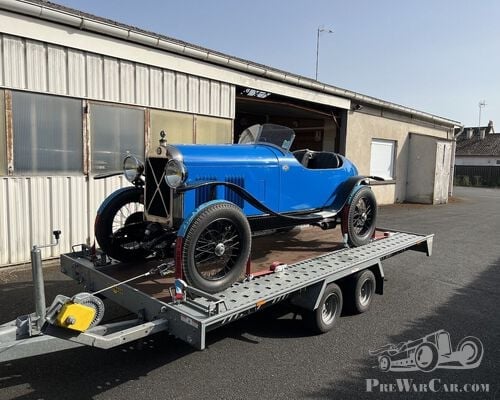
Salmson VAL 3 Séries 7
1927 Salmson VAL3 Series 7. Completely restored a few years ago, in very good overall condition, both bodywork and mechanics. Bordino-style bodywor..
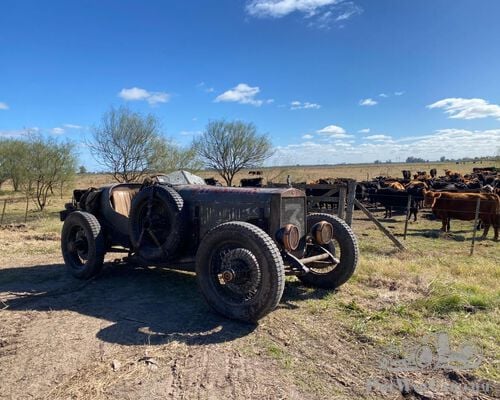
Studebaker 1927 for sale
Authentic race car of the time - Everything is working - All parts of its original mechanics - I have the history of the car - 6 cylinders - Ready ..
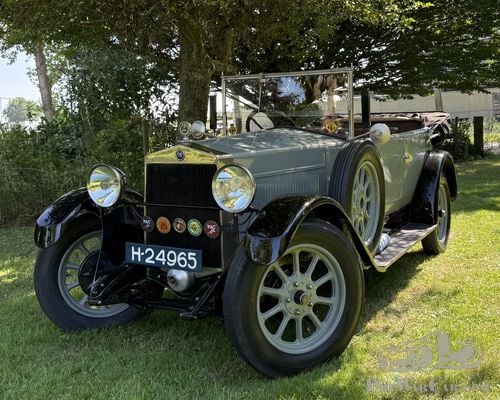
Fiat 509 Torpedo / Spider – Exceptionally Original and Complete
A Rare and Highly Original Example with Long-Term Dutch HistoryOffered for sale is an exceptionally original and remarkably complete Fiat 50..