The global magazine and marketplace for classic car enthusiasts, by enthusiasts.


Filter
Classic Rex for sale - Rex cars for sale
-

1921 Rolls Royce 20hp Experimental tourer
1921 Rolls Royce 20hp Experimental tourer. Chassis number: 4G2 Registration Number: CH2892 Sir Henry Royces' personal car used for development of the 20HP chassis. He is pictured in it both at his French house; La Villa Mimosa in Le Canadel & also near his UK home "Elmsted" .. -
Oldsmobile Curved Dash Model 6C 7hp 1904
We have available for sale this exceptionally original 7hp Curved Dash Oldsmobile. Manufactured in 1904. Continuous ownership/history for many years. This is the larger engined motor car with rear brakes & larger hp. These are exceptionally good strong motor cars and can certainly cover some miles without any issues, well built & very go.. -
BMW 326 Cabriolet
AVAILABLE – NEAR PARISRare two-door Convertible version.EU import duties paid, supplied with its US title.Requires a complete restoration. The car is complete and is sold with an additional complete engine. -
Fiat 509 Torpedo / Spider – Exceptionally Original and Complete
A Rare and Highly Original Example with Long-Term Dutch HistoryOffered for sale is an exceptionally original and remarkably complete Fiat 509 Torpedo / Spider, preserved with many of its original components, fittings and period details still intact.For the serious collector of early Italian motor cars, its principal appeal lies not.. -
1929 Delage DMN (6 Cyl.) Tourer
Delage is a marque synonymous with style and a sporting history. This example is no exception, wearing a stunning body in the style of Vanden Plas. Its most adequately powered by its 3.8 liter overhead valve, straight six engine. The DMN offered the larger valves that would be used in the D8 model, and a lightened fly wheel. The 6 cylinde.. -
Singer 9 Le Mans Special Speed in British Racing Green, bouwjaar 1935
Prachtige Singer 9 Le Mans Special Speed. (De Singer 9 Le Mans werd uitgebracht na het succes van Singer in de gelijknamige 24u race.) 4 cilinder in lijn, 972cc, 34 pk met dubbele solex carburators. De special speed heeft een getunede motor met dubbele carburators en een versnellingsbak met kortere overbrenging.De buitenkleur is Br.. -
C1926 DFP open
Rare DFP from c1926Mechanical complet, Missing interior and hood topno documents,can see in LisbonCan help with transportchassis # 40 273 -
Citroën B2, 10hp, 1923 Coupé docteur
Der Typ B2 war ab 1921 das zweite Modell, das der französische Hersteller Citroën baute.Das hier angebotene Fahrzeug von 1923 besitzt eine seltene geschlossene Kabine "Coupé docteur" mit 2 Sitzplätzen plus Notsitz. Es scheint das einzige überlebende Fahrzeug dieser Bauart mit dem stärkeren 10-hp-Motor (1452 ccm) und mit langem Radstand zu.. -
Horch 854 – A Masterpiece of Automotive Craftsmanship (1939)
This Horch 854 represents one of the finest examples of pre-war German luxury engineering. Built on the shorter and more agile 854 chassis and equipped with the more powerful A-engine, this vehicle combines elegance, rarity, and exceptional craftsmanship. Originally, only 7 chassis of the 854 series we.. -
1928 Mercedes Benz SSK Rebuild
A faithful, high-quality rebuild of an SSK, carried out in 2003 by a renowned specialist in GermanySubsequently owned and actively used by a single owner for 20 years Original 1929 supercharged engine with impressive performanceComprehensive documentation availableEligible to participate in numerous histo..


Rex/ Rex-Simplex
D, 1901 – 1923
(1) Deutsche Automobil-Industrie Friedrich Hering, Ronneburg, 1901 – 1904
(2) Deutsche Automobil-Industrie Hering & Richard, Ronneburg, 1904 – 1908
(3) Automobilwerk Richard & Hering AG, Ronneburg, 1908 – 1921
(4) Elitewagen AG, Ronneburg, 1921 – 1923
Before the Rex car firm started to build their own Rex cars they offered various components for car construction, such as chassis, wheels, axles etc. Their first cars appeared in 1901, using De Dion engines, and were marketed under the name of Rex, but the single-cylinder 6hp 698cc model was called the Rex Simplex. The name Rex-Simplex car was later used for all other Rex car models. After 1907 the Rex car firm produced engines of their own design.
A Rex-Simplex car participated in the Prince Henry Trial, 1908, and until 1914 the Rex-Simplex car had a reputation for high technical standards. Best known were their models Rex-Simplex 9/16PS (2.120cc), Rex-Simplex 10/28PS (2.680cc), and the very successful Rex-Simplex 17/38PS (4.500cc), which Rex-Simplex car was produced from 1908 until 1914. After 1911 Dr. Valentin was engaged as chief designer of the Rex-Simplex car. When he went to Russo-Baltique some of his designs for this company were based on the Rex-Simplex car. After World War 1 two improved pre-war Rex-Simplex cars were continued, the 10/30PS and the 13/40PS. In 1921 the Rex-Simplex car factory was taken over by Elite and only the Rex-Simplex 13/40PS was continued for a time as the Elite-Wagen.
GB, 1901 – 1914
(1) Birmingham Motor Manufacturing and Supply Co Ltd, Birmingham, 1901 – 1902
(2) Rex Motor Manufacturing Co Ltd, Coventry, Warwickshire, 1902 – 1914
Though the Rex car company was always best known for their motorcycles, Rex made cars under a confusing variety of names, these including Ast-Rex cars, Airex cars, Rexette, Rex-Remo, and even Rex-Simplex car which Rex car had no connection with the products of the German Rex car firm of Richard and Hering. The original Birmingham concern added Rex cars to its repertoire in 1901, with a conventional 900cc single-cylinder voiturette. This Rex car cost £168 and had bevel drive, a 2-speed gearbox, and a curious cylindrical raditator, at first mounted low down at the front, and later moved to the rear.
The fusion of Rex cars with Allard and the move to Coventry in June 1902 resulted in a wider range of Rex cars, including some 3-speed singles, and a ‘square’ 2.4-litre vertical-twin. In 1903, when there were rumours – which came to nothing – of a racing Rex car for the Gordon Bennett Eliminating Trials, the manufacture of pedal cycles was abandoned and a good variety of Rex car models with Panhard-style radiators was offered at prices from £198/10s to over £400 for a Rex car. In addition a motorcycle-based tricar became available, and by 1904 this had evolved into the Rexette with car-type frame, a seat for the driver instead of a saddle, a watercooled single-cylinder engine started by a handle and a 2-speed gearbox. The Rexette became even more car-like in 1905 with the adoption of wheel steering and 3-wheel brakes for a list price of £105, and the 1906 ‘Rexettes’ had transverse V-twin engines and were available with 2-seater forecarriages.
Though the 12hp 2-cylinder Rex-Simplex car was sold in 1904 and 1905, the tricar was the principal product (the motor cycles apart) until the 1906 season, when the Ast-Rex car appeared. This Rex car was a conventional shaft-driven vehicle with 3.7-litre 4-cylinder Aster engine and 3-speed gearbox, selling for £510. The Ast-Rex car did not last long, giving way to the Airex car line, announced as V4s with two forward speeds only in 1906. Production Airex cars, however, were air-cooled 1.3-litre aiv V-twins rated at 9/11hp; the Rex car had shaft drive, 3-speed gearboxes, coil ignition and round ‘radiators’, all for £194/5s. 1907 also brought a reversion to the motor-cycle-type tricar with the handlebar-steered Litette at £78/15s, though this Rex car was still powered by a 726cc water-cooled engine and a wheel-steered version was made in 1908. Though the tricars survived for another season, these last Triettes were strictly on 2-wheeler lines.
Meanwhile Rex cars had returned to full-sized Rex cars with the Rex-Remo models introduced for 1908; these Rex cars were straightforward T-headed 4-cylinder affairs with shaft drive, magneto ignition, 3-speed gearboxes and quadrant change. An interesting feature of the Rex car was the use of a ‘honeycomb’ grille to conceal the gilled-tube radiator. The Rex cars were made in 2.6-litre and 2.8-litre forms until 1911, the last examples of Rex cars having detachable wire wheels.
After this Rex car company concentrated on motorcycles, though there were two more abortive attempts to produce a Rex car. The first of these was a watercooled V-twin cyclecar of 1912, which Rex car had an underslung frame and friction drive; the second Rex carmodel came after a reorganization of the Rex car firm in 1914, and was a conventional light Rex car with a 1.100cc sv 4-cylinder Dorman engine, intended for production in private and commercial forms. World War 1 intervened, and in 1922 Rex merged with another Coventry motor cycle producer, Acme. This combined operation expired in 1928, and though there was a brief revival in 1932, the Rex car lasted only a year.
US, 1914
Rex Motor Co, Detroit, Mich.
The two-seater Rex cyclecar had a 4-cylinder, water-cooled engine of 15/18hp. A friction transmission and shaft final drive were used on this Rex car.
Source: Georgano, encyclopedia of motorcar; HON, MCS, GMN
The information is written with the greatest of care. However, if you have any suggested amendments please contact us at office@prewarcar.com


Featured
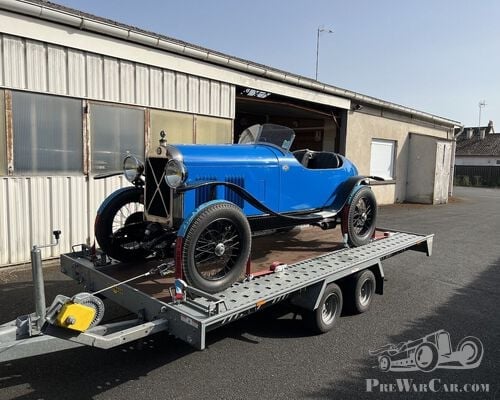
Salmson VAL 3 Séries 7
1927 Salmson VAL3 Series 7. Completely restored a few years ago, in very good overall condition, both bodywork and mechanics. Bordino-style bodywor..
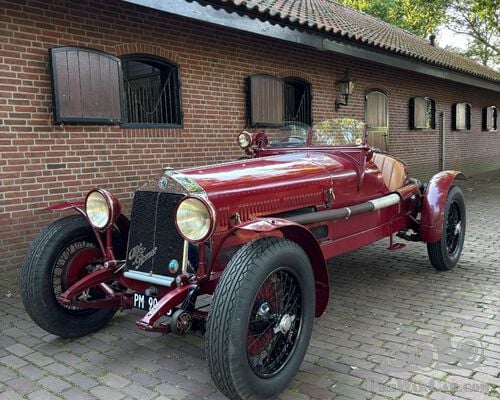
1930 Alfa Romeo 6C 1750 Spider
1930 Alfa Romeo 6C 1750 Spider with complete history from delivery to first owner in 1930 in Firenze till today with copy Libretto/license plate.
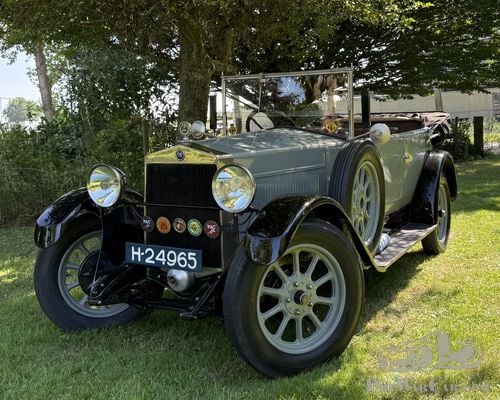
Fiat 509 Torpedo / Spider – Exceptionally Original and Complete
A Rare and Highly Original Example with Long-Term Dutch HistoryOffered for sale is an exceptionally original and remarkably complete Fiat 50..