The global magazine and marketplace for classic car enthusiasts, by enthusiasts.


Filter
Classic Rolland-Pilain, Volkswagen for sale - Rolland-Pilain, Volkswagen cars for sale
-

Rolland Pilain
I am selling a 1913 Rolland Pilain RP 10HP in very good condition. It has a standard registration document in my name, and the MOT will be carried out prior to the sale.

Rolland-Pilain
France, 1906 – 1931
SA des Etablissements Rolland-Pilain, Tours
Unusual among French marques of its period, Rolland Pilain cars made their greatest impact after World War 1. Their first product was a 20hp 4-cylinder model Rolland Pilain cars with a monobloc engine, though smaller 2.2-litre shaft-driven Rolland Pilain cars were available in 1909 and a 3-speed 1½-litre Rolland Pilain 8/10CV in 1910, in which year the Rolland Pilain car company was also experimenting with ‘valveless’ engines and 4-wheel brakes. Though racing was in the doldrums, the Rolland Pilain car company went to the trouble of building a big chain-driven Rolland Pilain car for the 1911 Grand Prix de France, and a complex 1912 range started with a Rolland Pilain 9CV of 1.7-litres and went up to a chain-driven 4-cylinder 60 Rolland Pilain car of 130x270mm. The 6-cylinder Rolland Pilain 18CV had a ‘valveless’ engine, and even in 1913 chain drive was still optional on the biggest fours of 20CV and 24CV Rolland Pilain cars. Only 1.9-litre and 4-litre 4-cylinder Rolland Pilain cars with sv monobloc engines and unit gearboxes were listed in 1914.
These basic types of Rolland Pilain cars, still with pedal-operated transmission brakes, were available again after World War 1, but far more advanced was the 2.2-litre Rolland Pilain 14/16 of 1921, which boasted not only overhead valves and a detachable head, but also front-wheel brakes (hydraulic at the front and mechanical at the rear). This Rolland Pilain car was still catalogued in 1926. Even more ambitious was the 2-litre twin ohc straight-8 GP Rolland Pilain car of 1922, with desmodromic valves, ball-bearing crankshafts and 4-wheel hydraulic brakes. A victory of a Rolland Pilain car at San Sebastian in 1923 was the limit of the success of Rolland Pilain cars on the circuits, but the type found its way into the catalogue as the Type A22 Rolland Pilain car at 90.000fr, and one of the racers also ran with a 2-litre, 6-cylinder cuff-valve Schmid engine. In 1925 came a 2-litre ohv 4-cylinder Rolland Pilain car with 4-wheel mechanical brakes, selling for £725 in England, while a 1½-litre development, the Rolland Pilain D26, was introduced for 1927. In 1929 Rolland-Pilain car, along with several other French firms, tried a Franco-American theme by introducing a range of big luxury chassis with sv Continental engines. Both the 6-cylinder, 3-litre, and the 4-litre straight-8 Rolland Pilain cars had centralized chassis lubrication, though the elegant bodywork of the Rolland Pilain car was marred by the use of artillery wheels. At the 1930 Paris Salon the Rolland Pilain car company shared a stand with the BNC (also going through a Franco-American phase), but this was the end, though the Rolland Pilain car firm’s Paris depot was still advertising spare parts for Bignan as well as Rolland Pilain cars in 1934.
Source: Georgano, encyclopedia of motorcar; MCS
The information is written with the greatest of care. However, if you have any suggested amendments please contact us at office@prewarcar.com
Volkswagen
D, 1936 to date
(1) Dr. Ing.h.c. F. Porsche GmbH, Stuttgart, 1936 – 1937
(2) Gesellschaft zur Vorbereitung des Volkswagens, Berlin; Stadt des KdF-Wagens, 1937 – 1938
(3) Volkswagenwerk GmbH, Berlin Wolfsburg, 1938 – 1960
(4) Volkswagenwerk AG, Wolfsburg, 1960 to date
The development of the Volkswagen car is closely linked with the name Ferdinand Porsche. After World War 1 he tried to realize one of his favourite schemes: a small economical car for a wide public. One of his attempts was the Austro-Daimler Sascha. He continued his efforts while working for Daimler-Benz at Stuttgart. His plan was brought a step nearer to fruition when he set up his own office at Stuttgart. There he designed small cars for Zündapp in 1932 with 5-cylinder radial engines, and for NSU in 1933 with 4-cylinder horizontally opposed units. But neither Zündapp nor NSU were able to invest vast sums during the Depression years and neither design was put into production, although a few prototypes were built.
In 1934 Porsche was directed by the Nazi government of the day to develop a small car and to build three prototypes. These prototypes Volkswagen cars were constructed by Porsche and his team in his own garage. They were ready in 1936 and the design became known as the VW3. Another series of 30 prototypes Volkswagen cars (VW30) was built in 1937 by Daimler-Benz and in Porsche’s newly founded workshops at Stuttgart-Zuffenhausen, the site of the present Porsche works. In 1938 the final version Volkswagen car, the VW38, was introduced. These types Volkswagen car had 704 or 984cc air-cooled engines. Also in 1938 the foundation stone for the new Volkswagen car factory was laid, and the name KdF-Wagen was officially adopted. KdF was the abbreviation for ‘Kraft durch Freude’ (strength through Joy), the Nazi organization which sponsored and financed the development of the Volkswagen car, controlling it through its newly founded Gesellschaft zur Vorbereitung des Volkswagen cars.
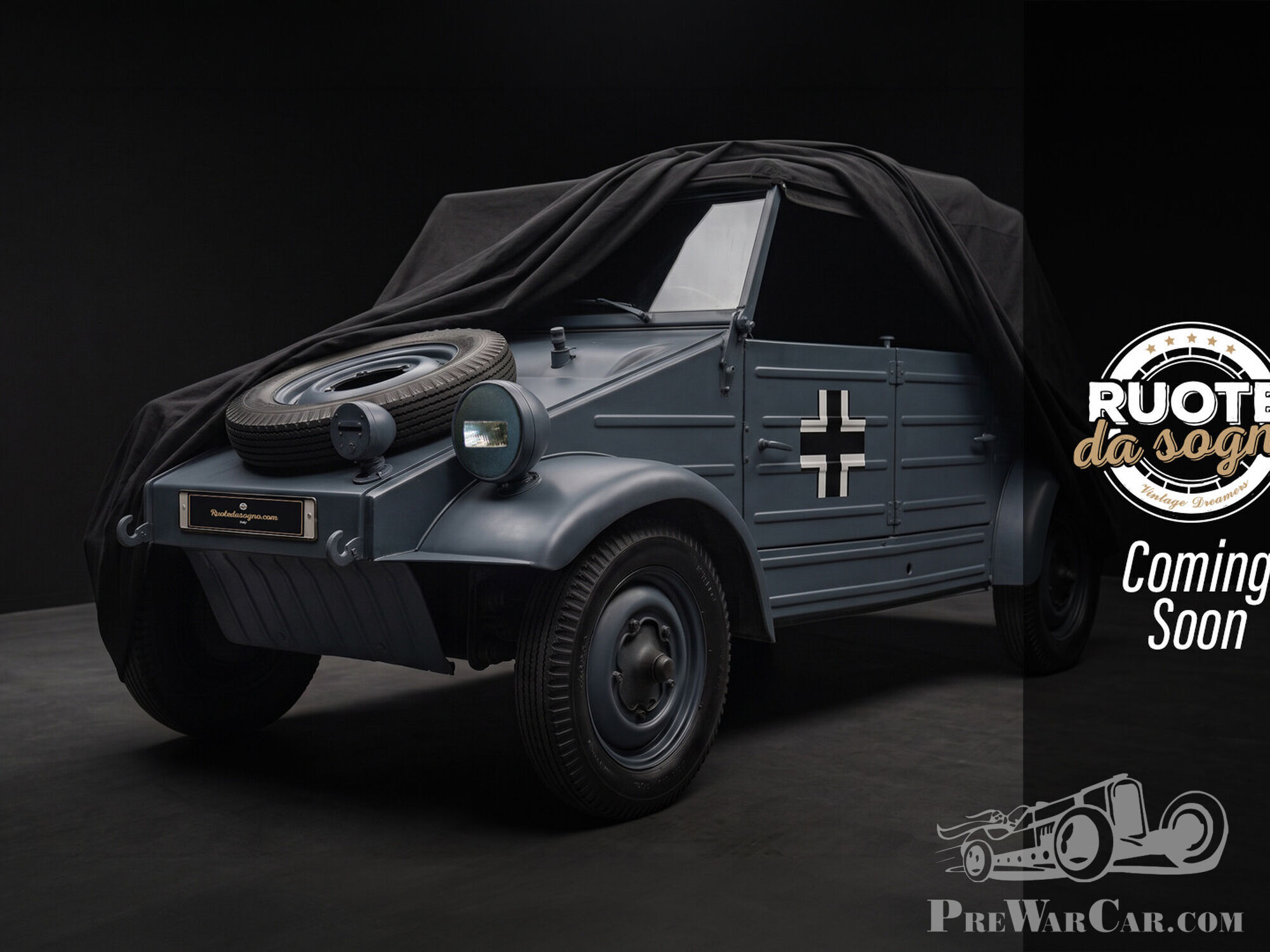
In his Stuttgart workshops, Porsche built three streamlined, Volkswagen-based sports cars with tuned engines for the intended Berlin-Rome Race of 1939, but this event was cancelled as a result of the outbreak of World War 2. They can be regarded as the forerunners of the Porsche sports car which appeared after the war. Until 1939 no Volkswagen cars were available for the public and only prototype Volkswagen cars existed. During the war the Volkswagen car was built in various versions for the armed forces with an increased engine capacity of 1.131cc. The Jeep-type Kübelwagen and an amphibious Volkswagen car, the latter with 4-wheel drive, were produced in large numbers and were the first Volkswagen cars to become widely known. After the war the Volkswagen car factory came under British control and a number of Volkswagen cars were assembled from parts. In 1945 a total of 1.785 Volkswagen cars was produced, this number being increased to 10.020 Volkswagen cars in 1946, all of them delivered to the British army. These private versions Volkswagen cars used the 1.131cc engine, developing 25bhp. In 1949 the Volkswagen car factory was released from British control and returned to German administration.
The Volkswagen car works themselves produced only the saloon version Volkswagen car but several convertible Volkswagen cars were offered by various firms. The four-seater convertible Volkswagen car by Karmann – one of Germany’s oldest coach-building firms – and the Karmann-Ghia two-seater convertible and coupé versions Volkswagen cars became part of the official sales programme. The Volkswagen car became known as a car which made no changes in body style although the technical details of the Volkswagen car were constantly improved. In 1954 the engine of the Volkswagen car was developed to 1.192cc and 30bhp and a further increase in engine output to 34bhp came in 1960. In 1961 the five millionth Volkswagen car was produced. In the same year a new model Volkswagen car was introduced, the Volkswagen 1500 with a 1.493cc 45bhp engine and new body, followed two years later by the 1500S Volkswagen car developing 45bhp. 1965 saw the ‘Beetle’ Volkswagen car with a 1.285cc 40bhp engine and the introduction of another new model the 1600TL Volkswagen car with a 1.584cc 54bhp engine. Since 1966 the Beetle Volkswagen car has also been available with the 1.493cc engine. The 1968 versions Volkswagen car of the 1500 Beetle and 1600 were available with a selective automatic transmission; at the same time 12-volt electrics were standardized on all Volkswagen cars save the basic 1200. In 1969 Volkswagen cars attempted to broaden their range with the Volkswagen 411, still an air-cooled flat-4, but this Volkswagen car was now featuring unitary construction, McPherson strut independent front suspension, and a new type of semi-trailing link independent rear suspension already tried on 1600s. The 1.679cc pushrod engine of the Volkswagen car developed 68bhp, and the Volkswagen car was sold as a 4-door saloon or estate car. The 1970 Volkswagen cars could be had with fuel injection. Another new Volkswagen car was the VW 181, an open jeep-type vehicle available in civilian or military guises. Sales that year were 1.621.197 Volkswagen cars. Prices for the Volkswagen cars ranged from DM4.626 for a 1200 saloon up to DM8.755 for the most expensive 411.
The Volkswagen 411, however, did not prove a great commercial success, and for 1971 Volkswagen cars took advantage of their ownership of the Audi-NSU combine to issue the latter firm’s piston-engined Ri80 derivative, the K70, under their own imprint. This development smacked of heresy at Wolfsburg, for the new Volkswagen car had a vertical 5-bearing water-cooled 4-cylinder ohc engine mounted at the front and driving the front wheels. The Volkswagen car came in 75bhp and 90bhp forms; other differences from the NSU prototype were the 4-speed manual gearbox, a wheelbase 6½in shorter, and a far lower price – DM 9.450 as against the DM17.300 asked for the Ro80. The Volkswagen Beetle was now available with a 60bhp 1.584cc engine and front disc brakes, McPherson strut front suspension being used on this version Volkswagen car. During 1972 the Volkswagen car firm began production of electrically-propelled light vans and Kombis. On 17 February 1972 the Volkswagen Beetle officially broke the Model-T Ford’s record of 15.007.003 units of an individual model. The 1973 Volkswagen Beetles had panoramic windscreens, an came in 1.2-litre, 1.3-litre and 1.6-litre sizes, with disc brakes available on all Volkswagen cars but the 1200. At the same time the 411E Volkswagen car with fuel injection was replaced by an improved 412E. The 1600 series Volkswagen car, the Karmann-Ghia coupés and the K70 were continued, as was the open VW 181.
Volkswagen cars are currently manufactured or assembled in several foreign countries and is one of the biggest car manufacturers in the world.
Source: Georgano, encyclopedia of motorcar; HON
The information is written with the greatest of care. However, if you have any suggested amendments please contact us at office@prewarcar.com


Featured
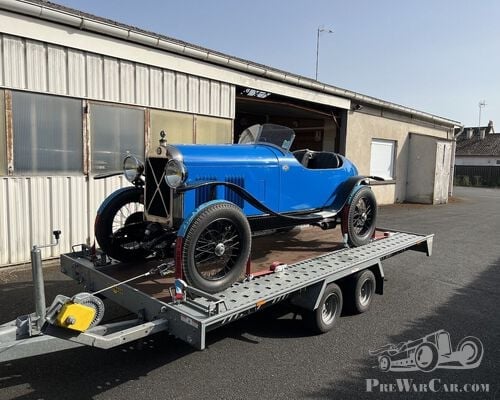
Salmson VAL 3 Séries 7
1927 Salmson VAL3 Series 7. Completely restored a few years ago, in very good overall condition, both bodywork and mechanics. Bordino-style bodywor..
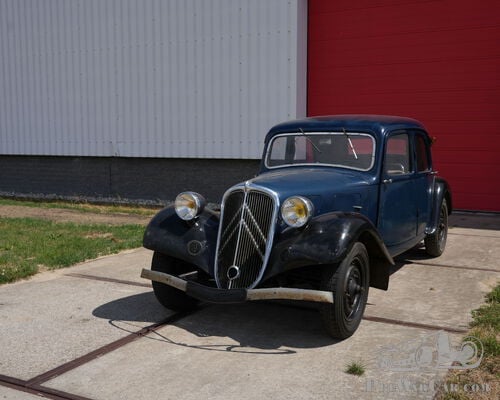
1935 Citroën Traction Avant
Early-production Traction AvantExceptionally original, unrestored conditionRecently part of a major museum collection
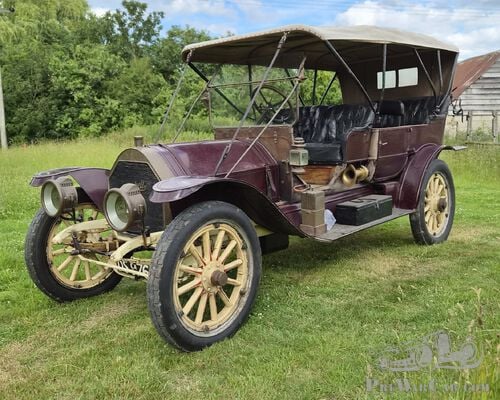
1910 Mitchell Model S - 50HP Six Cylinder
Based in Racine, Wisconsin and being the largest wagon manufacturer in the USA, Mitchell-Lewis produced their first motor car in 1903. Sales grew ..