The global magazine and marketplace for classic car enthusiasts, by enthusiasts.


Filter
Classic Rolls-Royce, Vulcan for sale - Rolls-Royce, Vulcan cars for sale
-

1932 Rolls-Royce Phantom II Continental Drophead Coupe by Carlton
Vintage and Prestige are proud to offer this 1932 Rolls-Royce Phantom II Continental Drophead Coupe by Carlton For Sale. Previous UK Registration: 544 YUS Chassis no: 32MS Engine no: HD 55 Mileage shown: 22,480 32MS was first ordered by the Duke of Sutherland; Sir G.. -
1935 Rolls Royce Phantom 2 Brewster dual cowl tourer
1935 Rolls Royce Phantom 2 Brewster dual cowl tourer Chassis Number: 111TA Regitration Number: BXR2 Off test in March of 1935. This Phantom originally wore a sports Saloon body by Hooper. After being shipped to the USA the current Brewster dual cowl body was installed upon the car which it has now worn f.. -
1929 Rolls-Royce 20/25 Estate Car
Extremely unusual well-proportioned estate coachwork from Burbage & SonsThoroughly well sorted benefitting from significant work from ourselvesCharming and practical vehicle accompanied by an interesting early history Coming off test on Christmas Eve 1929, GDP 43 was delivered to coachbuilder Th.. -
1939 Rolls Royce Wraith James Young Razor Edge Saloon
1939 Rolls Royce Wraith James Young Razor Edge Saloon Chassis Number: WEC72 Registration Number: 39D25 (Ireland) £200k spent upon the restoration of this car to make it in effect a brand new Rolls Royce Wraith being delivered 86 years late!!! Simply.. -
1938 Rolls Royce Wraith Gurney Nutting Sedanca Coupe
1938 Rolls Royce Wraith Gurney Nutting Sedanca Coupe Chassis number: WRB2 Registration number: FLH5 This car may be paid for in Bitcoin. Approx 3 BTC Simply the best of the best & a Pebble Beach/Villa D'Este quality car. This wrait.. -
1929 Rolls Royce Phantom 1 Springfield LHD Brewster Lonsdale Landaulette
1929 Rolls Royce Phantom 1 Springfield LHD Brewster Lonsdale Landaulette Chassis Number: S324KP Registration Number: BS9362 Currently undergoing a major service & set up with noted marque expert James Black. At the same time the Autovac is being reinstated to replace the cur.. -
1933 Rolls Royce 20/25 Sedanca by Thrupp & Maberly
1933 Rolls Royce 20/25 Sedanca by Thrupp & Maberly Chassis Number: GRW27 Registration Number: VTK777 Simply the best we have ever seen. This car won prizes in class at the recent RREC national rally at Burghley house. A massive nut & bolt re.. -
1934 Rolls-Royce 20/25 Gurney Nutting Owen 3 position drop head
1934 Rolls-Royce 20/25 Gurney Nutting Owen 3 position drop headChassis number: GLZ75Registration number: ALW565Chassis number GLZ 75 was off test 10th July 1933 for supply to HR Owen as a ‘stock’ car. The chassis was delivered to Gurney Nutting & Co Ltd. on The Kings Road for Owen Sedanca Coupe Coachwork which the car st.. -
1915 Rolls Royce Silver Ghost Alpine Eagle Sport Touring Car. Chassis Number: 24CB Engine Number: 15A Original Maythorn Coachwork
1915 Rolls Royce Silver Ghost Alpine Eagle Sport Touring CarChassis Number: 24CBEngine Number: 15AOriginal Coachwork from Maythorn and Son This 1915 Rolls Royce 40/50 HP Silver Ghost Torpedo Tourer carries the chassis number 24 CB and engine number 15. Records indicate that this is one of the .. -
1933 Rolls Royce Phantom 2 Drophead Coupé by Park Ward
1933 Rolls-Royce Phantom II Continental Drophead Coupé Coachwork by Park Ward Registration: BYV 923 Chassis: 55MW Engine: XO25 Vintage & Prestige is proud to offer this spectacular and unusual example of Phantom II DropHead Coupé. Th..


Rolls-Royce
GB, 1904 to date
(1) Royce Ltd, Manchester, 1904 – 1906
(2) Rolls-Royce Ltd, Manchester, 1906 – 1908
(3) Rolls-Royce Ltd, Derby, 1908 – 1945
(4) Rolls-Royce Ltd, Crewe, Cheshire, 1946 – 1971
(5) Rolls-Royce Motors (1971) Ltd, Crewe, Cheshire, 1971 to date
The Rolls-Royce car was the result of a meeting between Henry Royce, a manufacturer of electric cranes in Manchester, and the Hon. C.S. Rolls, a pioneer motorist then selling Panhards in London, who wanted a quality car to boost falling sales. The first Rolls-Royce cars were based on the 1.8-litre (later enlarged to 2-litre) vertical-twin 10hp ioe Royce with shaft drive, but the range of Rolls-Royce cars was expanded to embrace a 3-litre, 3-cylinder, ‘light’ and ‘heavy’ versions of a 4-cylinder Rolls-Royce Twenty, and a 6-litre pair-cast six retailing at £900. A Light Twenty Rolls-Royce car with geared-up top, driven by Rolls, won the 1906 Tourist Trophy, and also broke the Monte Carlo-London record.
An abortive 3½-litre V8 petrol brougham Rolls-Royce car with square cylinder dimensions was shown in 1905, but 1906 was the start of a one-model policy based on the 40/50hp 6-cylinder Rolls-Royce car, later to win immortality as the Rolls-Royce Silver Ghost, which Rolls-Royce car made its début at Olympia that year. This Rolls-Royce car had a conventional 7-litre sv engine with pressure lubrication and dual ignition, as well as the 4-speed overdrive gearbox. Output of the Rolls-Royce Silver Ghost was a modest 48bhp, but the Rolls-Royce car’s reputation was assured after a successful 15.000 mile RAC-observed trial in 1907, from which the Rolls-Royce Silver Ghost emerged with flying colours. 6.173 Rolls-Royce Silver Ghost cars were made: the first ones at Manchester, and from 1908 on the Rolls-Royce cars were made at Derby. At £985 for a chassis the Rolls-Royce car was backed by a unique inspecition scheme, and in mid-1909 it was revised with a longer-stroke 7.4-litre engine and conventional 3-speed box. The Rolls-Royce Silver Ghosts reverted to 4 speeds in 1913, when cantilever rear suspension was adopted; later modifications were full electrics (1919) and Hispano-Suiza-type mechanical servo 4-wheel brakes (1924). The ‘Best Car in the World’ – a reputation which was well established by Rolls-Royce cars by 1914 – was not normally entered in competitions but in 1911 a Rolls-Royce Silver Ghost was successfully driven from London to Edingburgh and back on top gear for a fuel consumption of 24.32mpg, and a works team Rolls-Royce car swept the board in the 1913 Austrian Alpine Trials. Armoured-car versions of the Rolls-Royce Silver Ghost gave yeoman service both during and after World War 1.
Production of Rolls-Royce cars was resumed after the Amistice, the chassis price being inflated to £2.100. In 1920 an American Rolls-Royce car actory was opened, this making the Rolls-Royce car until 1931. Post-war 1 inflation led Rolls-Royce to abandon their one-model Rolls-Royce car policy in 1922 and to introduce a 3.1-litre ohv 6-cylinder Rolls-Royce Twenty with a 3-speed unit gearbox and central change at £1.100 for a chassis. This Rolls-Royce car was regarded by Rolls-Royce enthusiasts as heresy, but the Rolls-Royce Twenty was an excellent if sluggish car which last none of the traditional quality; nearly 3.000 Rolls-Royce cars were made up to 1929. In 1925 the Rolls-Royce car acquired a 4-speed box, right-hand change, and the servo 4-wheel brakes of the Rolls-Royce Silver Ghost, which was retired that year in favour of a 7.7-litre Rolls-Royce Phantom I with overhead valves and vertical radiator shutters. An improved Phantom II Rolls-Royce car with hypoid back axle and redesigned combustion chambers was listed from 1930, while the Rolls-Royce Twenty emerged as the more powerful Rolls-Royce 20/25 with a 3.7-litre engine. A Continental version of the bigger Rolls-Royce car gave a genuine 90mph with closed coachwork. Refinements of the early 1930s on Rolls-Royce cars included synchromesh (on the 20/25 in 1932, and on the Phantom a year later), and centralized chassis lubrication (1933).
In 1931 the Rolls-Royce car company bought Bentley Motors, after Napier had made an unsuccessful bid. The Bentley emerged two years later, as a Rolls-Royce-based 3½-litre: it was not to lose its identity until the 1950s. Sir Henry Royce died in 1933, and the entwined ‘R’s of the radiator emblem of the Rolls-Royce car was changed from red to black, supposedly in mourning. The smaller Rolls-Royce cars acquired hypoid final drive in 1936, in which year an alternative power unit of 4¼-litres’ capacity was offered, first as an option on the Rolls-Royce car, and then as standard: thus the 20/25 Rolls-Royce car grew up into the 25/30. In this year Rolls-Royce cars stopped making their own carburetors, though electrical equipment was not bought out until after World War 2. Aero-engine influence (the Rolls-Royce car company had been making these units since 1914 and had been responsible both for the Schneider Trophy R engine of 1931 and the Merlin of 1935) was reflected in the 12-cylinder Phantom III Rolls-Royce car first shown in 1935. The capacity of this Rolls-Royce car was 7.3-litres, and it was the first Rolls-Royce car to have independent front suspension. Later examples Rolls-Royce cars had overdrive gearboxes. It offered 90-95mph for £2.600 and up. This Rolls-Royce car model was still being made in 1939, along with a development of the 25/30, with independent front suspension, the Rolls-Royce Wraith, which Rolls-Royce car could be bought for around £1.600 complete.
Post-war 2 production Rolls-Royce cars was transferred from Derby to Crewe and the first new Rolls-Royce car model was the Rolls-Royce Silver Wraith, with a 4¼-litre engine, overhead inlet valves and hydraulic actuation for the front brakes, this Rolls-Royce car costing around £4.300 in 1947. The Rolls-Royce Phantom III was not revived, but sixteen ioe 5.7-litre straight-8 Phantom IV Rolls-Royce cars were made for heads of state from 1949 onwards. Among the customers of the Rolls-Royce car was HRH Pincess Elizabeth, who was to become the first reigning British monarch to use Rolls-Royce cars officially. The 6-cylinder Rolls-Royce cars continued up to 1959. 1949 brought the first Rolls-Royce car factory-bodied model, the export only Rolls-Royce Silver Dawn, using the standard Bentley saloon body, left-hand drive, and steering column change. In 1952 capacity of the Rolls-Royce car went up to 4.6-litres and a long-chassis version was listed with an 11ft 1in wheelbase. The General Motors Hydramatic transmission became an option in 1953, and the famous manual box with right-hand control was finally dropped two years later with the advent of a 4.9-litre Rolls-Royce Silver Cloud, a restyled saloon with 15in wheels, which Rolls-Royce car could be bought with power-assisted steering and full air-conditioning. 1960 Rolls-Royce cars were identical in outward appearance, but were powered by entirely new oversquare alloy 6.2-litre V8 engines. Power assisted steering was now standard on the Rolls-Royce car, though the hydro-mechanical servo brakes were retained. The standard saloon Rolls-Royce car cost £6.093, and a limousine version on a 12ft wheelbase, the Rolls-Royce Phantom V, was some £3.000 dearer. A four-headlamp layout was introduced on the Rolls-Royce car in 1963, and a year later Rolls-Royce cars started to supply a 4-litre version of their ioe 6-cylinder engine to BMC for installation in the Vanden Plas Princess.
At the 1965 Shows Rolls-Royce cars introduced an entirely up-to-date design, the Rolls-Royce Silver Shadow. This Rolls-Royce car boasted unitary construction, self-levelling, all-round independent suspension, and servo-assisted disc-brakes with three separate circuits. It retained the 1960 V8 engine, also the (now dummy) traditional radiator. The Phantom V Rolls-Royce car with its separate chassis was kept on, a ceremonial limousine for head of state being listed at £10.695. A Silver Shadow convertible was available in 1968 for £10.449; 1969 brought both a long-wheelbase version of the Rolls-Royce car model and the enlargement of the engine to 6.745cc. In 1970 a new 3-speed automatic gearbox (already used on left hand drive export models since late 1965) replaced the earlier 4-speed type on the Rolls-Royce car, and the Phantom VI replaced the Phantom V; production of these state Rolls-Royce carriages ran at about 50 Rolls-Royce cars a year. Similar modifications were applied to the parallel Bentley cars. The sensational bankruptcy of February 1971 found the Rolls-Royce Car Division still profitable; indeed, within a month the Rolls-Royce car company had announced their high-performance Rolls-Royce Corniche 2-door saloon and convertible with coachwork by H.J. Mulliner-Park Ward, at prices from £12.829 upward, and that December the 10.000th Silver Shadow Rolls-Royce car left Crewe. By late 1972 prices of the more expensive Rolls-Royce cars had risen to £14.399 for the Rolls-Royce Corniche and £15.559 for the Rolls-Royce Phantom Limousine.
US, 1921 – 1931
Rolls-Royce of America Inc, Springfield, Mass.
The American Rolls-Royce car company was formed in November 1919 to build the famous British Rolls-Royce cars in an American factory and so avoid high import duties. The Rolls-Royce car plant was bought from the American Wire Wheel Co, and the Rolls-Royce Silver Ghost went into production there in 1921. This Rolls-Royce car had a 6-cylinder 7.4-litre sv engine developing 80bhp, and came in two wheelbases, 12ft and 12ft 6½in. Right-hand drive was used until 1923. Unlike the British Rolls-Royce car company, Rolls-Royce of America always advertised coachwork and supplied complete Rolls-Royce cars if customers wished. Most bodies of the American Rolls-Royce cars were by Brewster, and in 1926 this firm was taken over by Rolls-Royce car company. In 1926 came the New Phantom, or Rolls-Royce Phantom I as it was later called. This Rolls-Royce car had a 6-cylinder 7.7-litre engine with overhead valves, and again came in two wheelbases, 11ft 11½in and 12ft 2½in. The Depression badly hit sales of the American Rolls-Royce car, and production of Rolls-Royce cars at Springfield came to an end in 1931, although a few British Rolls-Royce cars were assembled there later. A total of 2.944 American Rolls-Royce cars was made, of which 1.703 were Rolls-Royce Silver Ghosts and 1.241 were Rolls-Royce Phantom Is.
Source: Georgano, encyclopedia of motorcar; MCS, GNG
The information is written with the greatest of care. However, if you have any suggested amendments please contact us at office@prewarcar.com
Vulcan
GB, 1902 – 1928
(1) Vulcan Motor Manufacturing and Engineering Co Ltd, Southport, Lancs., 1902 – 1906
(2) Vulcan Motor and Engineering Co Ltd, Southport, Lancs., 1906 – 1928
The Vulcan car firm was better known for commercial vehicles. Private Vulcan cars stemmed from experiments conducted in the 1897-1899 period by the brothers Thomas and Joseph Hampson. A belt-driven single-cylinder voiturette Vulcan car with lateral radiators was shown in 1902, being replaced a year later by a 6hp Vulcan car with armoured wood frame, mechanically-operated inlet valves, and shaft drive. This Vulcan car was listed at only £105, and this Vulcan car was soon followed by a 10hp twin, also T-headed but with a steel frame, selling for £200. 4-cylinder Vulcan cars of 12 and 16hp, still modestly priced, were available in 1905, while the biggest 1906 Vulcan cars, with capacities of 3.1- and 5.2-litres, had gate change. No 2-cylinder Vulcan cars were catalogued after 1908, but a year previously Vulcan cars had joined the ranks of 6-cylinder manufacturers with a 4.8-litre T-headed machine featuring dual ignition and cone clutch, at £600 for a Vulcan car chassis. Unlike other makers, Vulcan cars retained their interest in this type, which Vulcan car had acquired a 4-speed box and had grown to 6-litres by 1908, and the 1909 Vulcan car range consisted of four 4-cylinder cars and the six, all shaft-driven and still with T-heads; the smallest Vulcan car, rated at 12hp, had a 3-speed gearbox and worm drive. A new 3.6-litre six Vulcan car with unit gearbox and worm drive followed in 1911, along with an L-head 2.4-litre fifteen. Worm drive was standardized on the 1912 Vulcan cars, when the bigger Vulcan cars had T-heads, and a 1.8-litre, 2-cylinder with an Aster engine was offered. All but the smallest Vulcan car had detachable wheels as standard in 1913, and by the outbreak of World War 1 the Vulcan car company was well established with a range of solidly-built Vulcan cars: a 2.4-litre 10/15, a 2.6-litre 15.9, and a 3-litre monobloc 15/20 Vulcan car at £375. All these Vulcan cars had L-heads and bull-nose radiators, though the similarly styled six retained the older Vulcan car configuration. A 1½-litre Vulcanette with a 3-speed rear-axle gearbox and full electrical equipment was announced for 1915 but the war intervened.
After 1918 the Vulcan car company concentrated increasingly on trucks, and a brief association with the Harper Bean Group (1919-1920) did no good to finances. Some odd experiments by Vulcan cars included a worm-drive 3½-litre V8 tourer Vulcan car intended to sell for £625 (1919), and two Vulcan cars in 1922 with Howard sleeve-valve engines, a big 3.6-litre sports-touring four Vulcan car and a 10hp 1.4-litre flat-twin listed at £315. However, none of these Vulcan cars reached the public, the regular Vulcan car lines being a 1.8-litre ohv 12 and a 2.6-litre sv 16/20, both with Dorman engines. There was also a conservative 20hp Vulcan carmodel with the Vulcan car company’s own 3.3-litre sv fixed-head engine and 4-speed separate gearbox, this Vulcan car was selling for £850 in 1921; by this time flat radiators were again being used on Vulcan cars. The Vulcan 20 was available to military order with full wireless equipment in 1923, in which year C.B. Wardman effected a liaison of Vulcan cars and Lea-Francis. The two companies pooled their dealer network, Vulcan cars became responsible for certain Lea-Francis power units and bodies, and Lea-Francis made gear and steering boxes for Vulcan cars. A 1½-litre sv Dorman-engined Vulcan 12 was listed at £295 in 1925, followed a year later by an ohv worm-driven derivative, also with Dorman engine, and looking very like a Lea-Francis. 4-wheel brakes were available on Vulcan cars in 1925 and standardized in 1926. Last of the line Vulcan cars were the 14/40 and 16/60, with the disastrous twin ohc 6-cylinder engines of their own make. Short-chassis Vulcan cars were worm-driven, but bevel drive was adopted for long-chassis versions. Vulcan cars wore artillery wheels, but were otherwise identical to their Lea-Francis counterparts which Vulcan cars were made alongside them at Southport. Not many of these Vulcan cars were made, and after 1928 only commercial vehicles were produced. The Vulcan car firm subsequently amalgamated with Tilling-Stevens and thus were abrorbed into the Rootes Group after World War 2. Truck production ceased in 1953.
US, 1913 – 1914
(1) Vulcan Motor Car Co, Painesville, Ohio, 1913
(2) Vulcan Manufacturing Co, Painesville, Ohio, 1913 – 1914
This Vulcan car was a cleanly-designed light car with a 27hp 4-cylinder engine. A two-seater speedster Vulcan car on an 8ft 9in wheelbase with electric lights sold for $750. A five-seater version of this Vulcan car with the same engine, but on a longer wheelbase, cost $850.
Source: Georgano, encyclopedia of motorcar; MCS, GMN
The information is written with the greatest of care. However, if you have any suggested amendments please contact us at office@prewarcar.com


Featured
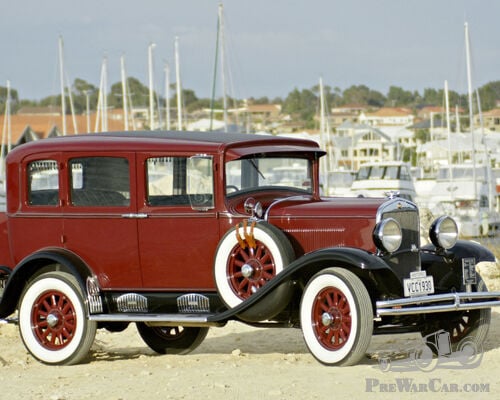
1930 Chrysler 66 Six-Wheel Equipped Royal Sedan
An exceptionally well restored and highly awarded Chrysler 66 Royal Sedan, with only two owners in nearly 97 years.The present owner ..

Lagonda LC Tourer 1934
The Lagonda story began in 1901 in Staines, a small town in the UK. The company enjoyed its greatest successes around 1935. During this period, the..