The global magazine and marketplace for classic car enthusiasts, by enthusiasts.


Filter
Classic Rolland-Pilain, Rosengart for sale - Rolland-Pilain, Rosengart cars for sale
-

Rolland Pilain
I am selling a 1913 Rolland Pilain RP 10HP in very good condition. It has a standard registration document in my name, and the MOT will be carried out prior to the sale. -
Rosengart LR2 Limousine 1929 / in good condition
Rosengart LR2 Limousine 1929 Company / History Rosengart was founded by Lucien Rosengart, a successful entrepreneur who had previously supplied components to manufacturers such as Peugeot and Citroën. Recognizing the enormous success of the small and affordable Austin 7 in England, he acquired the license rights in 19.. -
Rosengart LR4N2 1938 – Rare Pre-War French Saloon – Restoration Project
Na sprzedaż: Rosengart LR4N2 z 1938 roku Rzadki francuski samochód przedwojenny, projekt do renowacji.


Rolland-Pilain
France, 1906 – 1931
SA des Etablissements Rolland-Pilain, Tours
Unusual among French marques of its period, Rolland Pilain cars made their greatest impact after World War 1. Their first product was a 20hp 4-cylinder model Rolland Pilain cars with a monobloc engine, though smaller 2.2-litre shaft-driven Rolland Pilain cars were available in 1909 and a 3-speed 1½-litre Rolland Pilain 8/10CV in 1910, in which year the Rolland Pilain car company was also experimenting with ‘valveless’ engines and 4-wheel brakes. Though racing was in the doldrums, the Rolland Pilain car company went to the trouble of building a big chain-driven Rolland Pilain car for the 1911 Grand Prix de France, and a complex 1912 range started with a Rolland Pilain 9CV of 1.7-litres and went up to a chain-driven 4-cylinder 60 Rolland Pilain car of 130x270mm. The 6-cylinder Rolland Pilain 18CV had a ‘valveless’ engine, and even in 1913 chain drive was still optional on the biggest fours of 20CV and 24CV Rolland Pilain cars. Only 1.9-litre and 4-litre 4-cylinder Rolland Pilain cars with sv monobloc engines and unit gearboxes were listed in 1914.
These basic types of Rolland Pilain cars, still with pedal-operated transmission brakes, were available again after World War 1, but far more advanced was the 2.2-litre Rolland Pilain 14/16 of 1921, which boasted not only overhead valves and a detachable head, but also front-wheel brakes (hydraulic at the front and mechanical at the rear). This Rolland Pilain car was still catalogued in 1926. Even more ambitious was the 2-litre twin ohc straight-8 GP Rolland Pilain car of 1922, with desmodromic valves, ball-bearing crankshafts and 4-wheel hydraulic brakes. A victory of a Rolland Pilain car at San Sebastian in 1923 was the limit of the success of Rolland Pilain cars on the circuits, but the type found its way into the catalogue as the Type A22 Rolland Pilain car at 90.000fr, and one of the racers also ran with a 2-litre, 6-cylinder cuff-valve Schmid engine. In 1925 came a 2-litre ohv 4-cylinder Rolland Pilain car with 4-wheel mechanical brakes, selling for £725 in England, while a 1½-litre development, the Rolland Pilain D26, was introduced for 1927. In 1929 Rolland-Pilain car, along with several other French firms, tried a Franco-American theme by introducing a range of big luxury chassis with sv Continental engines. Both the 6-cylinder, 3-litre, and the 4-litre straight-8 Rolland Pilain cars had centralized chassis lubrication, though the elegant bodywork of the Rolland Pilain car was marred by the use of artillery wheels. At the 1930 Paris Salon the Rolland Pilain car company shared a stand with the BNC (also going through a Franco-American phase), but this was the end, though the Rolland Pilain car firm’s Paris depot was still advertising spare parts for Bignan as well as Rolland Pilain cars in 1934.
Source: Georgano, encyclopedia of motorcar; MCS
The information is written with the greatest of care. However, if you have any suggested amendments please contact us at office@prewarcar.com
Rosengart
France, 1928 – 1955
(1) Automobiles L. Rosengart, Neuilly-sur-Seine, 1928 – 1937
(2) Société Industrielle de l’Ouest Parisienne, Paris, 1937 – 1955
The first Rosengart cars were made in the old Bellanger factory under the direction of Lucien Rosengart and Jules Salomon (the designer of the original Citroëns). The Rosengart cars were Austin Sevens built under licence, and differed from their British prototypes mainly in matters of styling: for example the ribbon radiator shells, not adopted by Birmingham until late 1930. Production had reached 28 Rosengart cars a day by the summer of 1930, and the Austin theme was continued by Rosengart cars until the end of pre-World War 2 production, though 1932 and subsequent Rosengart cars had a longer wheelbase and semi-elliptic rear suspension. By 1939, when a roadster Rosengart car could be bought for the equivalent of £78, the chassis had channel-section side members. In the 1932 range of Rosengart cars there was also a 1.100cc 20bhp 6-cylinder, which Rosengart car was virtually an elongated 5CV with 3-speed gearbox and vacuum-servo brakes. A line of fwd 4-cylinder sv Rosengart cars began in 1933, with transverse independent front suspensions, built under Adler licence and based on the German company’s 1.6-litre Trumpf. A more conventional rear-driven Rosengart car was sold ast he ‘8/40’.
Fwd Rosengart cars were still marketed in 1939, but by this time the Rosengart cars were based on the 11CV Citroën, from which they derived their 1.9-litre ohv engines, 3-speed synchromesh gearboxes, and hydraulic brakes. Sporting 2-door saloon Rosengart car and cabriolet bodies were mounted on a platform-type chassis. Similar bodies were used on the 1947 Super-Trahuit, but the Super-Traction fwd structure now housed a 95bhp 3.9-litre sv Mercury engine. Such a car was an unrealistic proposition in the prevailing economic climate, and 1952 brought Rosengart cars a return to the Austin Seven theme – the sv 747cc engine now gave 21bhp, and the Rosengart Ariette and Rosengart Artisane saloons had modern styling, transverse independent front suspension and hydraulic brakes. Speeds of 60mph were claimed on these Rosengart cars.
The last of the line of Rosengart cars, the Rosengart Sagaie of 1954, abandoned the old sv four in favour of a 40bhp, 750cc, ohv air-cooled flat-twin engine. Saloon and convertible models Rosengart cars were made, and it was said to do 70mph, but failed to compete with Renault and Panhard.
Source: Georgano, encyclopedia of motorcar; MCS
The information is written with the greatest of care. However, if you have any suggested amendments please contact us at office@prewarcar.com


Featured
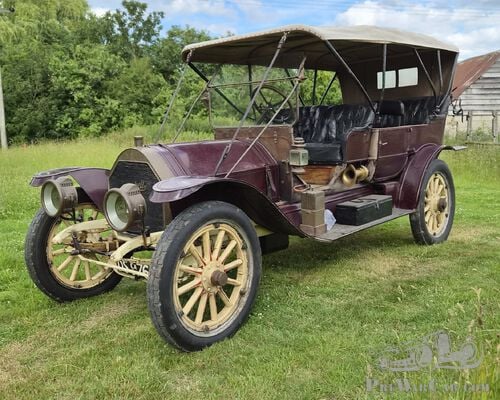
1910 Mitchell Model S - 50HP Six Cylinder
Based in Racine, Wisconsin and being the largest wagon manufacturer in the USA, Mitchell-Lewis produced their first motor car in 1903. Sales grew ..
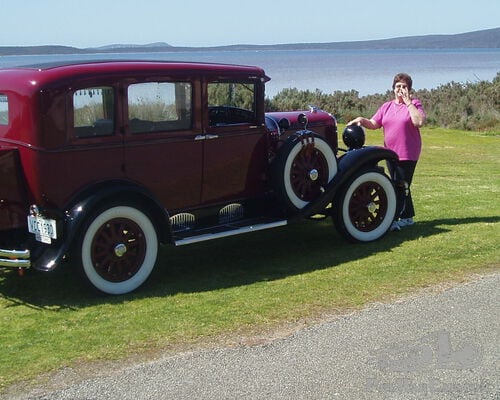
1930 Chrysler 66 Six-Wheel Equipped Royal Sedan
An exceptionally well restored and highly awarded Chrysler 66 Royal Sedan, with only two owners in nearly 97 years.The present owner ..
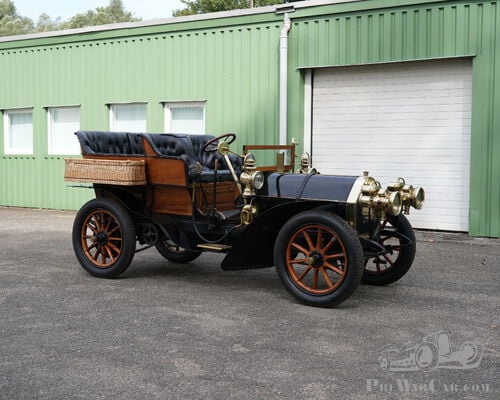
1904 Aster 16/20 HP Four-Cylinder Five-Seat Rear-Entrance Tonneau
Powerful four-cylinder engineFour-speed gearboxChain driveFive seatsMore than €100,000 recently invested