The global magazine and marketplace for classic car enthusiasts, by enthusiasts.


Filter
Classic Rosengart for sale - Rosengart cars for sale
-

Rosengart LR4N2 1938 – Rare Pre-War French Saloon – Restoration Project
Na sprzedaż: Rosengart LR4N2 z 1938 roku Rzadki francuski samochód przedwojenny, projekt do renowacji. -
Rosengart LR2 Limousine 1929 / in good condition
Rosengart LR2 Limousine 1929 Company / History Rosengart was founded by Lucien Rosengart, a successful entrepreneur who had previously supplied components to manufacturers such as Peugeot and Citroën. Recognizing the enormous success of the small and affordable Austin 7 in England, he acquired the license rights in 19..


Rosengart
France, 1928 – 1955
(1) Automobiles L. Rosengart, Neuilly-sur-Seine, 1928 – 1937
(2) Société Industrielle de l’Ouest Parisienne, Paris, 1937 – 1955
The first Rosengart cars were made in the old Bellanger factory under the direction of Lucien Rosengart and Jules Salomon (the designer of the original Citroëns). The Rosengart cars were Austin Sevens built under licence, and differed from their British prototypes mainly in matters of styling: for example the ribbon radiator shells, not adopted by Birmingham until late 1930. Production had reached 28 Rosengart cars a day by the summer of 1930, and the Austin theme was continued by Rosengart cars until the end of pre-World War 2 production, though 1932 and subsequent Rosengart cars had a longer wheelbase and semi-elliptic rear suspension. By 1939, when a roadster Rosengart car could be bought for the equivalent of £78, the chassis had channel-section side members. In the 1932 range of Rosengart cars there was also a 1.100cc 20bhp 6-cylinder, which Rosengart car was virtually an elongated 5CV with 3-speed gearbox and vacuum-servo brakes. A line of fwd 4-cylinder sv Rosengart cars began in 1933, with transverse independent front suspensions, built under Adler licence and based on the German company’s 1.6-litre Trumpf. A more conventional rear-driven Rosengart car was sold ast he ‘8/40’.
Fwd Rosengart cars were still marketed in 1939, but by this time the Rosengart cars were based on the 11CV Citroën, from which they derived their 1.9-litre ohv engines, 3-speed synchromesh gearboxes, and hydraulic brakes. Sporting 2-door saloon Rosengart car and cabriolet bodies were mounted on a platform-type chassis. Similar bodies were used on the 1947 Super-Trahuit, but the Super-Traction fwd structure now housed a 95bhp 3.9-litre sv Mercury engine. Such a car was an unrealistic proposition in the prevailing economic climate, and 1952 brought Rosengart cars a return to the Austin Seven theme – the sv 747cc engine now gave 21bhp, and the Rosengart Ariette and Rosengart Artisane saloons had modern styling, transverse independent front suspension and hydraulic brakes. Speeds of 60mph were claimed on these Rosengart cars.
The last of the line of Rosengart cars, the Rosengart Sagaie of 1954, abandoned the old sv four in favour of a 40bhp, 750cc, ohv air-cooled flat-twin engine. Saloon and convertible models Rosengart cars were made, and it was said to do 70mph, but failed to compete with Renault and Panhard.
Source: Georgano, encyclopedia of motorcar; MCS
The information is written with the greatest of care. However, if you have any suggested amendments please contact us at office@prewarcar.com



Featured
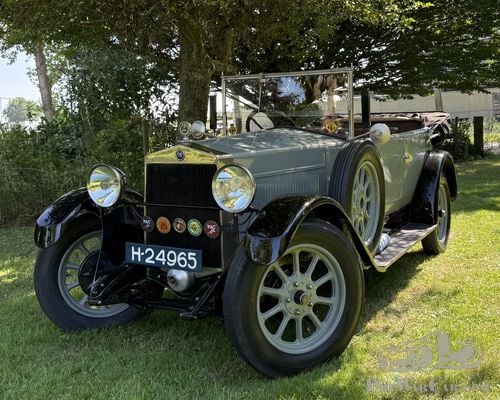
Fiat 509 Torpedo / Spider – Exceptionally Original and Complete
A Rare and Highly Original Example with Long-Term Dutch HistoryOffered for sale is an exceptionally original and remarkably complete Fiat 50..
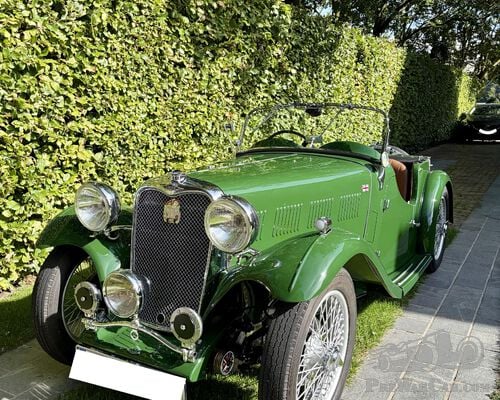
Singer 9 Le Mans Special Speed in British Racing Green, bouwjaar 1935
Prachtige Singer 9 Le Mans Special Speed. (De Singer 9 Le Mans werd uitgebracht na het succes van Singer in de gelijknamige 24u race.) 4 cil..
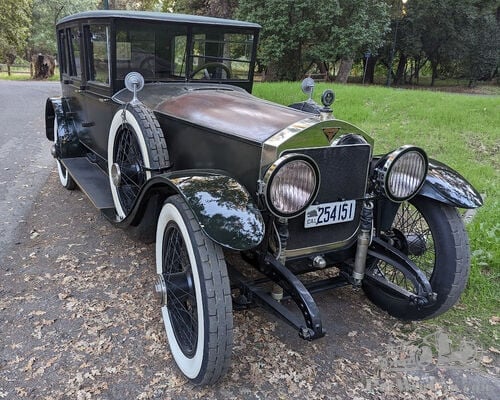
1916 Simplex, Crane model 5
1916 Simplex, Crane MODEL 5CUSTOM MADE HISTORIC PRESERVATION VEHICLE – READY TO TOUR!This Simplex recently completed th..